Posted on Leave a comment

Super Bass: An Album Played on Nothing But Three Basses

This article is written by Toru Hoshino, a jazz bassist and instructor based in Japan who teaches online lessons to students worldwide. In this article, he recommends an album made up of nothing but three basses.

This time around, I want to recommend an ensemble album played entirely on three basses.

Can you picture it? An instrument that normally just holds down the backbeat quietly in the background, here singing melodies, harmonizing with itself, doing whatever it wants. Just the concept alone is a genuinely striking thing to hear.

“Super Bass” — Ray Brown with John Clayton & Christian McBride

The title “Super Bass” feels almost too on the nose. This is a leader album from Ray Brown — a bassist so foundational to bebop and modern jazz bass playing through the 1940s and ’50s that people still say “if you’re going to play jazz bass, listen to him first.”

His powerful one-finger plucking technique, backing up an endless list of legendary musicians from Charlie Parker to Bud Powell, was defined by note attacks and evenness so precisely consistent that it elevated every great performance he was part of.

This album brings Ray Brown together with his student John Clayton, and with Christian McBride — a bassist who, without much exaggeration, stands at the very top of the jazz scene today.

The Limitless Possibility I Hear in This Instrument

The double bass is an unglamorous, unassuming instrument — heavy to haul around, and one that can take years just to nail consistent intonation on. And yet, right from the opening track, “SuperBass Theme,” it explodes into three-part harmony and unison lines.

Tracks 2 (“Blue Monk”) and 3 (“Bye Bye Blackbird”) take familiar standards and rearrange them with total freedom, constantly making you think, “wait, it’s going there?”

And by the time you get to track 4, “Lullaby of Birdland,” the arco playing evokes a chamber-music quality that gleefully defies whatever expectations you walked in with.

This is an instrument that, here, takes on the role of the beat, the melody, the harmony, the strings, and the rhythmic percussion all at once. The sheer conviction of hearing a bass do all of that — and the cohesion that comes from twelve strings across different ranges playing in concert — is a sound that almost nobody has had the chance to actually hear before.

An Album Every Bassist Needs to Hear

When students ask me, “Is there some incredible bass album I should check out?” — this is one of the two I always point them to, the other being “Portrait of Jaco Pastorius.”

If your only frame of reference is rock or pop, you probably picture a “standard band lineup” — a guitarist, a keyboardist, a drummer, and so on.

“An album with nothing but three basses? What is that supposed to be?” is a completely fair reaction. But at its core, music is simply one way of giving shape to freedom through sound.

I’d love for as many bassists as possible to hear this album, feel that jolt straight to the brain, and let it get their right brain spinning.

I hope this gives you something great to add to your listening list — and once an album like this gets your ear excited about what the bass can do, channeling that into your own playing is exactly where having a second set of ears helps.

Want Personalized Feedback on Your Playing?

This is exactly the kind of thing that’s hard to fix alone — and where having a teacher makes all the difference.

At Line on Bass, I offer an online lesson service where you send me a video of your playing, and I give you specific, detailed feedback — every single day if you want.

Students from around the world are using this to fix exactly these kinds of issues and steadily improve their jazz bass skills.
Check Out the Lesson Service →

Posted on Leave a comment

MuseScore: A Free Notation Tool Worth Using for Bass

This article is written by Toru Hoshino, a jazz bassist and instructor based in Japan who teaches online lessons to students worldwide. In this article, he introduces MuseScore, a free notation program he relies on constantly for writing out bass lines.

About MuseScore

MuseScore is music notation software. You can write out sheet music, generate audio playback, and export your files as PDF, WAV, and various other formats to share with others.

Sheet Music Made With MuseScore

Audio Made With MuseScore

Bass only:

Full ensemble:

Features in MuseScore That Are Especially Useful for Bass

Transposing

You can transpose notes in one click (Notes ▶ Transpose).

Adding Text

You can add titles, or write notes off to the side of the staff.

Copying and Pasting Notes

You can copy a passage of notes and paste it into other bars. It’s a huge time-saver — no need to write out the same notes twice.

Writing Linked Tab and Standard Notation

Enter an F, and the tab automatically shows up on the 3rd fret of the D string. Enter a B♭, and it automatically shows up on the 1st fret of the A string.

For both bass and guitar, you can write notation that stays linked to a tab staff automatically.

MuseScore is free to download for both Windows and Mac here:
https://musescore.org/en

It might take a little time to get used to, but you can save your files locally on your computer, and once you’re comfortable with it, it’s incredibly useful. I use it constantly myself.

I hope this is a useful tool to add to your practice routine — and once you’ve got your bass lines written out clearly, getting feedback on how you’re actually playing them is the natural next step.

Want Personalized Feedback on Your Playing?

This is exactly the kind of thing that’s hard to fix alone — and where having a teacher makes all the difference.

At Line on Bass, I offer an online lesson service where you send me a video of your playing, and I give you specific, detailed feedback — every single day if you want.

Students from around the world are using this to fix exactly these kinds of issues and steadily improve their jazz bass skills.

Check Out the Lesson Service →

Posted on Leave a comment

A Bass Solo Over ‘All of Me’: Phrasing Breakdown

This article is written by Toru Hoshino, a jazz bassist and instructor based in Japan who teaches online lessons to students worldwide. In this article, he plays and breaks down a bass solo improvised over the chord progression to “All of Me”.

A Bass Solo Over “All of Me”

Here’s a solo I played over it.

Let me walk through the phrasing and the thinking behind how I built it.

What I Focused On While Building This Solo

Connecting the First Note of Each Bar Through Chord Tones

My basic approach was to connect the first note of each new bar using a chord tone from that bar’s chord.

Bar 1 starts on the major 3rd of CM7, E. From there, I connect to the 5th of E7 in bar 3, B. Then bar 5 connects to the root of A7, A… and so on.

Leaning Heavily on Hammer-Ons

Hammer-ons are key to getting that jazz phrasing to feel right. I use them a lot, even just in the first half.

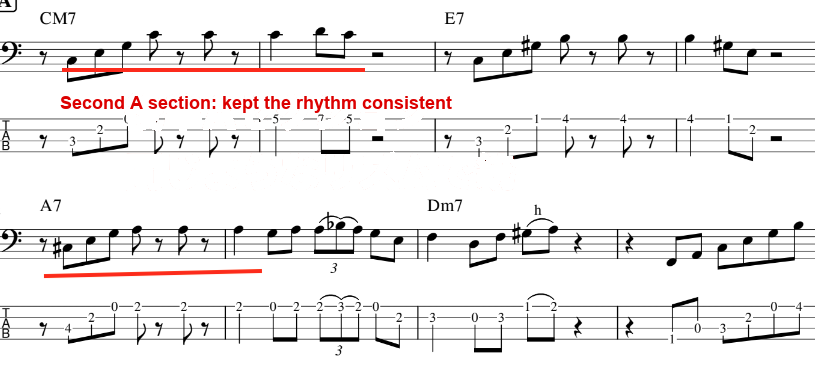
Repeating a Similar Rhythmic Pattern

For the first eight bars of the second A section, I built the phrasing around a repeating rhythmic pattern, to give that stretch a sense of cohesion.

Adding the ♭9 Over Dominant Seventh Chords

For example, over the A7 in bar 6 of the A section, I add the ♭9, B♭.

And over the G7 in bar 8 of the B section, I add its ♭9, A♭.

Adding the ♭9 over dominant 7th chords like this is a very common approach in jazz phrasing.

There are some other go-to phrases worth covering too.

Go-To Phrases Worth Having for Sessions

Go-To Phrase #1

In bars 1–2 of the C section, there’s an F△7 → Fm7 progression. This is a phrase I reach for often whenever a progression like this moves between the major and minor version of the same key.

It moves: 5th → 3rd → 2nd → root → 5th → ♭3rd → 2nd → root.

I cover this same-key major/minor approach in more depth in another video:

Go-To Phrase #2

Over the Dm7 → G7 in the C section, I use the phrase below — a classic “two-five phrase” that’s great for creating a sense of resolution, and one I reach for constantly.

I hope these phrases find their way into your own playing — and turning ideas like these into something you can pull off confidently on the spot is exactly the kind of thing that benefits from outside feedback.

Want Personalized Feedback on Your Playing?

This is exactly the kind of thing that’s hard to fix alone — and where having a teacher makes all the difference.

At Line on Bass, I offer an online lesson service where you send me a video of your playing, and I give you specific, detailed feedback — every single day if you want.

Students from around the world are using this to fix exactly these kinds of issues and steadily improve their jazz bass skills.

Check Out the Lesson Service →

Posted on Leave a comment

What Is an Upright Bass? A Beginner’s Guide to the Instrument

This article is written by Toru Hoshino, a jazz bassist and instructor based in Japan who teaches online lessons to students worldwide. In this article, he gives a beginner-friendly introduction to the upright bass — what it actually is and how it’s different from playing electric.

Not nearly as many people play upright bass as play electric bass or guitar, so a lot of people simply aren’t sure what the instrument actually is. Here’s a quick rundown.

What Is an Upright Bass, Exactly?

Upright bass
Double bass
Contrabass
Bass fiddle

There are a lot of different names for it, but they all refer to the same instrument:

An upright bass standing in a room

In classical circles, it’s usually called “double bass” or “contrabass.” In rock and rockabilly circles, “upright bass” is common. In jazz, people often just call it “the bass.”

Parts of the Instrument

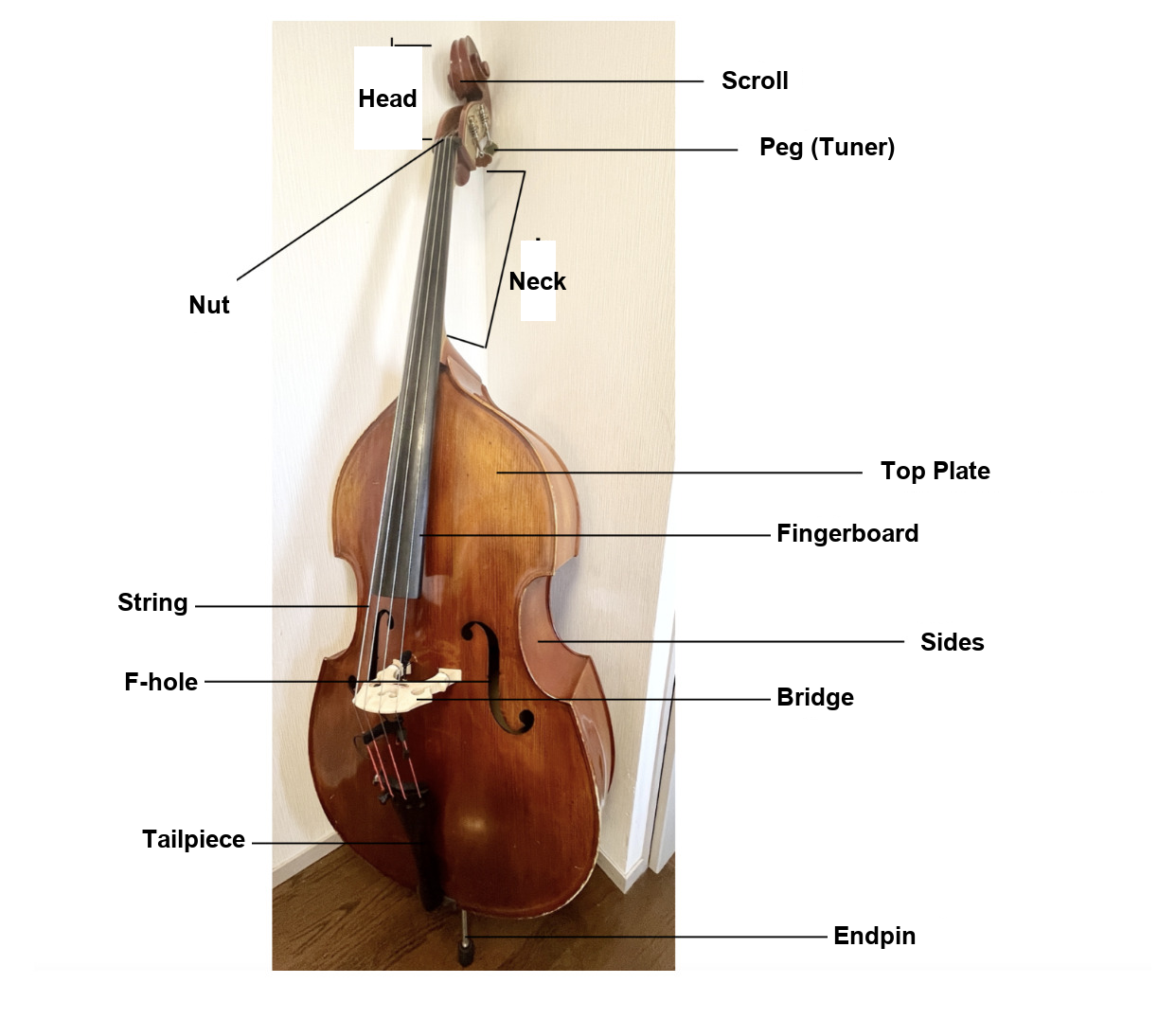
Here’s a diagram of the main parts:

Diagram labeling the parts of an upright bass

How Big Is an Upright Bass?

Measuring with a tape from the floor up to the top of the scroll, as shown in the photos, it comes out to roughly 190 cm (about 6 feet 3 inches).

Measuring the height of an upright bass with a tape measure

Measuring near the scroll of an upright bass

The strings are strung like this:

Strings on an upright bass

When you pluck a string, it vibrates the body. That vibration travels through the top plate, down through an internal rod called the sound post, and the whole body resonates to produce the sound.

Close-up of the upright bass body

Here’s a look inside the body and the sound post:

Inside view of an upright bass showing the sound post

And here’s what it sounds like. It might not come across fully on a phone recording, but the acoustic sound pressure is huge — hearing it live is genuinely powerful.

A Few Notable Parts

This is the bridge, which supports the tension of the strings.

Close-up of the bridge on an upright bass

This is the endpin at the bottom, which you adjust to match your height.

Endpin at the bottom of an upright bass

This is a pickup, sold separately. It’s basically a microphone that picks up the string vibrations, and I use it when I need to run through an amp in a larger venue.

A pickup attached to an upright bass

Tuning an Upright Bass

I tune mine using a standard clip-on tuner or a tuning fork.

Tuning an upright bass with a clip-on tuner

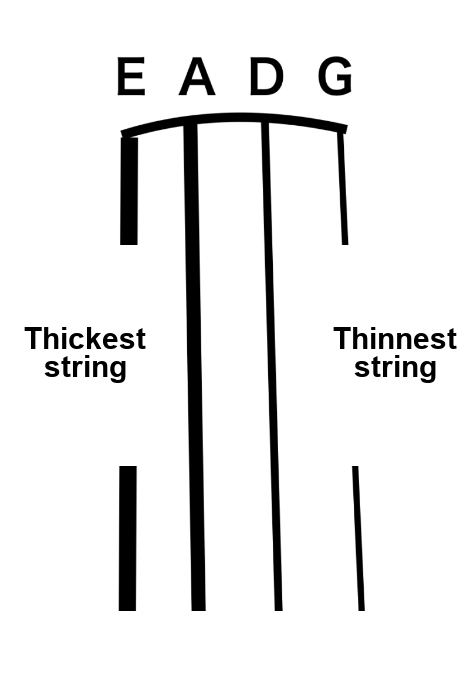
The tuning is the same as electric bass:

The open E string matches the open 4th string on electric bass.
The open A string matches the open 3rd string on electric bass.
The open D string matches the open 2nd string on electric bass.
The open G string matches the open 1st string on electric bass.

Diagram showing the E, A, D, and G strings from thickest to thinnest

Frequently Asked Questions

Q: How much does an upright bass cost?

Prices vary enormously — anywhere from around $700–800 on the low end up into five figures or beyond.

More expensive instruments are generally better quality, of course, but if you’re a beginner, it’s genuinely hard to judge what’s worth paying for. I’d recommend starting with something aimed at beginners.

Q: How do you transport an upright bass?

Whether I’m walking, taking a car, or using public transportation, I always move the bass in a case.

Personally, I use a case like this:

An upright bass in a padded case

…and I strap it onto a dedicated set of wheels often called a “bass buggy” to wheel it around.

A bass buggy used to transport an upright bass

Q: How do you practice?

I practice at home in my apartment, but only during the day out of consideration for my neighbors. I’m lucky to have an understanding landlord.

When I practice at night, I use an electric upright bass instead — it doesn’t put out much volume, so it’s convenient for practicing quietly.

Q: Why play such a huge instrument?

I actually started out on electric bass. Once I got into jazz, more and more of the people around me were upright players, and honestly, I kind of just got swept up in it.

These days, though, I genuinely love it for that deep low end — that’s what keeps me playing it.

So that’s a quick rundown of what an upright bass actually is.

Want Personalized Feedback on Your Playing?

Upright bass brings its own set of challenges — posture, hand position, intonation — that are genuinely hard to self-diagnose without someone watching you play.

This is exactly the kind of thing that’s hard to fix alone — and where having a teacher makes all the difference.

At Line on Bass, I offer an online lesson service where you send me a video of your playing, and I give you specific, detailed feedback — every single day if you want.

Students from around the world are using this to fix exactly these kinds of issues and steadily improve their jazz bass skills.
Check Out the Lesson Service →

Posted on Leave a comment

5 Jazz Standards Every Beginner Bassist Should Practice First

This article is written by Toru Hoshino, a jazz bassist and instructor based in Japan who teaches online lessons to students worldwide. In this article, he shares five jazz standards he practiced constantly as a beginner, coming from a rock background himself.

These five tunes are relatively easy to build a walking bass line over, and they all have catchy, approachable melodies that make them a great entry point.

If you’re just getting started with jazz bass, I hope these are useful to you.

Jazz Standards I Practiced Constantly as a Beginner

Autumn Leaves

Even people who don’t know jazz tend to recognize this one.

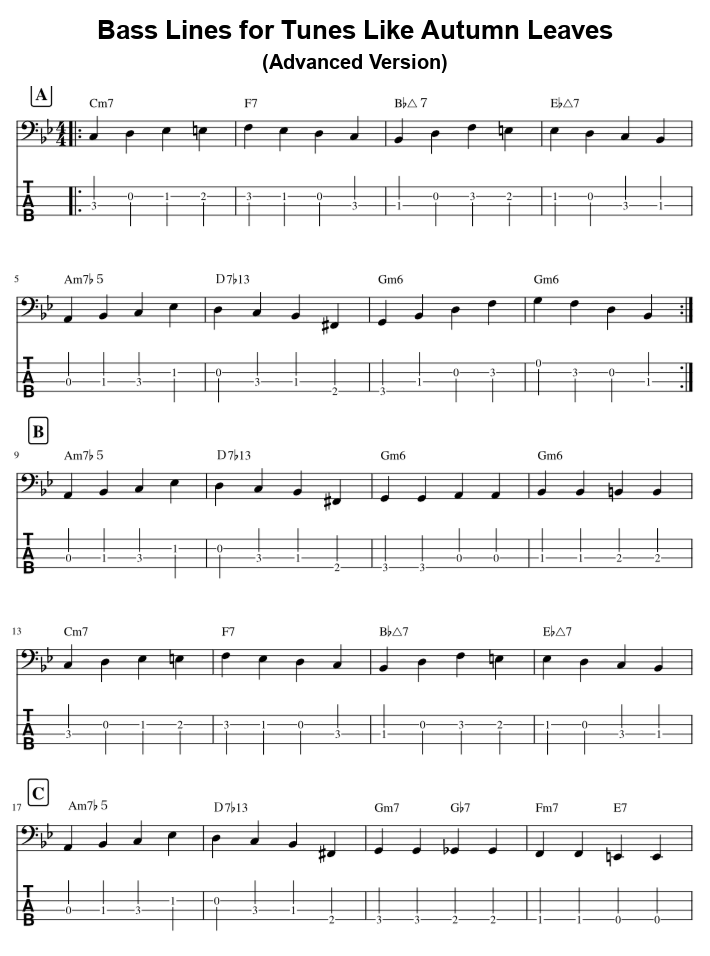
It’s easy to build an efficient, comfortable walking bass line over, and the melody has a beautifully melancholy quality to it. It also comes up constantly at jam sessions, so it’s well worth mastering.

Fly Me to the Moon

This is an extremely catchy, singable tune, and it gets covered by vocalists constantly.

Bye Bye Blackbird

Another tune with a catchy melody that sticks in your ear, and one that comes up a lot at sessions.

That said, the first four bars all sit on the same F chord, and I remember being genuinely unsure how to approach that stretch when I was starting out.

The Girl from Ipanema

The defining tune of bossa nova — a genre with a distinctly different rhythmic feel from straight-ahead jazz.

The bass line here is mostly built around the root and the 5th.

I wrote up a full breakdown of the bass line for this tune, with video, in this article.

F Blues

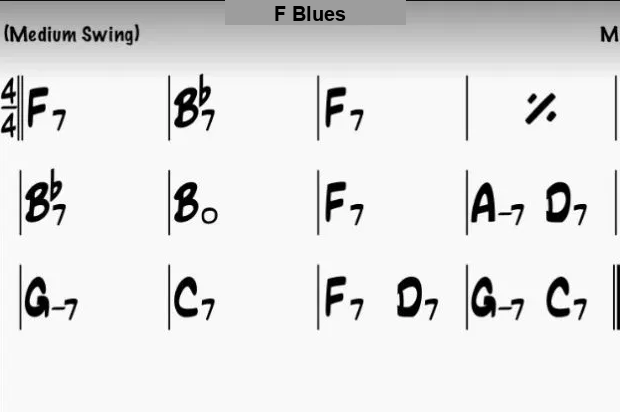
“F Blues” isn’t the title of one specific song — it refers to any tune built on the 12-bar chord progression shown below. Tunes commonly played as F blues include:

Bags’ Groove
Now’s the Time
Billie’s Bounce

Chord chart for a standard F blues progression

I put together a full practice method for improvising a walking bass line over an F blues, with video, in this article.

What Comes After This

I still have students work through these five tunes early on in lessons.

Once those are sounding solid, students move on to new tunes — and beyond these five, I also put together a list of 40 tunes I personally played constantly at sessions around Tokyo. You can check that out in this article.

Once you’re comfortable, it’s common to pick your next tune yourself from a list like that.

The more you listen — bebop, Coltrane-style playing, Bill Evans-style playing, Monk-style playing, bossa and Latin, bluesy stuff — the more your own sense of what kind of jazz you actually love starts to take shape.

There’s a lot to work through either way, so you might as well dive into whatever tunes genuinely grab you or sound cool to your ear.

Hopefully this gives you something useful for your daily practice.

Want Personalized Feedback on Your Playing?

Working through these standards builds a great foundation, but knowing whether your own walking lines over them are actually solid — rhythmically and harmonically — is much easier to judge with a second pair of ears.

This is exactly the kind of thing that’s hard to fix alone — and where having a teacher makes all the difference.

At Line on Bass, I offer an online lesson service where you send me a video of your playing, and I give you specific, detailed feedback — every single day if you want.

Students from around the world are using this to fix exactly these kinds of issues and steadily improve their jazz bass skills.

Check Out the Lesson Service →

Posted on Leave a comment

5 Jazz Standards Every Beginner Bassist Should Learn First

This article is written by Toru Hoshino, a jazz bassist and instructor based in Japan who teaches online lessons to students worldwide. In this article, he shares five jazz standards he practiced constantly as a beginner, back when he was coming from a rock background.

These are tunes that make it relatively easy to build a walking bass line, with melodies catchy enough that they’re approachable right from the start.

I hope this is useful if you’re just getting into jazz bass.

Jazz Standards I Practiced Constantly as a Beginner

Autumn Leaves

This is a tune even people who don’t follow jazz tend to recognize.

It’s easy to build an efficient, comfortable walking bass line for, and the melody has that wistful, melancholic quality. It also comes up constantly at jam sessions, so it’s well worth having under your fingers.

Fly Me to the Moon

A catchy, singable tune that gets covered by vocalists constantly.

Bye Bye Blackbird

Another tune with a catchy, memorable melody that comes up often at sessions.

That said, the first four bars all sit on the same F chord, and I remember being genuinely unsure how to approach that stretch when I was starting out.

The Girl from Ipanema

The defining tune of bossa nova — a genre with a feel and rhythmic approach a bit different from straight-ahead jazz.

The bass line here is mostly built around the root and the 5th.

→ Read my full breakdown of the bass line for “The Girl from Ipanema” here.

F Blues

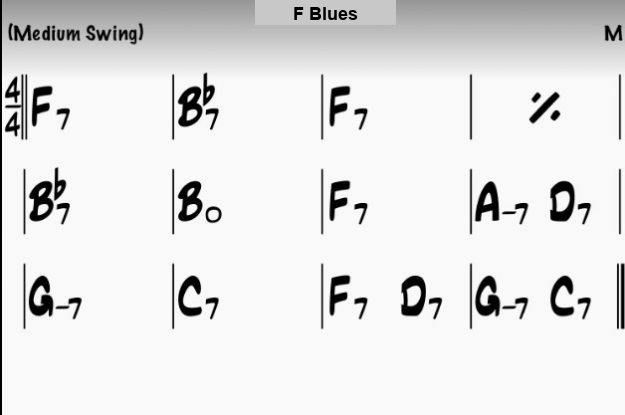
There’s no single tune actually called “F Blues” — it just refers to any tune built on the standard 12-bar blues progression shown below, in the key of F.

Tunes like “Bags’ Groove,” “Now’s the Time,” and “Billie’s Bounce” are all commonly played F blues tunes.

→ Read my full step-by-step practice method for improvising over an F blues here.

After That

These five tunes are usually what I have students work through first in lessons.

Once those are sounding solid, I have them move on to new tunes — and beyond these five, I also put together a list of 40 tunes I personally played constantly at sessions around Tokyo over the years.

→ See the full list of 40 jazz standards here.

Once you’re comfortable with the basics, I’ll often have students pick their next tune from that list themselves. Listen to plenty of bebop, Coltrane-style playing, Bill Evans, Monk, bossa and Latin tunes, bluesy stuff — and your own sense of what kind of jazz you actually love will start to take shape.

There’s a lot to work through either way, so you might as well dive into whatever tune catches your ear or sounds genuinely cool to you.

I hope this gives you something useful for your day-to-day practice — and once you’ve got a few of these standards under your fingers, getting feedback on how you’re actually playing them is exactly the next step worth taking.

Want Personalized Feedback on Your Playing?

This is exactly the kind of thing that’s hard to fix alone — and where having a teacher makes all the difference.

At Line on Bass, I offer an online lesson service where you send me a video of your playing, and I give you specific, detailed feedback — every single day if you want.

Students from around the world are using this to fix exactly these kinds of issues and steadily improve their jazz bass skills.
Check Out the Lesson Service →

Posted on Leave a comment

A Quick Refresher on Music Notation Symbols and Chord Notation

This article is written by Toru Hoshino, a jazz bassist and instructor based in Japan who teaches online lessons to students worldwide. In this article, he shares a quick refresher on the notation symbols and chord notation you’ve probably been reading on autopilot without ever stopping to look up what they actually mean.

You’re playing through tunes just fine, but could you actually explain what every symbol and notation marking in front of you is doing? Let’s take a moment to get the common ones straight.

Sharp, Flat, Natural

Sharp

#

Raises the note a half step.

Flat

Lowers the note a half step.

Natural

Cancels out a sharp or flat that was applied earlier in the same measure, restoring the note to its original pitch.

Final Barline, Double Barline, and Repeat Marks

Final Barline

This marks the end of one full chorus of the tune. A “chorus” here means one full pass through the tune’s form — verse, B section, and hook all together, like one complete “lap.”

Double Barline

This is used to mark a transition — the end of the verse section, the end of the B section, and so on.

Repeat Marks

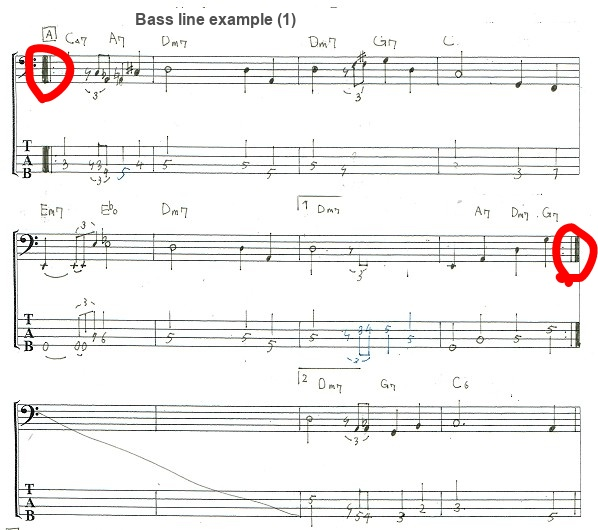
When you hit this mark,

you jump back to wherever this matching mark is.

First Ending and Second Ending Brackets

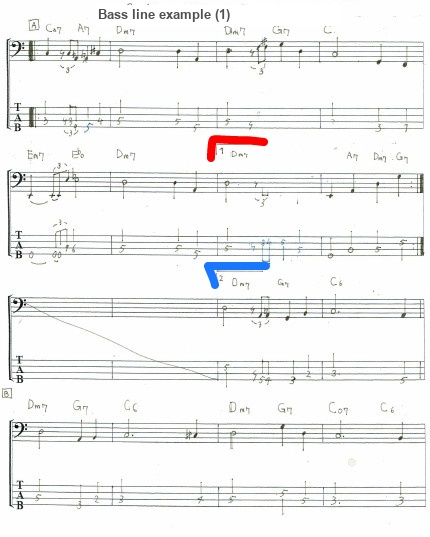
Here’s how to read first-ending and second-ending brackets like the ones below.

Being able to read first- and second-ending brackets is essential if you want to avoid getting lost in a tune.

Major, Minor, Diminished, and the Rest

I’ll skip over the theory behind what each of these actually does and just cover how to read them.

Major Seventh

△7

Read as a triangle plus “7” — “major seventh.”

C△7 ← “C major seven”
B♭△7 ← “B-flat major seven”

Some published charts write C△7 as CM7 instead, with a capital M. Same chord, different notation.

Seventh

7

Sometimes you’ll just see a plain “7” with no triangle at all. That’s a dominant seventh.

C7 ← “C seven”
B♭7 ← “B-flat seven”

Minor

m7

Cm7 ← “C minor seven”
B♭m7 ← “B-flat minor seven”

You’ll also sometimes see m7 written as “-7” instead (C-7, B♭-7, etc.) — same chord, just different notation.

Diminished

dim

Cdim (“C diminished”)
B♭dim (“B-flat diminished”)

Diminished is sometimes written as a small circle instead (C°, B♭°, etc.) — same chord either way.

Minor Seventh Flat Five (Half-Diminished)

m7(♭5), -7♭5

Read as “minor seven flat five,” also called “half-diminished.”

Cm7(♭5) (“C minor seven flat five” / “C half-diminished”)
B♭m7(♭5) (“B-flat minor seven flat five” / “B-flat half-diminished”)

Since the full name is a mouthful, players often just shorten it to “C half-dim,” “B-flat half-dim,” and so on. You’ll also sometimes see it written with a Ø symbol (CØ, BØ, etc.) — same chord.

Slash Chords

A7/F, C7/E, etc.

Sometimes you’ll see two chords written together separated by a slash, like A7/F or C7/E. This is called a “slash chord” — the chord to the left of the slash is the chord itself, and the note to the right is the bass note underneath it. It mostly comes up because of what’s happening in the piano or other harmony instruments.

In these cases, the safest bet for the bass is to play the root note on the right side of the slash (F for A7/F, E for C7/E) — that’ll keep things solid and in place.

There are plenty more symbols used in music notation beyond these, but knowing the ones above will already make reading through well-known jazz standards a lot smoother.

I hope this gives you something useful for your day-to-day practice — and once you’re reading these symbols comfortably, working on translating that into clean, confident playing is exactly the next step worth getting feedback on.

Want Personalized Feedback on Your Playing?

This is exactly the kind of thing that’s hard to fix alone — and where having a teacher makes all the difference.

At Line on Bass, I offer an online lesson service where you send me a video of your playing, and I give you specific, detailed feedback — every single day if you want.

Students from around the world are using this to fix exactly these kinds of issues and steadily improve their jazz bass skills.

Check Out the Lesson Service →

Posted on Leave a comment

Notation Symbols and Chord Notation Every Bassist Should Know

This article is written by Toru Hoshino, a jazz bassist and instructor based in Japan who teaches online lessons to students worldwide. In this article, he shares a refresher on the notation symbols and chord notation every bassist runs into on a chart.

You’ve probably been playing tunes just fine without thinking too hard about it — but could you actually explain what every symbol and marking on the chart means? Let’s go through the common ones and get them straight.

Sharp, Flat, and Natural

Sharp

#

Raises the note by a half step.

Flat

Lowers the note by a half step.

Natural

Cancels out a sharp or flat that was applied earlier within the same measure, bringing the note back to its original pitch.

Notation example showing a natural sign canceling a sharp

Final Bar Line, Double Bar Line, and Repeat Marks

Final Bar Line

Final bar line notation

Marks the end of one chorus of the tune. A “chorus” here means one full pass through the song’s form — the A section, B section, and the bridge/hook all grouped together as one complete cycle, similar to what you’d call a “verse” structure repeating once through.

Double Bar Line

Double bar line notation

Used to mark the end of a section — for example, “the A section ends here” or “the B section ends here.”

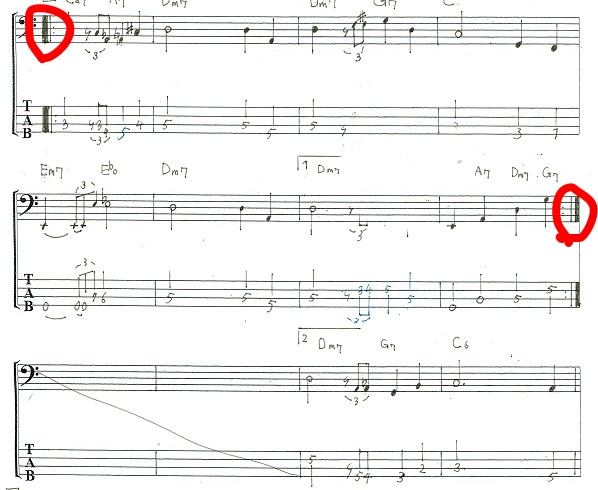
Repeat Marks

Repeat end mark

When you hit this mark…

Repeat start mark

…you jump back to wherever this matching mark appears earlier in the chart.

A full chart example showing repeat marks in context

First Ending and Second Ending Brackets

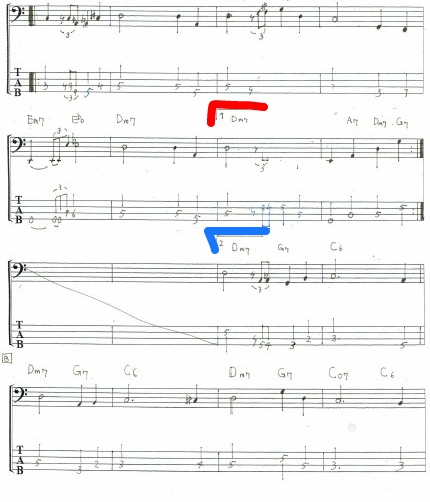
Here’s how to read the “1st ending” and “2nd ending” brackets you’ll often see on a chart:

Example of first ending and second ending brackets in a chord chart

Being able to read 1st-ending and 2nd-ending brackets correctly is important if you want to avoid getting lost in the form while playing.

Major, Minor, Diminished, and More

I’ll skip over what each chord quality actually sounds like and just focus on notation here.

Major Seventh

△7

Read as “major seventh” — the triangle plus a 7.

C△7 is read “C major seven.”
B♭△7 is read “B-flat major seven.”

Some publishers write C△7 as CM7 instead, using a capital M. Same meaning, different notation.

Seventh (Dominant)

7

Sometimes you’ll just see a plain “7” with no triangle. That’s a dominant seventh chord.

C7 is read “C seven.”
B♭7 is read “B-flat seven.”

Minor

m7

Cm7 is read “C minor seven.”
B♭m7 is read “B-flat minor seven.”

You’ll sometimes see m7 written as “-7” instead (e.g., C-7, B♭-7). Same chord, different notation.

Diminished

dim

Cdim is read “C diminished.”
B♭dim is read “B-flat diminished.”

dim is sometimes written as a small circle instead (e.g., C°, B°). Same chord — just written in lowercase-style shorthand.

Half-Diminished (Minor Seventh Flat Five)

m7(♭5), or -7♭5

Read as “minor seven flat five,” also commonly called “half-diminished.”

Cm7(♭5) is read “C minor seven flat five” (or “C half-diminished”).
B♭m7(♭5) is read “B-flat minor seven flat five” (or “B-flat half-diminished”).

Since the full name is a mouthful, players often just shorten it to “C half” or “B-flat half.”

This is also sometimes written using the symbol Ø (e.g., CØ, BØ). Same chord either way.

Slash Chords

A7/F, C7/E, and so on.

Sometimes you’ll see two chords separated by a slash, like A7/F or C7/E. This is called a “slash chord” — the chord on the left of the slash is the chord itself, and the note on the right is the bass note underneath it. This mostly comes up in relation to chordal instruments like piano.

In these situations, the safest bet for a bassist is to play the root indicated after the slash (F for A7/F, E for C7/E) — that’ll keep things solid and in line with what everyone else is playing.

There are plenty more symbols used in music notation, but knowing the ones above will already make a big difference when you’re working through well-known jazz standards. Hopefully this gives you something useful for your daily practice.

Want Personalized Feedback on Your Playing?

Knowing what a symbol means on paper is one thing — actually reacting to it correctly in real time while you’re playing is a different skill, and one that’s much easier to build with someone watching and giving you feedback.

This is exactly the kind of thing that’s hard to fix alone — and where having a teacher makes all the difference.

At Line on Bass, I offer an online lesson service where you send me a video of your playing, and I give you specific, detailed feedback — every single day if you want.

Students from around the world are using this to fix exactly these kinds of issues and steadily improve their jazz bass skills.
Check Out the Lesson Service →

Posted on Leave a comment

How to Stop Your Left-Hand Thumb From Hurting on Bass

This article is written by Toru Hoshino, a jazz bassist and instructor based in Japan who teaches online lessons to students worldwide. In this article, he shares a simple way to stop your left-hand thumb from hurting when you practice.

If you’ve been teaching yourself bass and you’ve noticed “my left thumb has been hurting lately,” try the approach in this article.

Why Your Left-Hand Thumb Starts Hurting

Hand gripping the bass neck tightly

A common cause of thumb pain is practicing with a grip where you’re really pressing hard into the back of the neck with your thumb.

First off — if it already hurts, it’s fine to take a few days off from practicing. Don’t push through pain. That’s never worth it.

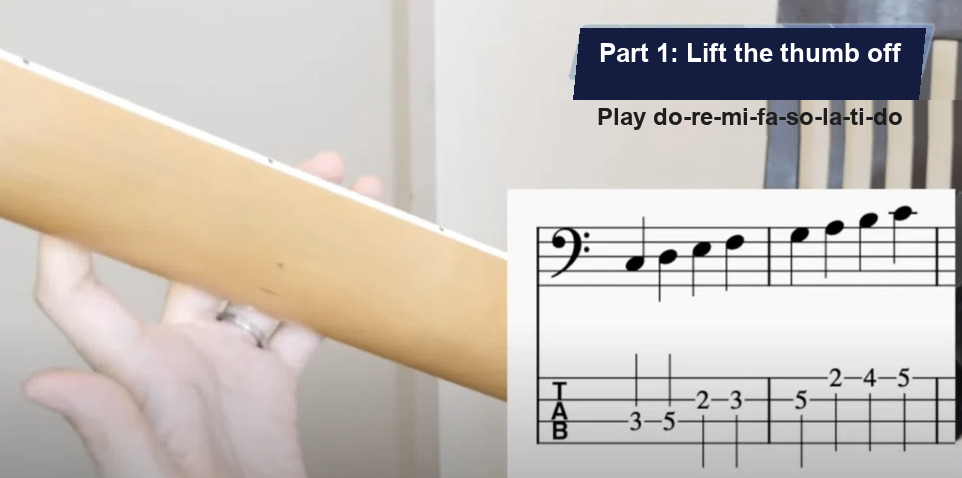
Once you’ve rested properly and you feel like the pain is starting to ease up, try this exercise: play with your thumb lifted off the neck entirely.

Practice Playing With Your Thumb Off the Neck

Playing a scale with the thumb lifted off the back of the neck

Try lifting your left thumb completely off the neck and playing do-re-mi-fa-so-la-ti-do.

It’ll feel really awkward at first. But you’ll find you can actually do it — barely!

After playing through do-re-mi-fa-so-la-ti-do a few times with your thumb lifted off, bring your thumb back — but this time, just rest it lightly against the back of the neck instead of pressing into it.

Once you do that, you’ll find you can play through the same do-re-mi-fa-so-la-ti-do smoothly and lightly, without needing to dig your thumb into the back of the neck at all.

The whole point of this exercise is to first feel that instability of playing with no thumb support, so that when you bring your thumb back in lightly, you really notice just how stable your hand can be with barely any thumb pressure at all.

This is a lot easier to follow by watching it than reading about it, so I made a video covering everything above.

Want Personalized Feedback on Your Playing?

Whether you’re actually gripping too hard without realizing it is something that’s genuinely difficult to judge on your own — it’s exactly the kind of habit a second pair of eyes catches instantly.

This is exactly the kind of thing that’s hard to fix alone — and where having a teacher makes all the difference.

At Line on Bass, I offer an online lesson service where you send me a video of your playing, and I give you specific, detailed feedback — every single day if you want.

Students from around the world are using this to fix exactly these kinds of issues and steadily improve their jazz bass skills.

Check Out the Lesson Service →

Posted on Leave a comment

What Are Relative Keys? A Clear Explanation With a Full Key Chart

This article is written by Toru Hoshino, a jazz bassist and instructor based in Japan who teaches online lessons to students worldwide. In this article, he gives a clear explanation of relative keys, with a full reference chart for every key.

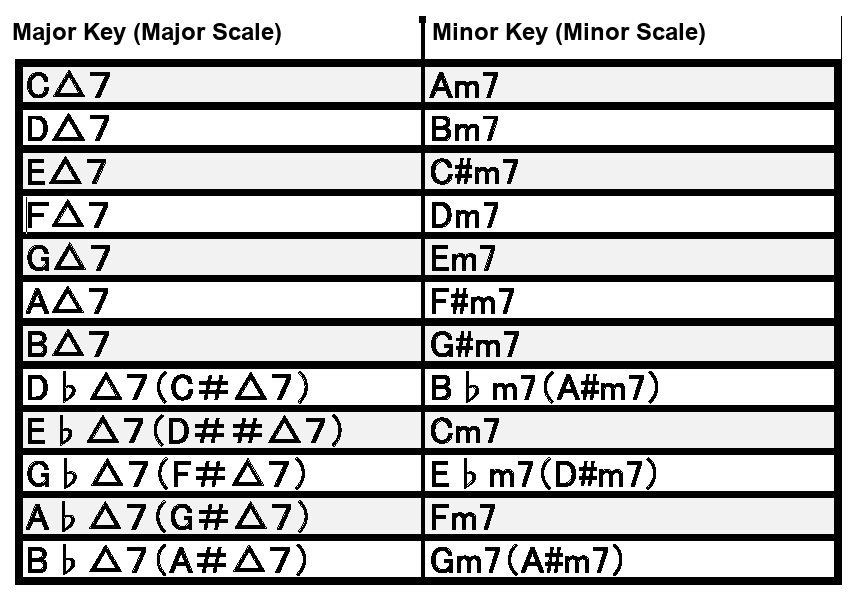
Here’s a quick-reference chart of relative keys:

Chart of relative major and minor keys

The chords linked by the bold black boxes on the left and right are relative to each other. Let’s break down exactly what that means.

Hearing It in Action: How Relative Keys Work

↑ That’s do-re-mi-fa-so-la-ti-do. This is the key of C major — the C major scale.

↑ That’s la-ti-do-re-mi-fa-so-la. This is the key of A minor — the A minor scale.

↑ That’s Bb-C-D-Eb-F-G-A-Bb. This is the key of B♭ major — the B♭ major scale.

↑ That’s G-A-Bb-C-D-Eb-F-G. This is the key of G minor — the G minor scale.

Chart of relative major and minor keys

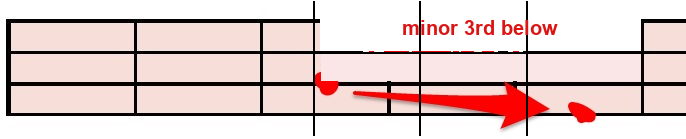
If you take the exact same notes used in a major scale on the left of the chart and start playing them from a minor third below, you get its relative key.

Minor third below:

Diagram showing a minor third interval on the fretboard

For C major, the scale is do-re-mi-fa-so-la-ti-do:

C major scale on the fretboard

For A minor, the scale is la-ti-do-re-mi-fa-so-la:

A minor scale on the fretboard

For a C△7 chord, if you take the same do-re-mi-fa-so-la-ti-do notes from the scale and instead start playing from the 5th fret on the 4th string, playing “la-ti-do-re-mi-fa-so-la,” that’s the relative key.

The notes being used are exactly the same — only the starting point and the chord’s “home base” change.

What Makes Relative Keys Distinctive (Major vs. Minor Scales)

Here’s a simple audio example — just the melody re-do-ti-la, re-do-ti-la, re-do-ti-la, re-do-ti-la — but I split the bass line into a C major version and an A minor version.

Major and minor give you a really different feel, even over the same melody.

· Major (C major scale)

· Minor (A minor scale)

This is the basic principle behind why major scales sound bright and minor scales sound dark. It’s a foundation used in an enormous number of songs out there.

Relative Keys and Walking Bass

In practice, nobody’s going to tell you “this tune is in a relative key relationship, so build your walking bass line this way.” You’re also not going to hear band mates or session players say things like “give me a bass line that sounds relative-key-ish” — in everyday musical communication, this concept almost never comes up directly in conversation.

That said, understanding how relative keys work is genuinely useful when you’re studying a chart, analyzing a tune, or writing your own music — it makes that whole process go a lot more smoothly.

Want Personalized Feedback on Your Playing?

Understanding the theory behind relative keys is one thing — actually hearing how that major/minor contrast comes through in your own bass lines is much easier to judge with outside ears.

This is exactly the kind of thing that’s hard to fix alone — and where having a teacher makes all the difference.

At Line on Bass, I offer an online lesson service where you send me a video of your playing, and I give you specific, detailed feedback — every single day if you want.

Students from around the world are using this to fix exactly these kinds of issues and steadily improve their jazz bass skills.
Check Out the Lesson Service →