This article is written by Toru Hoshino, a jazz bassist and instructor based in Japan who teaches online lessons to students worldwide. In this article, he shares a refresher on the notation symbols and chord notation every bassist runs into on a chart.
You’ve probably been playing tunes just fine without thinking too hard about it — but could you actually explain what every symbol and marking on the chart means? Let’s go through the common ones and get them straight.
Contents
Sharp, Flat, and Natural
Sharp
#
Raises the note by a half step.
Flat
♭
Lowers the note by a half step.
Natural
♮
Cancels out a sharp or flat that was applied earlier within the same measure, bringing the note back to its original pitch.

Final Bar Line, Double Bar Line, and Repeat Marks
Final Bar Line

Marks the end of one chorus of the tune. A “chorus” here means one full pass through the song’s form — the A section, B section, and the bridge/hook all grouped together as one complete cycle, similar to what you’d call a “verse” structure repeating once through.
Double Bar Line

Used to mark the end of a section — for example, “the A section ends here” or “the B section ends here.”
Repeat Marks

When you hit this mark…

…you jump back to wherever this matching mark appears earlier in the chart.
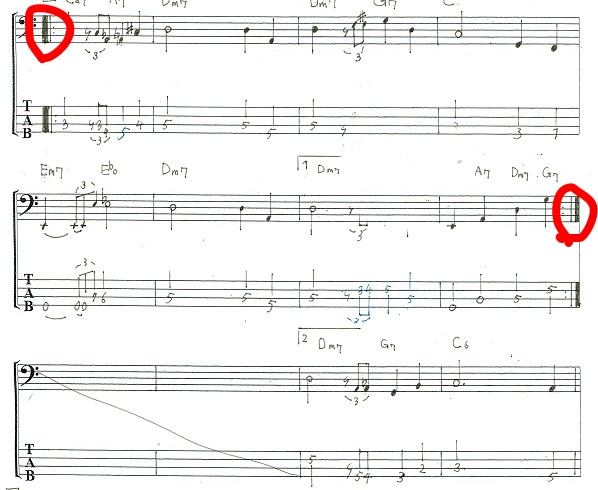
First Ending and Second Ending Brackets
Here’s how to read the “1st ending” and “2nd ending” brackets you’ll often see on a chart:
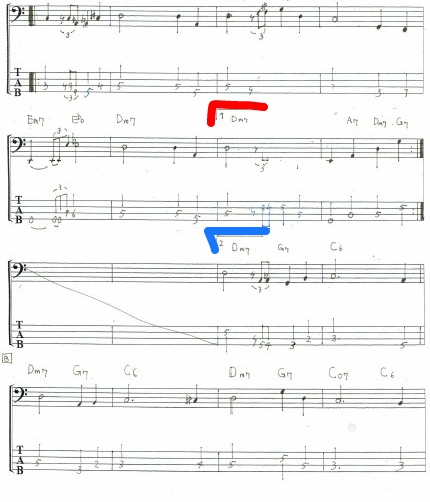
Being able to read 1st-ending and 2nd-ending brackets correctly is important if you want to avoid getting lost in the form while playing.
Major, Minor, Diminished, and More
I’ll skip over what each chord quality actually sounds like and just focus on notation here.
Major Seventh
△7
Read as “major seventh” — the triangle plus a 7.
C△7 is read “C major seven.”
B♭△7 is read “B-flat major seven.”
Some publishers write C△7 as CM7 instead, using a capital M. Same meaning, different notation.
Seventh (Dominant)
7
Sometimes you’ll just see a plain “7” with no triangle. That’s a dominant seventh chord.
C7 is read “C seven.”
B♭7 is read “B-flat seven.”
Minor
m7
Cm7 is read “C minor seven.”
B♭m7 is read “B-flat minor seven.”
You’ll sometimes see m7 written as “-7” instead (e.g., C-7, B♭-7). Same chord, different notation.
Diminished
dim
Cdim is read “C diminished.”
B♭dim is read “B-flat diminished.”
dim is sometimes written as a small circle instead (e.g., C°, B°). Same chord — just written in lowercase-style shorthand.
Half-Diminished (Minor Seventh Flat Five)
m7(♭5), or -7♭5
Read as “minor seven flat five,” also commonly called “half-diminished.”
Cm7(♭5) is read “C minor seven flat five” (or “C half-diminished”).
B♭m7(♭5) is read “B-flat minor seven flat five” (or “B-flat half-diminished”).
Since the full name is a mouthful, players often just shorten it to “C half” or “B-flat half.”
This is also sometimes written using the symbol Ø (e.g., CØ, BØ). Same chord either way.
Slash Chords
A7/F, C7/E, and so on.
Sometimes you’ll see two chords separated by a slash, like A7/F or C7/E. This is called a “slash chord” — the chord on the left of the slash is the chord itself, and the note on the right is the bass note underneath it. This mostly comes up in relation to chordal instruments like piano.
In these situations, the safest bet for a bassist is to play the root indicated after the slash (F for A7/F, E for C7/E) — that’ll keep things solid and in line with what everyone else is playing.
There are plenty more symbols used in music notation, but knowing the ones above will already make a big difference when you’re working through well-known jazz standards. Hopefully this gives you something useful for your daily practice.
Want Personalized Feedback on Your Playing?
Knowing what a symbol means on paper is one thing — actually reacting to it correctly in real time while you’re playing is a different skill, and one that’s much easier to build with someone watching and giving you feedback.
This is exactly the kind of thing that’s hard to fix alone — and where having a teacher makes all the difference.
At Line on Bass, I offer an online lesson service where you send me a video of your playing, and I give you specific, detailed feedback — every single day if you want.
Students from around the world are using this to fix exactly these kinds of issues and steadily improve their jazz bass skills.