This article is written by Toru Hoshino, a jazz bassist and instructor based in Japan who teaches online lessons to students worldwide. In this article, he gives a beginner-friendly introduction to the upright bass — what it actually is and how it’s different from playing electric.
Not nearly as many people play upright bass as play electric bass or guitar, so a lot of people simply aren’t sure what the instrument actually is. Here’s a quick rundown.
Contents
What Is an Upright Bass, Exactly?
Upright bass
Double bass
Contrabass
Bass fiddle
There are a lot of different names for it, but they all refer to the same instrument:

In classical circles, it’s usually called “double bass” or “contrabass.” In rock and rockabilly circles, “upright bass” is common. In jazz, people often just call it “the bass.”
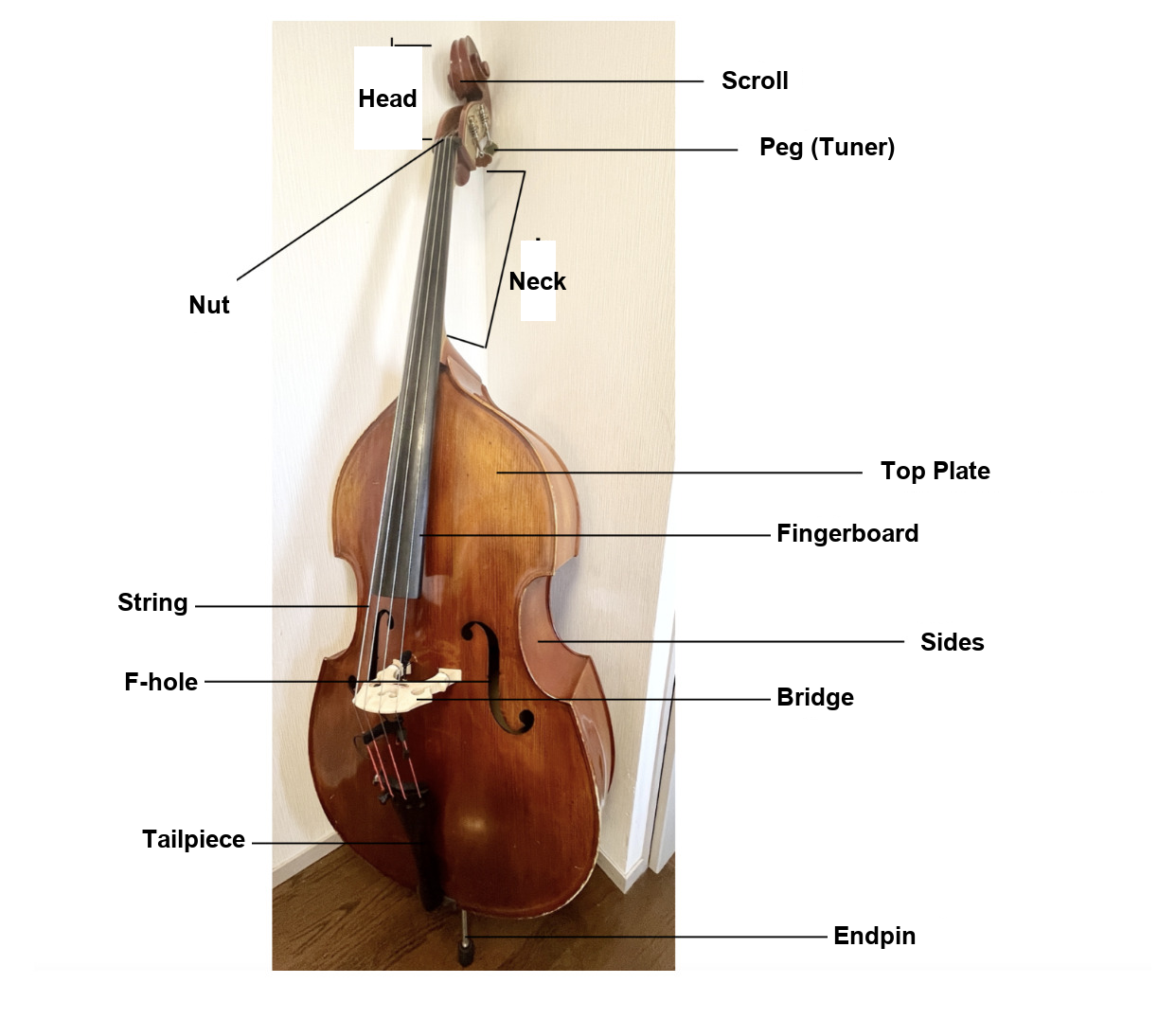
Parts of the Instrument
Here’s a diagram of the main parts:
How Big Is an Upright Bass?
Measuring with a tape from the floor up to the top of the scroll, as shown in the photos, it comes out to roughly 190 cm (about 6 feet 3 inches).


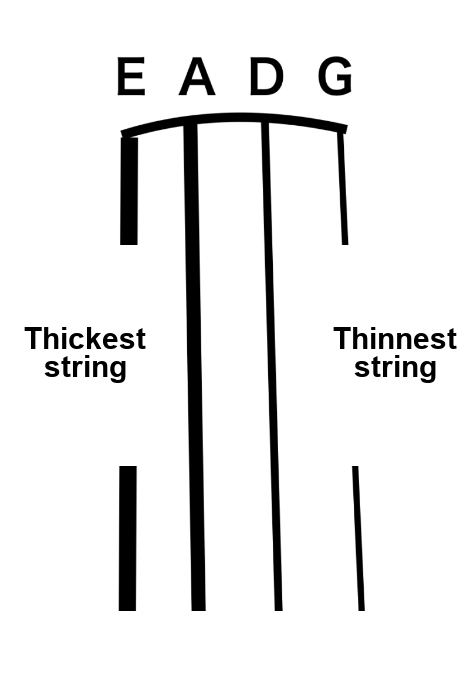
The strings are strung like this:

When you pluck a string, it vibrates the body. That vibration travels through the top plate, down through an internal rod called the sound post, and the whole body resonates to produce the sound.

Here’s a look inside the body and the sound post:

And here’s what it sounds like. It might not come across fully on a phone recording, but the acoustic sound pressure is huge — hearing it live is genuinely powerful.
A Few Notable Parts
This is the bridge, which supports the tension of the strings.

This is the endpin at the bottom, which you adjust to match your height.

This is a pickup, sold separately. It’s basically a microphone that picks up the string vibrations, and I use it when I need to run through an amp in a larger venue.

Tuning an Upright Bass
I tune mine using a standard clip-on tuner or a tuning fork.

The tuning is the same as electric bass:
The open E string matches the open 4th string on electric bass.
The open A string matches the open 3rd string on electric bass.
The open D string matches the open 2nd string on electric bass.
The open G string matches the open 1st string on electric bass.
Frequently Asked Questions
Q: How much does an upright bass cost?
Prices vary enormously — anywhere from around $700–800 on the low end up into five figures or beyond.
More expensive instruments are generally better quality, of course, but if you’re a beginner, it’s genuinely hard to judge what’s worth paying for. I’d recommend starting with something aimed at beginners.
Q: How do you transport an upright bass?
Whether I’m walking, taking a car, or using public transportation, I always move the bass in a case.
Personally, I use a case like this:

…and I strap it onto a dedicated set of wheels often called a “bass buggy” to wheel it around.

Q: How do you practice?
I practice at home in my apartment, but only during the day out of consideration for my neighbors. I’m lucky to have an understanding landlord.
When I practice at night, I use an electric upright bass instead — it doesn’t put out much volume, so it’s convenient for practicing quietly.
Q: Why play such a huge instrument?
I actually started out on electric bass. Once I got into jazz, more and more of the people around me were upright players, and honestly, I kind of just got swept up in it.
These days, though, I genuinely love it for that deep low end — that’s what keeps me playing it.
So that’s a quick rundown of what an upright bass actually is.
Want Personalized Feedback on Your Playing?
Upright bass brings its own set of challenges — posture, hand position, intonation — that are genuinely hard to self-diagnose without someone watching you play.
This is exactly the kind of thing that’s hard to fix alone — and where having a teacher makes all the difference.
At Line on Bass, I offer an online lesson service where you send me a video of your playing, and I give you specific, detailed feedback — every single day if you want.
Students from around the world are using this to fix exactly these kinds of issues and steadily improve their jazz bass skills.