Posted on Leave a comment

Album Recommendation: “Esperanza” by Esperanza Spalding

This is an album recommendation from me, Toru Hoshino (@jazzbassisttoru), founder of the online bass school Line on Bass.

This record carries forward everything great about straight-ahead jazz, with plenty to enjoy from the bass alone — and on top of that, it has a thoroughly modern, stylish feel.

It’s an album by a true super-bassist, and one I’ve had people thank me for introducing them to more times than I can count.

“Esperanza” by Esperanza Spalding


“Esperanza” by Esperanza Spalding

Esperanza Spalding is a world-class bassist who also happens to have a truly first-rate singing voice.

She sings moody, lush, glittering melodies while playing upright bass at the same time.

Esperanza has released four albums so far, and each one has a completely different feel.

This particular record is especially recommended if you:

・Like the smooth jazz sound
・Like Antônio Carlos Jobim
・Like bossa nova
・Like club jazz

Even my own ears — tuned to old-school ’40s and ’50s bebop, hard bop, and cool jazz — took to this one easily. The melodies are strong and easy to listen to, making it a comfortable entry point even for people new to jazz or Black American music in general.


Great for Moments Like These

・Cleaning or doing housework
・Studying
・Hosting friends for a party
・Before bed
・Morning coffee
・An evening drink (ideally wine, not a canned highball)


My Impressions of “Esperanza”

My strongest impressions are “watery” and “transparent.”

I personally get a similar “watery” feeling from artists like Bill Evans, early Herbie Hancock, and Antônio Carlos Jobim — though the particular flavor of that transparency is different here.

The songs are melodic and easy to sing along to. The bass playing leans more toward funk grooves than straight four-on-the-floor swing, with a lot of tight, punchy bass lines.

Rather than putting “bassiness” front and center the way Paul Chambers does on “Bass on Top,” this album puts the vocals first — it leans heavily into an R&B feel.

I also own another one of Esperanza’s albums — her third, “Chamber Music Society.” That one leans heavily on arco (bow) playing and has a strong chamber-music, classical feel. Personally, I prefer “Esperanza.”


“Chamber Music Society” by Esperanza Spalding

Esperanza Spalding’s Background

Esperanza Spalding became the youngest instructor in the history of Berklee College of Music — one of the most prestigious jazz schools in the world — when she joined the faculty at just 20 years old. President Obama himself is said to be a fan, and she has performed in front of him on multiple occasions.

After passing her GED and graduating high school at 16, she earned a music scholarship to Portland State University, where she’s on record as the youngest bassist in the school’s history. Despite never having formal training from upperclassmen, her talent was impossible for the faculty to ignore — her bass professor encouraged her to transfer to Berklee, and she won a full scholarship the moment she auditioned.

(Source: Wikipedia)

I’ve gone to see her perform live about four times — twice in Japan, twice in the US.

Her singing is wonderful, but the performance that’s stuck with me the most was at a jazz club in New York called Smalls, five or six years back. It wasn’t one of her own headlining shows — she was sitting in as the bassist for a saxophone quartet. A rare and special thing to catch. Her hands moved so fast I nearly fell off my chair.

Whether you’re into old-school jazz or contemporary Black music, this is an artist worth checking out. ^^

A Roundup of My Favorite Esperanza Videos

I went ahead and gathered up some of my favorite Esperanza Spalding videos.

Essential viewing if you’re a bassist — honestly, essential if you just love jazz, or really, if you love music at all.

Overjoyed

Filmed in February 2009. She’s rocking her trademark afro here.

A cover of the Stevie Wonder song. President Obama is watching right in front of her.

That beetle-shaped upright bass is a “Czech Ease” model made by David Gage.


On the Sunny Side of the Street

This time she’s on a standard 3/4-size upright. It’s a tune that comes up often at jam sessions in Japan too. President Obama makes another appearance here as well.

The bass solo really takes off about three minutes into the second half.

The solo is great, but the groove on the walking bass line is just as powerful.


Jazz à Vienne 2012

From a jazz festival in Vienne, France, in 2012.

In the second half, she switches to a 4-string electric jazz bass.


If I keep going down this rabbit hole I’ll never get this article finished, so I’ll stop here.

Want Personalized Feedback on Your Playing?

This is exactly the kind of thing that’s hard to fix alone — and where having a teacher makes all the difference.

At Line on Bass, I offer an online lesson service where you send me a video of your playing, and I give you specific, detailed feedback — every single day if you want.

Students from around the world are using this to fix exactly these kinds of issues and steadily improve their jazz bass skills.

Check Out the Lesson Service →

Posted on Leave a comment

Super Bass: An Album Played on Nothing But Three Basses

This article is written by Toru Hoshino, a jazz bassist and instructor based in Japan who teaches online lessons to students worldwide. In this article, he recommends an album made up of nothing but three basses.

This time around, I want to recommend an ensemble album played entirely on three basses.

Can you picture it? An instrument that normally just holds down the backbeat quietly in the background, here singing melodies, harmonizing with itself, doing whatever it wants. Just the concept alone is a genuinely striking thing to hear.

“Super Bass” — Ray Brown with John Clayton & Christian McBride

The title “Super Bass” feels almost too on the nose. This is a leader album from Ray Brown — a bassist so foundational to bebop and modern jazz bass playing through the 1940s and ’50s that people still say “if you’re going to play jazz bass, listen to him first.”

His powerful one-finger plucking technique, backing up an endless list of legendary musicians from Charlie Parker to Bud Powell, was defined by note attacks and evenness so precisely consistent that it elevated every great performance he was part of.

This album brings Ray Brown together with his student John Clayton, and with Christian McBride — a bassist who, without much exaggeration, stands at the very top of the jazz scene today.

The Limitless Possibility I Hear in This Instrument

The double bass is an unglamorous, unassuming instrument — heavy to haul around, and one that can take years just to nail consistent intonation on. And yet, right from the opening track, “SuperBass Theme,” it explodes into three-part harmony and unison lines.

Tracks 2 (“Blue Monk”) and 3 (“Bye Bye Blackbird”) take familiar standards and rearrange them with total freedom, constantly making you think, “wait, it’s going there?”

And by the time you get to track 4, “Lullaby of Birdland,” the arco playing evokes a chamber-music quality that gleefully defies whatever expectations you walked in with.

This is an instrument that, here, takes on the role of the beat, the melody, the harmony, the strings, and the rhythmic percussion all at once. The sheer conviction of hearing a bass do all of that — and the cohesion that comes from twelve strings across different ranges playing in concert — is a sound that almost nobody has had the chance to actually hear before.

An Album Every Bassist Needs to Hear

When students ask me, “Is there some incredible bass album I should check out?” — this is one of the two I always point them to, the other being “Portrait of Jaco Pastorius.”

If your only frame of reference is rock or pop, you probably picture a “standard band lineup” — a guitarist, a keyboardist, a drummer, and so on.

“An album with nothing but three basses? What is that supposed to be?” is a completely fair reaction. But at its core, music is simply one way of giving shape to freedom through sound.

I’d love for as many bassists as possible to hear this album, feel that jolt straight to the brain, and let it get their right brain spinning.

I hope this gives you something great to add to your listening list — and once an album like this gets your ear excited about what the bass can do, channeling that into your own playing is exactly where having a second set of ears helps.

Want Personalized Feedback on Your Playing?

This is exactly the kind of thing that’s hard to fix alone — and where having a teacher makes all the difference.

At Line on Bass, I offer an online lesson service where you send me a video of your playing, and I give you specific, detailed feedback — every single day if you want.

Students from around the world are using this to fix exactly these kinds of issues and steadily improve their jazz bass skills.

Check Out the Lesson Service →

Posted on Leave a comment

5 Jazz Standards Every Beginner Bassist Should Practice First

This article is written by Toru Hoshino, a jazz bassist and instructor based in Japan who teaches online lessons to students worldwide. In this article, he shares five jazz standards he practiced constantly as a beginner, coming from a rock background himself.

These five tunes are relatively easy to build a walking bass line over, and they all have catchy, approachable melodies that make them a great entry point.

If you’re just getting started with jazz bass, I hope these are useful to you.

Jazz Standards I Practiced Constantly as a Beginner

Autumn Leaves

Even people who don’t know jazz tend to recognize this one.

It’s easy to build an efficient, comfortable walking bass line over, and the melody has a beautifully melancholy quality to it. It also comes up constantly at jam sessions, so it’s well worth mastering.

Fly Me to the Moon

This is an extremely catchy, singable tune, and it gets covered by vocalists constantly.

Bye Bye Blackbird

Another tune with a catchy melody that sticks in your ear, and one that comes up a lot at sessions.

That said, the first four bars all sit on the same F chord, and I remember being genuinely unsure how to approach that stretch when I was starting out.

The Girl from Ipanema

The defining tune of bossa nova — a genre with a distinctly different rhythmic feel from straight-ahead jazz.

The bass line here is mostly built around the root and the 5th.

I wrote up a full breakdown of the bass line for this tune, with video, in this article.

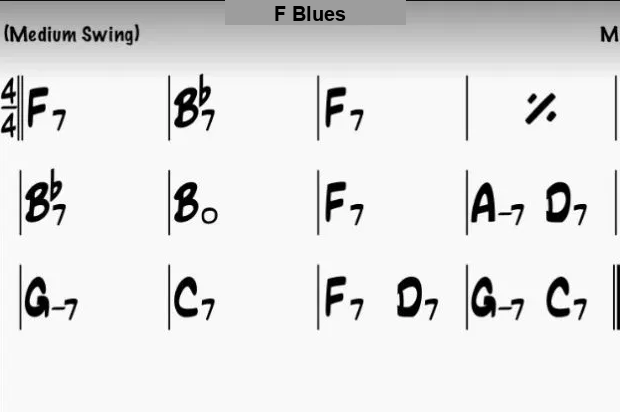
F Blues

“F Blues” isn’t the title of one specific song — it refers to any tune built on the 12-bar chord progression shown below. Tunes commonly played as F blues include:

Bags’ Groove
Now’s the Time
Billie’s Bounce

Chord chart for a standard F blues progression

I put together a full practice method for improvising a walking bass line over an F blues, with video, in this article.

What Comes After This

I still have students work through these five tunes early on in lessons.

Once those are sounding solid, students move on to new tunes — and beyond these five, I also put together a list of 40 tunes I personally played constantly at sessions around Tokyo. You can check that out in this article.

Once you’re comfortable, it’s common to pick your next tune yourself from a list like that.

The more you listen — bebop, Coltrane-style playing, Bill Evans-style playing, Monk-style playing, bossa and Latin, bluesy stuff — the more your own sense of what kind of jazz you actually love starts to take shape.

There’s a lot to work through either way, so you might as well dive into whatever tunes genuinely grab you or sound cool to your ear.

Hopefully this gives you something useful for your daily practice.

Want Personalized Feedback on Your Playing?

Working through these standards builds a great foundation, but knowing whether your own walking lines over them are actually solid — rhythmically and harmonically — is much easier to judge with a second pair of ears.

This is exactly the kind of thing that’s hard to fix alone — and where having a teacher makes all the difference.

At Line on Bass, I offer an online lesson service where you send me a video of your playing, and I give you specific, detailed feedback — every single day if you want.

Students from around the world are using this to fix exactly these kinds of issues and steadily improve their jazz bass skills.

Check Out the Lesson Service →

Posted on Leave a comment

5 Essential Bassists Every Jazz and Walking Bass Player Should Know

This article is written by Toru Hoshino, a jazz bassist and instructor based in Japan who teaches online lessons to students worldwide. In this article, he shares five essential bassists every jazz and walking bass player should listen to.

There are countless great bassists out there, and picking favorites is genuinely an impossible task. But a student of mine recently asked me:

“If I’m going to get into jazz, walking bass, and upright bass, can you just give me five bassists to start with?”

I thought about it for a second, and here’s who I told them.

Ray Brown

Known as “King Ray,” Ray Brown is one of the all-time masters of the upright bass.

His style — driving solos and grooves almost entirely with his index finger — produced a tone and pitch accuracy that were absolutely top tier.

“Listen to Ray Brown closely.” “Think about a solid, centered tone on every single note of that 4-feel.” I heard those two pieces of advice constantly when I was learning. He left behind an enormous number of recordings, and honestly, every single one of them sounds incredible.

Paul Chambers

Paul Chambers’ name shows up on an enormous number of recordings considered essential jazz classics.

His bass solo style — endless eighth notes mostly in the low-to-middle register — is instantly recognizable, and I personally transcribed a huge amount of his playing.

The first time I heard “You’d Be So Nice to Come Home To” off his album Bass on Top, it genuinely blew me away.

Scott LaFaro

One of the legendary bassists whose presence in the Bill Evans Trio was simply overwhelming.

I love his bass solo on “Waltz for Debby” from the album of the same name — the way it keeps flowing right across the bar lines without ever settling into a predictable pattern.

I tried to transcribe it once and gave up halfway through. I’d still like to take another crack at it someday.

Christian McBride

I saw him live once at the Village Vanguard in the US, and the way every single note of his 4-feel seemed to dig into the ground gave me a kind of groove I’d genuinely never felt before.

He’s still active today and is, without question, one of the strongest bassists alive.

The opening arco passage on “Tell Me a Bedtime Story,” from his album Fingerpainting, completely melted me.

Esperanza Spalding

I’ve seen her live about four times. Both her singing and her bass playing are absolutely top tier. Apparently former President Obama was a regular at her shows too.

Her second album, simply titled Esperanza, is one I really love.

So, those are five artists I’d recommend if you’re getting into walking bass. Go listen to some genuinely great playing and let it fire you up.

Want Personalized Feedback on Your Playing?

Listening to these greats is a fantastic way to build your ear and your sense of what’s possible — but turning that inspiration into real progress in your own playing is a different process entirely, and that’s where outside feedback really helps.

This is exactly the kind of thing that’s hard to fix alone — and where having a teacher makes all the difference.

At Line on Bass, I offer an online lesson service where you send me a video of your playing, and I give you specific, detailed feedback — every single day if you want.

Students from around the world are using this to fix exactly these kinds of issues and steadily improve their jazz bass skills.

Check Out the Lesson Service →

Posted on Leave a comment

How to Transcribe Walking Bass Lines by Ear (Plus an App That Makes It Easier)

This article is written by Toru Hoshino, a jazz bassist and instructor based in Japan who teaches online lessons to students worldwide. In this article, he shares why transcribing walking bass lines by ear is one of the most old-school but effective ways to improve, and how to actually do it.

Transcribing Walking Bass Lines by Ear?

Listening to bass with earbuds

Transcribing by ear means listening to a recording or video of an artist playing, and writing out what you hear as notation.

You might be thinking “there’s no way I can do that,” or “I don’t have absolute pitch, so it’s impossible” — but I started out the exact same way, just transcribing by ear.

How to Transcribe a Walking Bass Line by Ear

1. Get a recording you like and your bass ready. (An electric bass is easier to work with for this — plug into an amp if you can.)

2. Listen to the track.

3. You don’t have to start from the beginning of the song — just start from whichever phrase you want to transcribe. Listen closely, note by note, and write down what you hear. (Tab notation works fine too.)

Writing bass notation on blank staff paper

One hour later…

Still blank staff paper after an hour

…total defeat.

Yeah, I know. It’s tough to do right away.

Bass sits in a low frequency range, so compared to other instruments it has a weaker attack on the ear, which makes it genuinely harder to pick out.

That said, the notes used on bass are exactly the same as the keys on a piano — 7 white keys and 5 black keys, 12 notes total — and every note in any walking bass line you’re listening to is one of those 12.

So even if you can’t immediately identify a note, you can work through the 12 options one at a time — C, C#, D, D#, E, F… — until you find it.

“Easy for You to Say — the Song Is Just Too Fast!”

Fair enough — a lot of tunes really are too fast to follow note by note at full speed.

For that, I recommend an app called SLOW PLAYER.

It lets you slow a track down to half speed and loop the same section over and over.

Using an app like this makes transcribing by ear a lot more manageable.

Why Transcribing by Ear Is Worth the Trouble

1. It trains your relative pitch.

2. Once you’ve copied a bass line, you can actually play it over the tune right away — so you immediately have something usable.

Beyond that, once you’ve got some lines under your fingers, your own playing can start to fall into the same handful of habits. Listening objectively to how other bassists approach a given chord is a great way to break out of that.

It can lead to moments like, “oh, I never thought of playing it that way.”

Transcribing walking bass lines by ear is genuinely hard work, but what you get out of it is worth just as much. If you’re not sure what to practice next, it’s worth giving a shot.

Want Personalized Feedback on Your Playing?

Transcribing by ear will train your pitch and vocabulary, but it can’t tell you whether what you’re playing back actually holds up rhythmically and stylistically — that’s where outside feedback becomes invaluable.

This is exactly the kind of thing that’s hard to fix alone — and where having a teacher makes all the difference.

At Line on Bass, I offer an online lesson service where you send me a video of your playing, and I give you specific, detailed feedback — every single day if you want.

Students from around the world are using this to fix exactly these kinds of issues and steadily improve their jazz bass skills.

Check Out the Lesson Service →

Posted on Leave a comment

3 Jazz Standards Perfect for Spring Listening

This article is written by Toru Hoshino, a jazz bassist and instructor based in Japan who teaches online lessons to students worldwide. In this article, he shares three jazz standards perfect for spring listening.

It’s been getting warmer lately. At the live jazz gigs I play regularly, I often get requests from the audience, and this time of year, “something that feels like spring” comes up a lot.

So here are three songs I often play for exactly that request. They’re all beautiful tunes — I hope you’ll give them a listen.

1. Joy Spring

This is probably the tune that says “spring” the most to me. It’s got “Spring” right in the title, and it’s one I played often at jam sessions around this time of year.

That catchy melody always feels like it’s looking forward to the warm season ahead.

That said, catchy as it is, the tune modulates pretty aggressively, which makes both the bassline and the improvising genuinely challenging. But it’s such a great tune — definitely give it a listen.

2. It Might as Well Be Spring

Of all the “Spring” tunes, this is personally my favorite — and I’m especially fond of this particular recording.

The interplay between the organ and tenor sax here is gorgeous. It’s the kind of track I’d love to just sit in the sun and relax to.

3. You Must Believe in Spring

This one feels to me like spring with a little bit of winter’s chill still hanging on.

It’s not a tune I’ve personally played often at sessions, but it has “Spring” right there in the title, so I wanted to include it.

The bass solo right after the theme, from the very start, is wonderfully melodic and just sounds great.

I hope these give you something new to listen to this season — and listening closely to recordings like these is exactly the kind of ear-training that pays off when you’re trying to internalize a style.

Want Personalized Feedback on Your Playing?

This is exactly the kind of thing that’s hard to fix alone — and where having a teacher makes all the difference.

At Line on Bass, I offer an online lesson service where you send me a video of your playing, and I give you specific, detailed feedback — every single day if you want.

Students from around the world are using this to fix exactly these kinds of issues and steadily improve their jazz bass skills.

Check Out the Lesson Service →

Posted on Leave a comment

The Guy Who Showed Up to a Jam Session After One Day of Jazz

This article is written by Toru Hoshino, a jazz bassist and instructor based in Japan who teaches online lessons to students worldwide. In this article, he shares a true story from 2016 about a guy who showed up to a jam session after exactly one day of playing jazz.

The setting: a neighborhood bar near my place. I was sitting alone with a drink, reading a manga, when a young guy sat down at the counter nearby.

One Night

Young guy: “What are you reading?”

Me: “Oh, this? It’s called ‘Kids on the Slope.’ Ever heard of it?”

Young guy: “Nope, never heard of it.”

Me: “It’s about jazz. You know jazz?”

Young guy: “Oh yeah! I know that! Super cool stuff, jazz!”

Me (thinking): Wow, he’s really into this. Wish he were a girl.

Me: “Oh, I just finished it actually — want to borrow it?”

Young guy: “Really? Can I? Awesome! Actually, I do music too — I’m a guitarist/singer, just moved here from Okinawa. Starting at a music school here in Tokyo this spring.”

Me: “No kidding? That’s some serious commitment.”

We hit it off and kept talking. Since we lived nearby, I lent him the whole series — all 10-ish volumes — and we said goodnight.

The Next Afternoon

The next afternoon: “Toru! I finished the whole series! It was amazing! I’m bringing it back right now!”

Whoa — already?! He came by.

“Man, I got so into it, I actually cried. And the songs in the manga are real songs, so I looked them up and listened — ‘Moanin”, ‘Lullaby of Birdland.’ So cool!”

“Oh nice, got into jazz, huh? Love that.”

“What else is out there?”

“Alright, let me give you the rundown.”

Miles Davis, Charlie Parker, Bill Evans, John Coltrane, Bud Powell, Keith Jarrett. And since you play guitar — Wes Montgomery, Joe Pass, Jim Hall, George Benson. And personally, I’d throw in the incredible bassist Esperanza Spalding too.

I scribbled it all down on a sheet of paper and handed it to him.

Then — oh, right!

“Hey, you know what a ‘jam session’ is?”

“What’s that?”

“It’s where a bunch of musicians who’ve never met just bring their instruments and improvise together on the spot. It’s a classic jazz tradition.”

“No way! That’s so cool!”

“There’s actually one tomorrow — I’m playing bass for the house rhythm section. Want to come?”

“I’m in!”

What an enthusiastic kid. I don’t think I’d ever met anyone who said “I’m in!” to a jam session with zero hesitation like that.

The Day After That

The day after that — February 18th, a jam session at a venue in the western Tokyo suburbs. We met at the station at 6:30 and headed over together.

“You ever played jazz before?”

“Nope. But I did practice something called the ‘blues pentatonic’ today!”

“Huh. Huh!”

One day of jazz experience.

One day. There’s something almost poetic about that.

How many days have I logged at this point? Probably past 2,000 by now.

But then again — Christian McBride, Avishai Cohen, Paul Chambers — they all had a “day one” too.

We got to the venue, and I introduced him to everyone.

“This is a guy who just moved here from Okinawa, chasing a music career. One day of jazz experience.”

Everyone’s jaws dropped.

“So, what should we play?”

“Let’s do an F blues. Just solo — don’t worry about anything else. Stick to these notes and you’ll be fine.”

Just F, A♭, and C — that’s all he was told to hang onto.

And he played it exactly like someone with one day of jazz experience. But he had a huge smile on his face the whole time, clearly having a blast.

I remember my own first session — pure nerves and cold sweat the entire time.

Is this kid crazy? Or is he going to turn into something incredible?

It had been a while since I’d thought that about someone.

It was a cold, windy February night. We grabbed ramen on the way home.

“Oh, let me get my share—”

“Don’t worry about it. You came out tonight — this one’s on me.”

“I feel bad taking it…”

“Just promise me one thing — when you book your first real gig, let me know. Put together a band you’re genuinely proud of, and write some great songs.”

“Got it! Thank you so much!”

Somewhere along the way, I’d turned into the kind of person who says things like that. Guess I’d better live up to it myself.

March’s almost here.

Watching someone improvise on three notes with zero experience but total joy is a reminder that the fundamentals — chords, time, structure — are exactly what a teacher helps you turn that joy into real skill.

Want Personalized Feedback on Your Playing?

This is exactly the kind of thing that’s hard to fix alone — and where having a teacher makes all the difference.

At Line on Bass, I offer an online lesson service where you send me a video of your playing, and I give you specific, detailed feedback — every single day if you want.

Students from around the world are using this to fix exactly these kinds of issues and steadily improve their jazz bass skills.

Check Out the Lesson Service →

Posted on Leave a comment

Cool Jazz Recordings Where the Bass Takes the Melody

This article is written by Toru Hoshino, a jazz bassist and instructor based in Japan who teaches online lessons to students worldwide. In this article, he shares cool jazz recordings where the bass takes the melody.

Here are some recordings where the bass itself carries the melody on a jazz standard, rather than just backing up another instrument.

Donna Lee (Jaco Pastorius)

A lot of people already know this one. Personally, this is one of the most jaw-dropping recordings I’ve ever heard. Right from track 1, it’s just percussion and fretless bass covering Charlie Parker’s “Donna Lee” — no other instruments at all. Even at that blistering tempo, every single note comes through clean and well-defined, with slides, multiphonics, and harmonics unique to the fretless bass on full display throughout.

You’d Be So Nice to Come Home To (Paul Chambers)

A genuinely stunning recording — over three minutes straight of pure improvising right from the theme. The sheer tension of wondering “how much longer can this bass solo possibly keep going?” is thrilling. “Donna Lee” above is one of the most jaw-dropping electric bass performances I know — this one is, without question, one of the most jaw-dropping upright bass performances I know.

Samba De Orfeu (Ron Carter)

I tend to feel like a bass-carried melody fits brighter, major-key material less naturally — that bright major tunes like “Samba De Orfeu” are a tougher fit for a bass melody. But hearing Ron Carter casually nail a bright, breezy melody down in the bass’s low register, making it look effortless, is exactly what you’d expect from one of the greats.

Bye Bye Blackbird (Ray Brown with John Clayton & Christian McBride)

An ensemble of three of the world’s greatest bass players, and nothing else. Listen closely to this all-bass ensemble and you’ll hear not just incredible individual playing, but genuinely deep musical conversation between all three players.

These are all performances that really expand what the bass is capable of — hopefully you find something here to enjoy.

Hearing how these legends shape a melody is one thing — actually getting your own bass-led melody to sing with that same clarity and intention is exactly where a teacher’s feedback helps the most.

Want Personalized Feedback on Your Playing?

This is exactly the kind of thing that’s hard to fix alone — and where having a teacher makes all the difference.

At Line on Bass, I offer an online lesson service where you send me a video of your playing, and I give you specific, detailed feedback — every single day if you want.

Students from around the world are using this to fix exactly these kinds of issues and steadily improve their jazz bass skills.

Check Out the Lesson Service →

Posted on Leave a comment

3 Tunes With a Great Walking Bass Solo (Best Heard Loud)

This article is written by Toru Hoshino, a jazz bassist and instructor based in Japan who teaches online lessons to students worldwide. In this article, he shares three classic recordings featuring a genuinely cool “walking bass solo” — best heard at high volume.

If you’re not familiar with the term, a “walking bass solo” needs a quick explanation first. In jazz, when a horn or piano player takes a solo, the bassist typically backs them up with a “walking bass line” — a quarter-note-driven accompaniment pattern.

But when it becomes the bassist’s own turn to solo, most players switch things up, bringing in eighth notes, triplets, and often some genuinely virtuosic technique. A “walking bass solo” is the distinctive alternative approach where the bassist keeps that same quarter-note-driven pattern going even during their own solo, rather than breaking from it.

The first time I heard one, I actually thought, “wait, did they just miss their cue to really solo?” But these are legendary players we’re talking about — that’s obviously not what’s happening. It’s a different kind of cool from a flashy, technical solo, but it’s seriously cool in its own right. Here are three classic recordings featuring a great walking bass solo.

3 Tunes With a Great Walking Bass Solo

1. “Candy”

Album: Candy (1958) — Bassist: Doug Watkins — Walking bass solo at 4:48

Personally, I think this is the most famous walking bass solo out there. It comes up often at jam sessions too, so it’s well worth a listen.

2. “Airegin”

Album: The Incredible Jazz Guitar of Wes Montgomery (1960) — Bassist: Percy Heath — Walking bass solo at 2:58

A blisteringly fast walking bass solo — and what’s especially cool is how rock-steady and even it stays even at that speed.

3. “Oleo”

Album: Everybody Digs Bill Evans (1959) — Bassist: Sam Jones — Walking bass solo at 2:28

Once the walking bass solo kicks in, the rest of the band drops out almost entirely, which really lets the bass’s tone and nuance come through. Crank the volume and feel the tension for yourself.

Hopefully this is a fun way to get introduced to some genuinely cool music.

Getting your own walking bass solos to feel this composed and intentional takes real practice — that’s exactly the kind of playing a teacher can help you build toward.

Want Personalized Feedback on Your Playing?

This is exactly the kind of thing that’s hard to fix alone — and where having a teacher makes all the difference.

At Line on Bass, I offer an online lesson service where you send me a video of your playing, and I give you specific, detailed feedback — every single day if you want.

Students from around the world are using this to fix exactly these kinds of issues and steadily improve their jazz bass skills.

Check Out the Lesson Service →

Posted on Leave a comment

5 Great Bass-and-Piano Duo Albums Worth Hearing

This article is written by Toru Hoshino, a jazz bassist and instructor based in Japan who teaches online lessons to students worldwide. In this article, he shares five great bass-and-piano duo albums he’s enjoyed, along with a few favorite tracks from each.

Here are five bass-and-piano duo albums I’ve enjoyed listening to, along with some thoughts on a few favorite tracks from each. (Note: these impressions date back to around 2017 — purely my own personal take.)

5 Great Bass-and-Piano Duo Albums

Ballads & Blues

Recorded 1978 — Tommy Flanagan (piano), George Mraz (bass)

This album introduced me to “They Say It’s Spring,” and I fell for it instantly — such a beautiful melody. It shifts partway through into a medium 4-beat feel, and the legendary George Mraz’s rock-steady time and pitch on that 4-beat groove is something to marvel at.

Come Sunday

Recorded 2010 — Hank Jones (piano), Charlie Haden (bass)

The title track, “Come Sunday,” is one I’ve performed live a number of times myself. It’s a quiet, understated tune, but there’s a bluesy quality running underneath it that fits the somewhat fleeting, poignant impression I have of Charlie Haden’s playing.

Intuition

Recorded 1975 — Bill Evans (piano), Eddie Gomez (bass)

From the beauty of “Hi-Lili, Hi-Lo” (the theme from the film “Lili”) to Eddie Gomez’s passionate solo right from the top of the notoriously tricky standard “Falling Grace,” this album covers a lot of different moods. I love everything Bill Evans recorded, but this one’s a particular favorite of mine.

Conversations With Christian

Released 2011 — Christian McBride (bass)

Not every track on this one is a piano duo, but it’s a favorite of mine among his duo recordings. Track 1, “Afrika,” featuring Angelique Kidjo, is a duo of just bass and vocals. Christian McBride’s time feel is honestly something else.

DUO 2

Released 2011 — Niels-Henning Ørsted Pedersen (bass), Kenny Drew (piano)

Track 8, “A Child Is Born,” is a favorite of mine — the legendary NHØP takes the melody on bass. Hearing him play a graceful, gentle 3/4 ballad like this, after all those dazzling, lightning-fast solos he’s known for, makes me wonder what his expression must have looked like in the studio.

The Bass-and-Piano Duo: No Drums in Sight

With just bass and piano sounding, both instruments have to mesh well together while still creating moments that stand out. Stick to just roots and a steady 4-beat feel, and it gets monotonous fast — but move around too much, and it stops being a real ensemble. And yet, in the hands of musicians at this level, every single moment becomes a highlight.

Even with just two instruments, jazz can be genuinely exciting. And the fact that two different pairings of the same instrumentation can sound completely different in character is one of the things that makes this music so interesting.

Picking up the kind of interplay these duos build takes more than just listening — having a teacher point out specifically what’s happening between the bass and the rest of the band is where it really starts to click.

Want Personalized Feedback on Your Playing?

This is exactly the kind of thing that’s hard to fix alone — and where having a teacher makes all the difference.

At Line on Bass, I offer an online lesson service where you send me a video of your playing, and I give you specific, detailed feedback — every single day if you want.

Students from around the world are using this to fix exactly these kinds of issues and steadily improve their jazz bass skills.

Check Out the Lesson Service →