Posted on Leave a comment

My Experience With Tendinitis From Bass Practice (and What I Did About It)

Hi, I’m Toru Hoshino, a bass teacher.

If you practice bass a lot, you can end up developing tendinitis.

I’m not a doctor, so I can’t give you specific medical advice for preventing tendinitis in this article, but

I want to share my own experience with it, and what I did while dealing with it.

What Is Tendinitis?

Tendinitis is, as the name suggests, inflammation of a tendon. Most everyday cases come from overusing the muscles of the hand and arm in ways that put strain on the fingers or wrist. Often you don’t even realize you’ve been overdoing it until you’re suddenly diagnosed with it. There are also cases caused by infection through an injury, or linked to an underlying condition like diabetes or rheumatoid arthritis.

What Causes Tendinitis in Bass Players

Poor form and overpracticing seem to be the most common causes of tendinitis.

Even when you think you’ve relaxed your grip, you can still be putting unnecessary strain on your hand without realizing it.


Most players never think it’ll happen to them, so they don’t take any precautions — and only start worrying once they’re already dealing with it.

In my case it never got bad enough to disrupt daily life, but apparently severe cases can leave you unable to even hold chopsticks.

I actually know a drummer who got tendinitis so bad he couldn’t hold his drumsticks anymore.

What I Did While Dealing With Tendinitis

Getting diagnosed was a shock, but I decided to stop playing bass for a while.

Every doctor I saw told me the same thing: not playing is the best thing you can do.

I wanted to keep getting better on bass, so it was a hard call to make, but there wasn’t really a choice.


So instead of using my hands, I spent my time on these three things:

· Going to see live music
· Studying music theory
· Drinking and listening to music

Going to See Live Music

I went out to see all kinds of shows — genres outside what I usually play, bands led by old friends I’d lost touch with, all sorts of things.

Watching other people play taught me a lot, and honestly it was good medicine for the frustration of dealing with tendinitis.

Studying Music Theory

I figured this was as good a time as any, so I dug into music theory, which I’d always struggled with. I’d look things up when I didn’t understand them, and ask my teacher when even that didn’t help — just chipping away at it bit by bit.

I still do this today, and I think that period is where I picked up the habit of reading a little music theory every day.

Drinking and Listening to Music

Drinking too much obviously isn’t a good idea, but sipping a whiskey while listening to some smooth jazz and soaking in a cool, quiet moment isn’t a bad way to spend an evening either.

All the practice you’ve put in up to that point is never wasted, so when your body’s telling you it’s had enough, I think taking a little time to rest is part of what lets you keep playing music for the long haul.

If it starts to hurt, please don’t push through it!

Want Personalized Feedback on Your Playing?

This is exactly the kind of thing that’s hard to fix alone — and where having a teacher makes all the difference.

At Line on Bass, I offer an online lesson service where you send me a video of your playing, and I give you specific, detailed feedback — every single day if you want.

Students from around the world are using this to fix exactly these kinds of issues and steadily improve their jazz bass skills.

Check Out the Lesson Service →

Posted on Leave a comment

I Played a Bass Solo Over “Autumn Leaves”

Hi, I’m Toru Hoshino, a bass teacher.

In this article, I break down a solo I played over “Autumn Leaves,” a chord progression that’s a favorite at jam sessions.

When you look up bass solo videos, a lot of them are

amazing, but moving around so much you can’t really copy them.

I think that’s a common feeling.

So here I played a solo that stays in a range that’s easy to copy, with minimal use of the high register, while still sounding “jazzy.”

My “Autumn Leaves” Bass Solo

Filmed in April 2019. One chorus.

Points I Kept in Mind While Soloing

Point 1: Don’t Go All-Out Right From the Start

When you start a solo, it’s really common to rush in and play too much, too soon — especially at sessions.

A lot of this just comes down to experience, but by leaning into long tones in the opening, I’m setting up a contrast with the eighth-note lines that come later.

A section, measure 1. Video 0:00–

Point 2: Note Intervals

As a “jazzy” way of using notes, I often move through phrases using intervals of a whole step or more, especially 3rds.

Here’s a phrase built around an ascending run of 3rds.

A section, measure 8. Video 0:14–


I go into more detail on 3rd intervals in this article:

Why Your Solo Doesn’t Sound “Jazzy” Yet — and How to Fix It

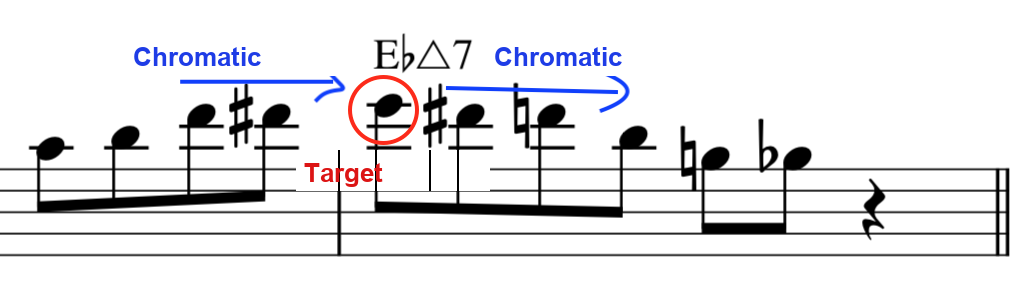
Point 3: Phrases Built on Chromatic Approach

Another “jazzy” trick I use a lot is the chromatic approach.

Measures 3–4 of the B section.

This phrase climbs chromatically toward the target note, then immediately descends chromatically right back down.

B section, measures 7–8. Video 0:47–

I hope this gives you some ideas for your own playing! ^^

Want Personalized Feedback on Your Playing?

This is exactly the kind of thing that’s hard to fix alone — and where having a teacher makes all the difference.

At Line on Bass, I offer an online lesson service where you send me a video of your playing, and I give you specific, detailed feedback — every single day if you want.

Students from around the world are using this to fix exactly these kinds of issues and steadily improve their jazz bass skills.
Check Out the Lesson Service →

Posted on Leave a comment

Chord Tones and Scales: How Are They Actually Different?

I’m Toru Hoshino, an upright and electric bassist and instructor based in Tokyo.

Today I want to cover something I get asked about a lot in lessons:

the difference between chord tones and scales.


A lot of players find this stays fuzzy no matter how long they’ve been playing.

Both are essential for playing bass, but they’re actually used in slightly different ways.

Chord Tones

Let’s start with chord tones.

A chord tone is a note you use when playing a given chord.

For example, a C major chord contains the notes C, E, and G.
Those three notes are the “chord tones.”

You use chord tones to build a bass line that follows the progression of the tune.

The more often you use chord tones, the more your line locks in with the chord changes.


Scales

A scale, on the other hand, is a group of notes arranged in order.

A C major scale, for instance, is C-D-E-F-G-A-B-C — eight notes in a row.
Using a scale lets you build melodies and solos freely, without being tied down to the chord.

Since a scale includes notes outside the chord as well, it gives you a much wider palette to play with.

To sum it up: think of chord tones as “stable notes,” and scales as “notes you’re free to use.”

Both matter, and once you learn when to reach for each one, playing bass gets a lot more fun!

Want Personalized Feedback on Your Playing?

This is exactly the kind of thing that’s hard to fix alone — and where having a teacher makes all the difference.

At Line on Bass, I offer an online lesson service where you send me a video of your playing, and I give you specific, detailed feedback — every single day if you want.

Students from around the world are using this to fix exactly these kinds of issues and steadily improve their jazz bass skills.

Check Out the Lesson Service →

Posted on Leave a comment

NANOBASS X4 by PHIL JONES BASS: My Honest Review

Hi, I’m Toru Hoshino, a bass teacher.

This article is basically me saying, “I bought a new amp and I love it.”

This article is for:

· Anyone curious about the NANOBASS X4
· Anyone looking to buy a new amp
· Anyone who wants a solid amp for home practice

If that’s you, I hope this is useful — read on.

The amp I’m covering today is the NANOBASS X4, made by PHIL JONES BASS.

· It’s small
· It doubles as a Bluetooth speaker
· It’s got real power

are the things I really love about it.

It’s a perfect amp for home practice, so I wanted to write up a review.

It’s Small

16 cm wide x 20 cm tall x 19.7 cm deep

That’s the size we’re talking about.

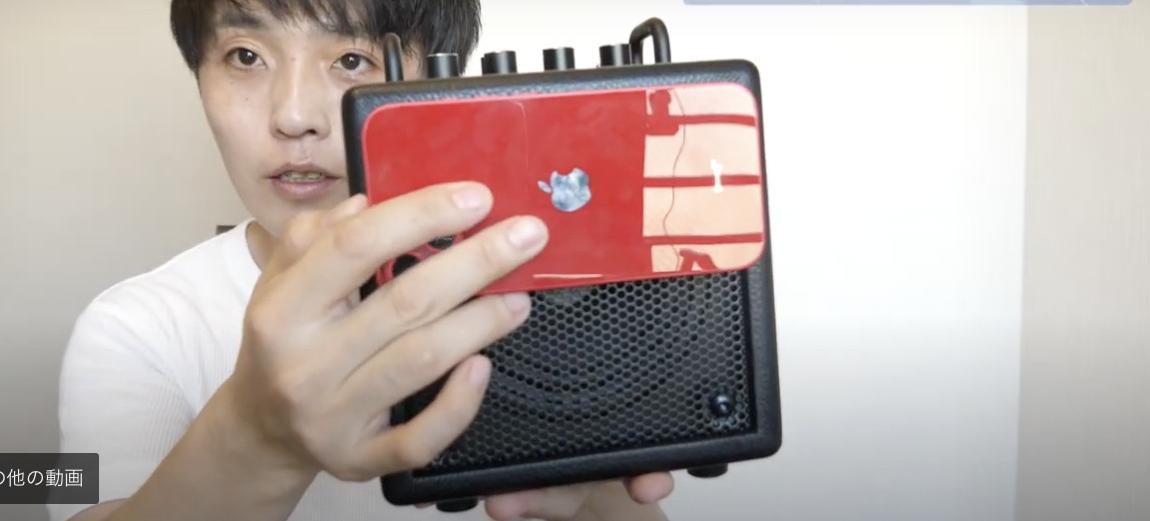
16 cm wide is about the size of my phone, lol.

It’s so small that I was genuinely surprised when I unboxed it.

I’ve tried a number of these compact amps before, and the one thing that always bothered me was the low end breaking up because of the small cabinet size.

But with this one, you don’t need to worry about that at all.

It puts out a genuinely punchy low end. Check the video further down to hear it in action. ^^

It Doubles as a Bluetooth Speaker

The amp itself works as a Bluetooth speaker, so you can connect it wirelessly to your phone and play, say, a YouTube track through it.

The sound quality over Bluetooth is great, and the low end holds up just as well — very on-brand for PHIL JONES BASS.

On top of that, you can stream a backing track over Bluetooth while playing your bass through the same amp at the same time, so this one amp alone is enough to practice efficiently along with a reference track.

It’s Got Real Power

Despite being small, it doesn’t break up on the low end and delivers a genuinely powerful, high-quality bottom.

It holds a solid low end even with a 5-string’s low B or with an upright bass.

Tone is hard to describe in text, so here’s a quote from the manufacturer’s own description:

“It took time to find the right balance and sound — pushing right up against the physical limits of such a tiny enclosure while still delivering the authentic PJB bass tone our standards demand. Tuning the dedicated passive radiator and speaker, adjusting the sound and controls — we went through countless revisions over two years before we finally arrived at a sound we were satisfied with.”

That’s what they say.

And reading that is exactly what got me to buy it. (lol) Total sucker for good marketing copy. (^o^)

Anyway, I also reviewed this amp on video, so if you’re curious, take a look below. ^^

Also Covered on YouTube

If you want to get a sense of how loud/full this thing actually sounds, definitely check out the video.

Want Personalized Feedback on Your Playing?

This is exactly the kind of thing that’s hard to fix alone — and where having a teacher makes all the difference.

At Line on Bass, I offer an online lesson service where you send me a video of your playing, and I give you specific, detailed feedback — every single day if you want.

Students from around the world are using this to fix exactly these kinds of issues and steadily improve their jazz bass skills.
Check Out the Lesson Service →

Posted on Leave a comment

I Practiced at Home With a Double Bass Mute for a Month — Did I Get Noise Complaints?

Hi, I’m Toru Hoshino, a bass teacher.

In this article, I (living in a one-room apartment in Tokyo at the time, in 2017) tested whether practicing upright bass at home with a double bass mute would actually get me complaints from neighbors.

This article is for:

· Anyone curious about trying a double bass mute

· Anyone worried that practicing upright bass might bother their neighbors

If that’s you, I hope this is useful — read on.

To give you the conclusion up front: no, I didn’t get any complaints.

The Double Bass Mute

You attach the mute to the tip of the bridge like this.

Even just this mutes the sound quite a bit. It might be hard to tell from a description alone, so I recorded myself bowing an open string with and without the mute.

Before muting:

After muting:

These were recorded with an iPhone placed about 30 cm (roughly a foot) from the instrument, using the default voice memo app.

In the end, whether you’ll get complaints or not really comes down to your specific living situation. Even with a mute on, the bass still puts out a noticeable amount of sound, so it’s not the case that “if you use a mute, you’ll never get a complaint, guaranteed.” That said, as someone who practices daily in a Tokyo apartment while staying mindful of my neighbors, here’s what I keep in mind.

I hope this gives you a useful reference point if you’re thinking about practicing upright bass at home.

What I Keep in Mind When Practicing With a Mute

Practice When Neighbors Are Likely Out

My neighbors seem to be out at work on weekdays, so I practice during weekday daytime hours.

No Playing at Night

I try to wrap up by around 7 PM, since I’d rather not draw attention to myself.

Treat It as Short-Session Practice Only

When I have a free 30 minutes or so, I’ll work on intonation or repeat a phrase a few times.

When I can carve out two or three hours, I head to a rehearsal space where I can actually play at full volume.

Does a Mute Fully Eliminate the Sound?

No, not completely. For reference, the unplugged acoustic sound of a Yamaha SLB series silent bass is far quieter than a muted acoustic upright.

If your neighbors are particularly sensitive to noise, they may still complain.

That said, a lot of people who buy a mute end up saying “huh, it’s not as quiet as I expected,” so I’d recommend trying one out at a music shop before buying.

Want Personalized Feedback on Your Playing?

This is exactly the kind of thing that’s hard to fix alone — and where having a teacher makes all the difference.

At Line on Bass, I offer an online lesson service where you send me a video of your playing, and I give you specific, detailed feedback — every single day if you want.

Students from around the world are using this to fix exactly these kinds of issues and steadily improve their jazz bass skills.

Check Out the Lesson Service →

Posted on Leave a comment

Upright Bass Posture: Standing, Stance, and Form

This article is written by Toru Hoshino, an upright bass player and teacher based in Tokyo.

It’s aimed at:

· Those picking up an upright bass for the first time

· Those who are about to start learning upright bass

· Those who want to revisit and refine their playing posture

*Different schools and teachers approach upright bass technique differently, so please treat this article as one reference among others, rather than the only correct way.

Posture

How to Stand

Keep your back straight, but don’t lean back too far.

That said, a hunched back looks unnatural too.

Aim for a relaxed, natural standing position.

Front view:

Foot Width

Set your feet about shoulder-width apart.

Standing with your feet too close together makes it hard to play,

and standing with your feet too far apart looks unnatural as well.

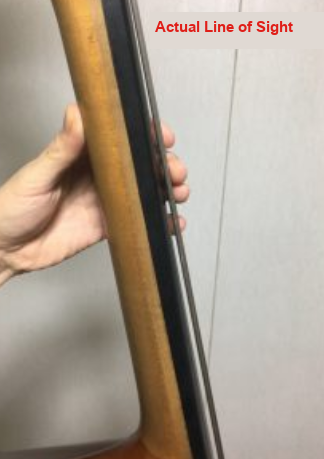
Angle of the Strings

If the strings face too far inward, it’s hard to reach the E string (the thickest one).

On the other hand, if the strings face too far outward, you won’t be able to see the fingerboard.

In practice, you want a line of sight where you can see the E string (the thickest one) but barely see the others.

Front view.

Neck Position

If the neck is too far away from you, fretting notes with your left hand becomes a struggle, so position the neck so it isn’t too far out.

Personally, I play with the neck positioned roughly like this relative to my body.

Find a Position Where the Bass Stays Balanced Even With Your Hands Off

Unlike an electric bass, the upright bass has no strap, so your body always has to support it.

Ideally, you want a position where the bass stays balanced for a moment even if you let go like this:

Skilled players can keep the bass balanced like this for extended periods without using their hands at all.

The Notch Near Your Side/Waist

This part of the bass —

— tends to sit more stably when nestled against the notch just below your right side/waist.

An Instrument Where Form Really Matters

The upright bass has high string tension and a large body, so it’s genuinely hard to get a solid sound out of it when you’re just starting — but plenty of smaller-framed players still play it well.

That said, if your form stays awkward, you won’t get a solid sound, so it’s worth making good form a habit early on.

Also, the advice you’ll get can vary depending on your height, hand size, the genre you play, and the teacher you study with — so if you’re just starting out, it’s a good idea to have a professional check your form periodically.

Want Personalized Feedback on Your Playing?

This is exactly the kind of thing that’s hard to fix alone — and where having a teacher makes all the difference.

At Line on Bass, I offer an online lesson service where you send me a video of your playing, and I give you specific, detailed feedback — every single day if you want.

Students from around the world are using this to fix exactly these kinds of issues and steadily improve their jazz bass skills.

Check Out the Lesson Service →

Posted on Leave a comment

What Is “Walking Bass,” Anyway?

This site is dedicated to helping bass players improve, with a focus on walking bass, jazz bass, and improvisation.

This article is written for bass players who:

· Want to learn how to play walking bass

· Want to write stylish bass lines

· Want to play jazz-flavored bass lines

What Is “Walking Bass”?

“This is what walking bass sounds like.”

“Walking bass has to be played exactly like this.”

There’s no strict definition like that, but in this article I’ll explain what’s generally referred to as “walking bass.”

What Walking Bass Sounds Like

Here’s a short video of a simple walking bass line.

This is a video of me playing a bass line over the chord changes to the jazz standard “Fly Me to the Moon.”

Features of a Walking Bass Line

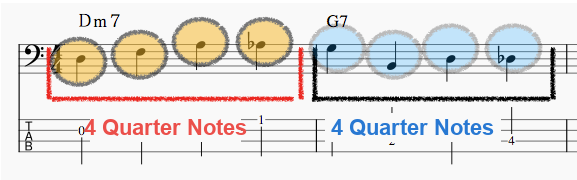
Toru: Like this, you play four quarter notes per bar, and instead of just hammering the root the way you might in rock, you use a variety of different notes. That’s generally what’s meant by a “walking bass line.”

It’s commonly used in jazz, blues, and shuffle-feel music.

It also works great on upright bass. ^^

How to Build a Walking Bass Line

Student: It sounds really difficult — like I’d need to know some complicated music theory just to get started.

A lot of people feel that way, but once you grasp the basic idea, anyone can build a walking bass line easily.

Today I’ll walk you through how to build a walking bass line over this simple chord progression.

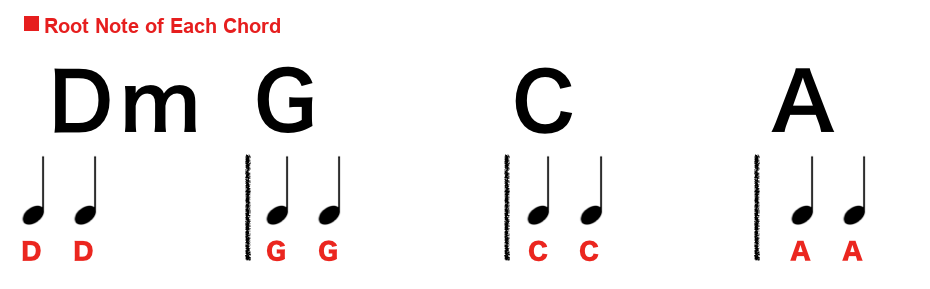
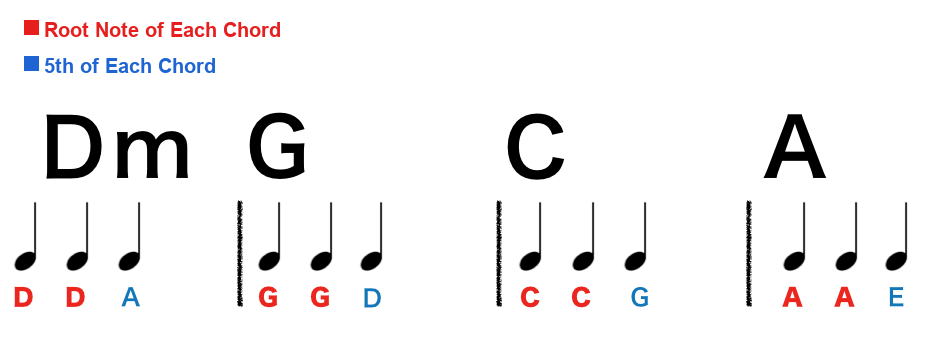
Notes 1 and 2: The Root

You’ll place four quarter notes in each bar.

First, make the 1st and 2nd notes the root note of the chord.

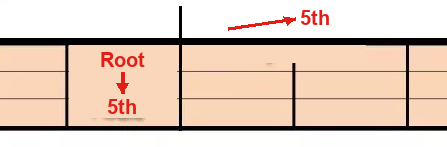
Note 3: The 5th

For the 3rd note, use the 5th of the chord.

Simply put, the 5th is the note found at this position relative to the root.

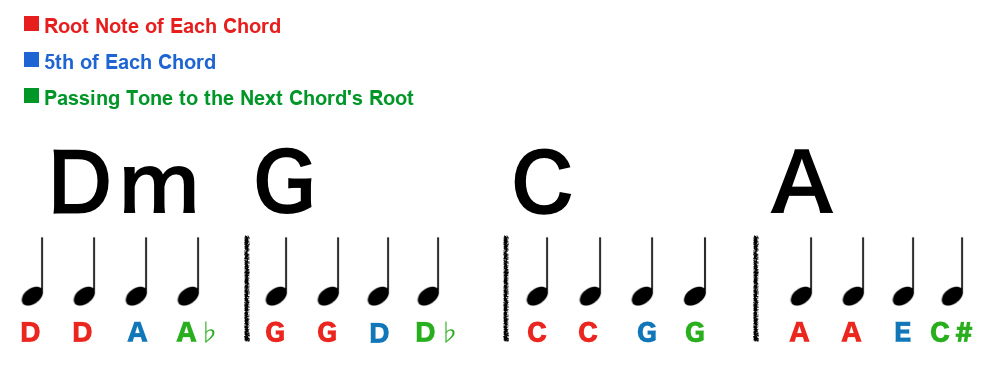
If you’ve played rock or pop bass before, the first three notes probably feel familiar already — but the 4th note is where it gets interesting.

Note 4: The Passing Tone

For the 4th note, it doesn’t matter much whether it’s a chord tone or not — approaching the next root from a half step above or below sounds great.

Toru: This is called a “passing tone,” and it’s a great tool whenever you want a jazzier sound.

For example:

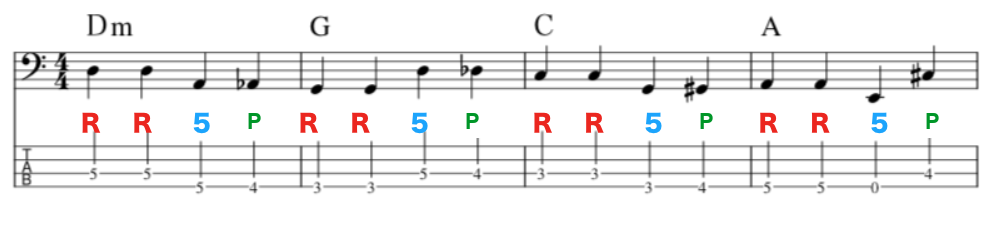
When approaching G, the root of the G7 chord in bar 2,

you can approach from Ab (a half step above) or Gb (a half step below).

When approaching C, the root of the CΔ7 chord in bar 3,

you can approach from Db (a half step above) or B (a half step below).

This kind of approach gives you that jazzy taste pretty easily.

This time, I built it like this with playability (fingering) in mind:

Here’s how it sounds against the actual track:

What did you think?

A convincing jazz bass line might sound like it requires a lot, but you can get surprisingly far using just the root, the 5th, and a passing tone.

I hope this gives you some ideas for building your own bass lines going forward.

Want Personalized Feedback on Your Playing?

This is exactly the kind of thing that’s hard to fix alone — and where having a teacher makes all the difference.

At Line on Bass, I offer an online lesson service where you send me a video of your playing, and I give you specific, detailed feedback — every single day if you want.

Students from around the world are using this to fix exactly these kinds of issues and steadily improve their jazz bass skills.

Check Out the Lesson Service →

Posted on Leave a comment

Album Recommendation: “Esperanza” by Esperanza Spalding

This is an album recommendation from me, Toru Hoshino (@jazzbassisttoru), founder of the online bass school Line on Bass.

This record carries forward everything great about straight-ahead jazz, with plenty to enjoy from the bass alone — and on top of that, it has a thoroughly modern, stylish feel.

It’s an album by a true super-bassist, and one I’ve had people thank me for introducing them to more times than I can count.

“Esperanza” by Esperanza Spalding


“Esperanza” by Esperanza Spalding

Esperanza Spalding is a world-class bassist who also happens to have a truly first-rate singing voice.

She sings moody, lush, glittering melodies while playing upright bass at the same time.

Esperanza has released four albums so far, and each one has a completely different feel.

This particular record is especially recommended if you:

・Like the smooth jazz sound
・Like Antônio Carlos Jobim
・Like bossa nova
・Like club jazz

Even my own ears — tuned to old-school ’40s and ’50s bebop, hard bop, and cool jazz — took to this one easily. The melodies are strong and easy to listen to, making it a comfortable entry point even for people new to jazz or Black American music in general.


Great for Moments Like These

・Cleaning or doing housework
・Studying
・Hosting friends for a party
・Before bed
・Morning coffee
・An evening drink (ideally wine, not a canned highball)


My Impressions of “Esperanza”

My strongest impressions are “watery” and “transparent.”

I personally get a similar “watery” feeling from artists like Bill Evans, early Herbie Hancock, and Antônio Carlos Jobim — though the particular flavor of that transparency is different here.

The songs are melodic and easy to sing along to. The bass playing leans more toward funk grooves than straight four-on-the-floor swing, with a lot of tight, punchy bass lines.

Rather than putting “bassiness” front and center the way Paul Chambers does on “Bass on Top,” this album puts the vocals first — it leans heavily into an R&B feel.

I also own another one of Esperanza’s albums — her third, “Chamber Music Society.” That one leans heavily on arco (bow) playing and has a strong chamber-music, classical feel. Personally, I prefer “Esperanza.”


“Chamber Music Society” by Esperanza Spalding

Esperanza Spalding’s Background

Esperanza Spalding became the youngest instructor in the history of Berklee College of Music — one of the most prestigious jazz schools in the world — when she joined the faculty at just 20 years old. President Obama himself is said to be a fan, and she has performed in front of him on multiple occasions.

After passing her GED and graduating high school at 16, she earned a music scholarship to Portland State University, where she’s on record as the youngest bassist in the school’s history. Despite never having formal training from upperclassmen, her talent was impossible for the faculty to ignore — her bass professor encouraged her to transfer to Berklee, and she won a full scholarship the moment she auditioned.

(Source: Wikipedia)

I’ve gone to see her perform live about four times — twice in Japan, twice in the US.

Her singing is wonderful, but the performance that’s stuck with me the most was at a jazz club in New York called Smalls, five or six years back. It wasn’t one of her own headlining shows — she was sitting in as the bassist for a saxophone quartet. A rare and special thing to catch. Her hands moved so fast I nearly fell off my chair.

Whether you’re into old-school jazz or contemporary Black music, this is an artist worth checking out. ^^

A Roundup of My Favorite Esperanza Videos

I went ahead and gathered up some of my favorite Esperanza Spalding videos.

Essential viewing if you’re a bassist — honestly, essential if you just love jazz, or really, if you love music at all.

Overjoyed

Filmed in February 2009. She’s rocking her trademark afro here.

A cover of the Stevie Wonder song. President Obama is watching right in front of her.

That beetle-shaped upright bass is a “Czech Ease” model made by David Gage.


On the Sunny Side of the Street

This time she’s on a standard 3/4-size upright. It’s a tune that comes up often at jam sessions in Japan too. President Obama makes another appearance here as well.

The bass solo really takes off about three minutes into the second half.

The solo is great, but the groove on the walking bass line is just as powerful.


Jazz à Vienne 2012

From a jazz festival in Vienne, France, in 2012.

In the second half, she switches to a 4-string electric jazz bass.


If I keep going down this rabbit hole I’ll never get this article finished, so I’ll stop here.

Want Personalized Feedback on Your Playing?

This is exactly the kind of thing that’s hard to fix alone — and where having a teacher makes all the difference.

At Line on Bass, I offer an online lesson service where you send me a video of your playing, and I give you specific, detailed feedback — every single day if you want.

Students from around the world are using this to fix exactly these kinds of issues and steadily improve their jazz bass skills.

Check Out the Lesson Service →

Posted on Leave a comment

Walking Bass Lines Over “Take the A Train”: A Breakdown

Hi there, I’m Toru Hoshino (@jazzbassisttoru), a bass instructor.

This article breaks down a walking bass line approach over the chord changes to the jazz standard “Take the A Train.”

It’s a popular tune that comes up often at jam sessions, so it’s well worth having in your back pocket.

A Walking Bass Line Over “Take the A Train”

The line is built mostly around the low frets (roughly frets 1–7), centered on one chorus in C major. It’s a catchy line overall, but with a few deliberate twists thrown in along the way to keep things varied. Let’s look at a few of those ideas.

Using a Minor Approach Over a Major Chord

Student: “Wait — isn’t that a minor 3rd over a major chord?”

Toru: Good catch!

A C6 chord is a major chord — the same family as C or C△7 — so you’d expect the major 3rd, E, to be the “correct” note here. But in this line, I actually used the minor 3rd, E♭.

An approach like “C E E A” below would have worked just fine too:

But by deliberately landing on E♭ — a note outside the scale — for the second note, you get a brief flash of “something’s off here” tension. Then, on the third note, the line resolves down to the chord tone E:

Tension → resolution — that’s the effect this creates.

Toru: It has a bit of a bluesy flavor to it, and it works well any time you’ve got the same chord lasting two bars in a row, like here.

Using the Whole-Tone Scale Over D7

This shows up over bars 3–4, and again over bars 10–11:

Student: That’s a lot of sharps…

Toru: This is the whole-tone scale — every interval in it is a whole step.

For a D whole-tone scale, the notes are:

D  E  F#  G#  A#  C

It’s a go-to approach over this particular bar of this particular tune — worth filing away for future reference.

What to Do When the Same Chord Lasts Several Bars

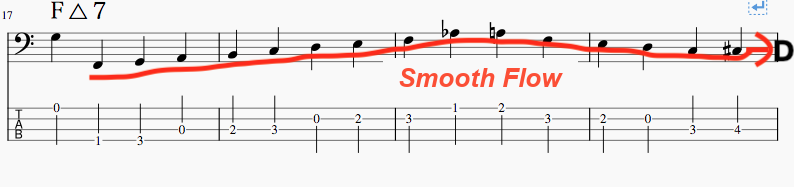
Section B of this tune (where the same chord lasts for several bars in a row) trips a lot of people up. A common but not-so-great approach looks like this:

Resetting to the root note at the start of every bar like this can make the line feel stuck and choppy.

Student: But doesn’t the first note of a bar have to be the root?

Toru: It depends — there are plenty of cases where it doesn’t have to be.

In this case, over the F△7 progression, I built a smooth line with a strong sense of forward motion, aiming to land cleanly on D — the first note of bar 5 of section B:

When the same chord lasts two or more bars, the first note of each bar doesn’t always have to be the root.

That’s a useful idea to keep in your back pocket.

That wraps up this breakdown.

Want Personalized Feedback on Your Playing?

This is exactly the kind of thing that’s hard to fix alone — and where having a teacher makes all the difference.

At Line on Bass, I offer an online lesson service where you send me a video of your playing, and I give you specific, detailed feedback — every single day if you want.

Students from around the world are using this to fix exactly these kinds of issues and steadily improve their jazz bass skills.

Check Out the Lesson Service →

Posted on Leave a comment

I Put Two Basses in a MONO Case and Weighed Myself — The Result Was Incredible

Hi there.

I’m Toru Hoshino (@jazzbassisttoru), a bass instructor.

I put two basses into a bass case and weighed myself with it on. The result was pretty incredible.

The MONO Bass Case

For work, I often need to bring two electric basses with me, so I bought a case that can hold two at once.

It’s MONO’s “M80 Dual Bass Guitar Case BLK M80-2B-BLK” — a gig bag built to hold two basses at once. I bought mine online.

Loading Two Basses

You load one bass in from each side, like this.

The padding is thick.


Inside, there’s a neck holder and cushioning to keep things secure.

The pockets are big too — there’s plenty of room for a fake book and two cables.

Time to Weigh Myself

So, I loaded the basses into the case — and it’s seriously heavy.

I decided to go weigh myself with it on.

I don’t have a scale at home, so I borrowed one from a share house I used to live in.

Here’s what it looked like carrying it on my back.

From behind:

From the side:

It’s about as thick as my face.

I could still ride a bike with it on, at least.


The Moment of Truth

Here’s my weight before:

About 55kg with clothes on. (Sorry about the weird socks.)

Alright, here goes!


Σ(゚д゚lll)

66kg!!

An 11kg increase!!

That was the result.

The case alone weighs about 4kg.

So loading two basses into MONO’s bass case — the “M80 Dual Bass Guitar Case BLK M80-2B-BLK” — adds about 11kg to your total weight, confirmed by actual experiment.

Every case I’ve owned before this one eventually had its strap give out, so this time I’m hoping it holds up for the long haul.


Want Personalized Feedback on Your Playing?

This is exactly the kind of thing that’s hard to fix alone — and where having a teacher makes all the difference.

At Line on Bass, I offer an online lesson service where you send me a video of your playing, and I give you specific, detailed feedback — every single day if you want.

Students from around the world are using this to fix exactly these kinds of issues and steadily improve their jazz bass skills.

Check Out the Lesson Service →