This site is dedicated to helping bass players improve, with a focus on walking bass, jazz bass, and improvisation.
This article is written for bass players who:
· Want to learn how to play walking bass
· Want to write stylish bass lines
· Want to play jazz-flavored bass lines
Contents
What Is “Walking Bass”?
“This is what walking bass sounds like.”
“Walking bass has to be played exactly like this.”
There’s no strict definition like that, but in this article I’ll explain what’s generally referred to as “walking bass.”
What Walking Bass Sounds Like
Here’s a short video of a simple walking bass line.
This is a video of me playing a bass line over the chord changes to the jazz standard “Fly Me to the Moon.”
Features of a Walking Bass Line
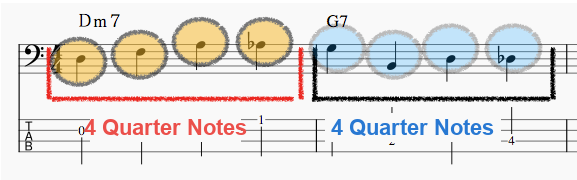
Toru: Like this, you play four quarter notes per bar, and instead of just hammering the root the way you might in rock, you use a variety of different notes. That’s generally what’s meant by a “walking bass line.”
It’s commonly used in jazz, blues, and shuffle-feel music.
It also works great on upright bass. ^^
How to Build a Walking Bass Line
Student: It sounds really difficult — like I’d need to know some complicated music theory just to get started.
A lot of people feel that way, but once you grasp the basic idea, anyone can build a walking bass line easily.
Today I’ll walk you through how to build a walking bass line over this simple chord progression.

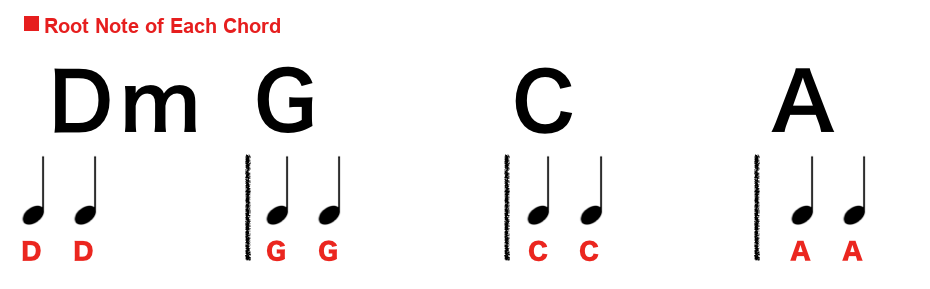
Notes 1 and 2: The Root
You’ll place four quarter notes in each bar.
First, make the 1st and 2nd notes the root note of the chord.
Note 3: The 5th
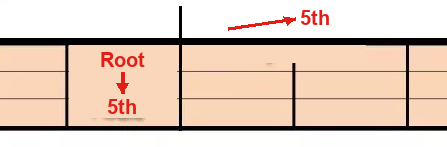
For the 3rd note, use the 5th of the chord.
Simply put, the 5th is the note found at this position relative to the root.
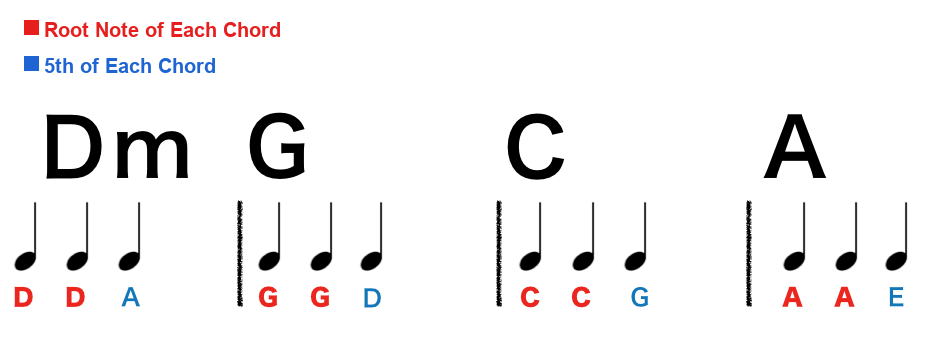
If you’ve played rock or pop bass before, the first three notes probably feel familiar already — but the 4th note is where it gets interesting.
Note 4: The Passing Tone
For the 4th note, it doesn’t matter much whether it’s a chord tone or not — approaching the next root from a half step above or below sounds great.
Toru: This is called a “passing tone,” and it’s a great tool whenever you want a jazzier sound.
For example:
When approaching G, the root of the G7 chord in bar 2,
you can approach from Ab (a half step above) or Gb (a half step below).

When approaching C, the root of the CΔ7 chord in bar 3,
you can approach from Db (a half step above) or B (a half step below).

This kind of approach gives you that jazzy taste pretty easily.
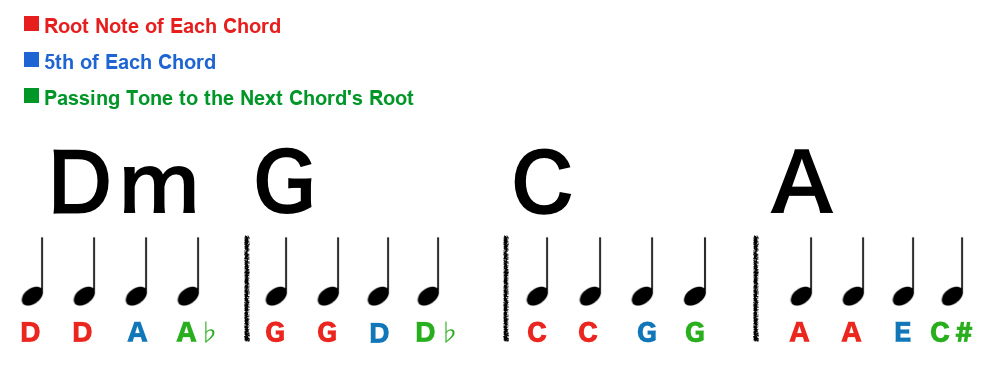
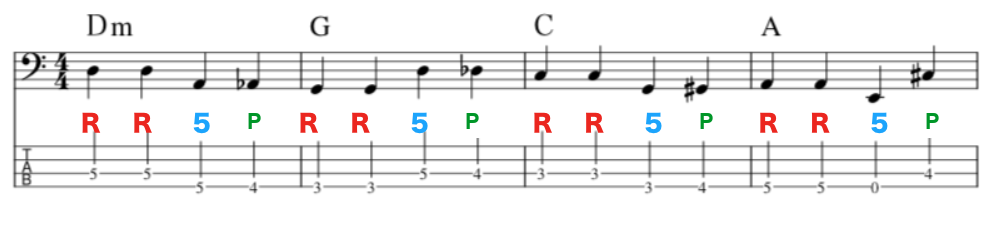
This time, I built it like this with playability (fingering) in mind:
Here’s how it sounds against the actual track:
What did you think?
A convincing jazz bass line might sound like it requires a lot, but you can get surprisingly far using just the root, the 5th, and a passing tone.
I hope this gives you some ideas for building your own bass lines going forward.
Want Personalized Feedback on Your Playing?
This is exactly the kind of thing that’s hard to fix alone — and where having a teacher makes all the difference.
At Line on Bass, I offer an online lesson service where you send me a video of your playing, and I give you specific, detailed feedback — every single day if you want.
Students from around the world are using this to fix exactly these kinds of issues and steadily improve their jazz bass skills.