Hi there, I’m Toru Hoshino (@jazzbassisttoru), a bass instructor.
This article breaks down a walking bass line approach over the chord changes to the jazz standard “Take the A Train.”
It’s a popular tune that comes up often at jam sessions, so it’s well worth having in your back pocket.
Contents
A Walking Bass Line Over “Take the A Train”
The line is built mostly around the low frets (roughly frets 1–7), centered on one chorus in C major. It’s a catchy line overall, but with a few deliberate twists thrown in along the way to keep things varied. Let’s look at a few of those ideas.
Using a Minor Approach Over a Major Chord

Student: “Wait — isn’t that a minor 3rd over a major chord?”
Toru: Good catch!
A C6 chord is a major chord — the same family as C or C△7 — so you’d expect the major 3rd, E, to be the “correct” note here. But in this line, I actually used the minor 3rd, E♭.
An approach like “C E E A” below would have worked just fine too:

But by deliberately landing on E♭ — a note outside the scale — for the second note, you get a brief flash of “something’s off here” tension. Then, on the third note, the line resolves down to the chord tone E:

Tension → resolution — that’s the effect this creates.
Toru: It has a bit of a bluesy flavor to it, and it works well any time you’ve got the same chord lasting two bars in a row, like here.
Using the Whole-Tone Scale Over D7
This shows up over bars 3–4, and again over bars 10–11:


Student: That’s a lot of sharps…
Toru: This is the whole-tone scale — every interval in it is a whole step.
For a D whole-tone scale, the notes are:
D E F# G# A# C
It’s a go-to approach over this particular bar of this particular tune — worth filing away for future reference.
What to Do When the Same Chord Lasts Several Bars
Section B of this tune (where the same chord lasts for several bars in a row) trips a lot of people up. A common but not-so-great approach looks like this:

Resetting to the root note at the start of every bar like this can make the line feel stuck and choppy.
Student: But doesn’t the first note of a bar have to be the root?
Toru: It depends — there are plenty of cases where it doesn’t have to be.
In this case, over the F△7 progression, I built a smooth line with a strong sense of forward motion, aiming to land cleanly on D — the first note of bar 5 of section B:
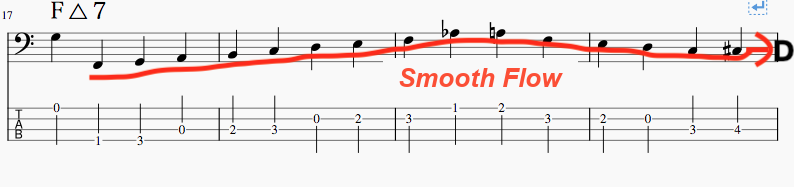
When the same chord lasts two or more bars, the first note of each bar doesn’t always have to be the root.
That’s a useful idea to keep in your back pocket.
That wraps up this breakdown.
Want Personalized Feedback on Your Playing?
This is exactly the kind of thing that’s hard to fix alone — and where having a teacher makes all the difference.
At Line on Bass, I offer an online lesson service where you send me a video of your playing, and I give you specific, detailed feedback — every single day if you want.
Students from around the world are using this to fix exactly these kinds of issues and steadily improve their jazz bass skills.