This article is written by Toru Hoshino, a jazz bassist and instructor based in Japan who teaches online lessons to students worldwide. In this article, he recommends a great jazz standards album recorded on electric bass.
“There are plenty of great jazz albums out there, but they’re almost all upright bass — is there a great electric bass record?” I get asked this a lot, so here’s one album featuring jazz standards played on electric bass.
Double Trios
The album I’m recommending is “Double Trios,” a leader album by jazz pianist McCoy Tyner.
The bassist is one every bass player loves: Marcus Miller.
Not every track on the album features his electric bass playing, but tracks 5 through 8 — “Down Home,” “Sudan,” “Lover Man,” and “Rhythm-A-Ning” — do. My favorite of the bunch is his playing on “Lover Man.”
He plays through a genuinely difficult ballad bass line and solo with total fluency — the solo in particular, packed with intricate phrasing, is stunning.
The electric bass never feels out of place here, and yet it still carries that distinctly “electric” nuance that’s different from an upright bass. That balance is just perfect — a real testament to a master at work. This is the kind of album that made me think exactly that.
It’s searchable on most streaming services, so give it a listen.
Hearing what makes a phrase like that work is one thing — actually building that kind of fluency into your own playing is exactly where a teacher’s feedback comes in.
Want Personalized Feedback on Your Playing?
This is exactly the kind of thing that’s hard to fix alone — and where having a teacher makes all the difference.
At Line on Bass, I offer an online lesson service where you send me a video of your playing, and I give you specific, detailed feedback — every single day if you want.
Students from around the world are using this to fix exactly these kinds of issues and steadily improve their jazz bass skills.
This article is written by Toru Hoshino, a jazz bassist and instructor based in Japan who teaches online lessons to students worldwide. In this article, he puts a rain cover on his bass case and bikes through the rain for 20 minutes to see if it actually works.
For this one, I put a rain cover on my bass case and biked for 20 minutes in the rain, to test whether the case stayed dry.
Spoiler: the bass came out completely fine. Here’s the full process, from putting the cover on to arriving at the destination.
Putting the Rain Cover On
Getting set up:
It’s generously sized, so it covers the case with plenty of room to spare: 385(w) x 1220(H) x 70(D) mm.
And off I go.
20 Minutes of Biking in the Rain — Arrived at the Studio
Made it to the studio. The outside is, naturally, soaked.
And on the inside…
Completely dry. Great job, rain cover.
Once You’re Done With It
Once you’re done using it:
Roll it up,
and it packs down small.
Small enough to fit right into your case.
Noah’sark Rain Coat NRC-Bass (Rain Cover for Electric Bass Cases)
The “Noah’sark Rain Coat” was built to protect your precious instrument from rain — the natural enemy of carrying a guitar or bass around. It’s designed to slip entirely over a gig bag or hard case and is easy to put on and take off. There’s a waterproof zipper section right where the case handle is, so you can pull the handle through and carry the case as normal. If you’re using it with the “Noah’sark Semi Hard Case,” you can even wear it on your back with the double shoulder strap while the cover is still on. When you’re not using it, it folds down small enough to tuck right into your case’s pocket. Bass size (BSH): 385(w) x 1220(H) x 70(D) mm
(Product description quoted from Amazon — note: the listing says “guitar,” but this is the bass version.)
Sudden rain catches you off guard precisely because you never have a rain cover on hand for it. Well worth having, just to protect an instrument and case you care about.
Update, July 2025
Since writing this, I’ve also tried out a few rain covers from other manufacturers, including some newer brands. All of them had solid water resistance and felt genuinely good to use.
I’ve also covered how they feel in actual use on video, if you’re curious.
Keeping your gear dry is one problem solved — knowing exactly what to work on once you sit down to actually practice is a different one, and that’s exactly where a teacher helps.
Want Personalized Feedback on Your Playing?
This is exactly the kind of thing that’s hard to fix alone — and where having a teacher makes all the difference.
At Line on Bass, I offer an online lesson service where you send me a video of your playing, and I give you specific, detailed feedback — every single day if you want.
Students from around the world are using this to fix exactly these kinds of issues and steadily improve their jazz bass skills.
This article is written by Toru Hoshino, a jazz bassist and instructor based in Japan who teaches online lessons to students worldwide. In this article, he answers a question from a lesson: how do you pick a pop song that actually works as a jazz arrangement?
Here’s a question I got recently in a lesson:
I want to arrange a pop song as jazz — what kind of songs actually work for that?
My answer is simple, and comes down to two things:
Does the song’s rhythm actually fit a swing feel?
Does the chord progression include a ii-V-I?
A song that checks both boxes is a great candidate for a jazz arrangement. Let’s look at each one.
1. Does It Fit a Swing Rhythm?
The easiest way to check is to literally try singing the melody in a swing rhythm and see how it feels.
Some melodies are built on tight, even, straight-eighth-note phrasing — the kind of rhythm common in a lot of uptempo pop and electronic-influenced music. Force a swing feel onto a melody like that, and it tends to sound unstable, like the rhythm doesn’t quite know where it’s going.
Other melodies — slower ballads, or songs with a naturally loose, laid-back rhythmic feel to begin with — already have something close to a swing lilt baked in. Sing those in swing time, and the vibe holds together naturally, without losing what made the song work in the first place.
So: try singing the melody in swing time. If it still feels natural and doesn’t lose its character, that’s a great sign it’ll convert well into a jazz arrangement.
2. Does the Chord Progression Include a ii-V-I?
Here’s an example in the key of C:
A common pop progression: F → G → C (IV → V → I)
A jazz-friendly progression: Dm7 → G7 → C (ii → V → I)
If a “ii-V-I” shows up in the progression, it’s much easier to develop a convincingly jazz-sounding harmonic flow around it.
Summary
Try singing the song in swing time and see if the vibe still holds together
Check whether the chord progression includes a ii-V-I
Checking these two things will help you pick out which pop songs are actually going to convert well into a jazz arrangement.
Picking the right song is one thing — actually building a convincing jazz bass line under it is another, and that’s exactly where a teacher’s feedback speeds things up.
Want Personalized Feedback on Your Playing?
This is exactly the kind of thing that’s hard to fix alone — and where having a teacher makes all the difference.
At Line on Bass, I offer an online lesson service where you send me a video of your playing, and I give you specific, detailed feedback — every single day if you want.
Students from around the world are using this to fix exactly these kinds of issues and steadily improve their jazz bass skills.
This article is written by Toru Hoshino, a jazz bassist and instructor based in Japan who teaches online lessons to students worldwide. In this article, he answers a common question about bass lines: should the 3rd or 5th go above or below the root?
Here’s a question that comes up constantly: “When I use the 3rd or 5th, should I play it above or below the root?”
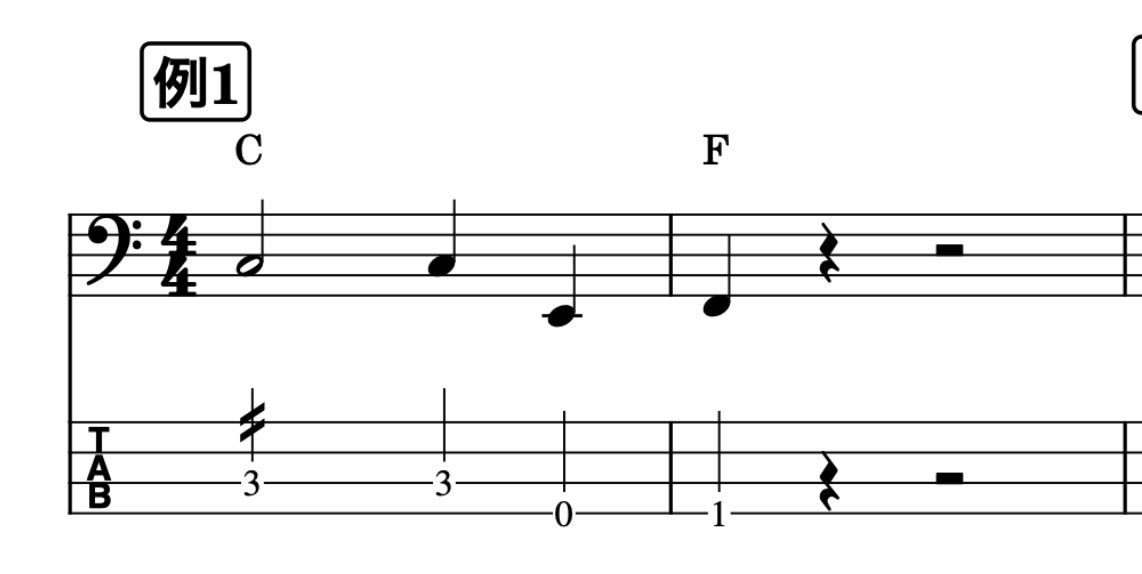
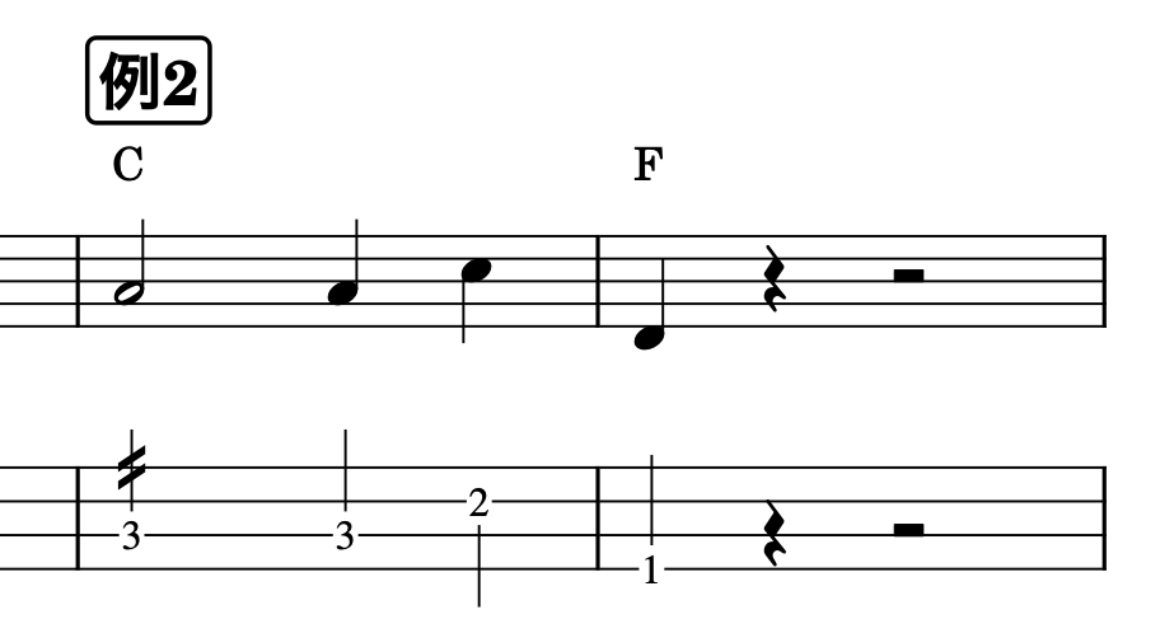
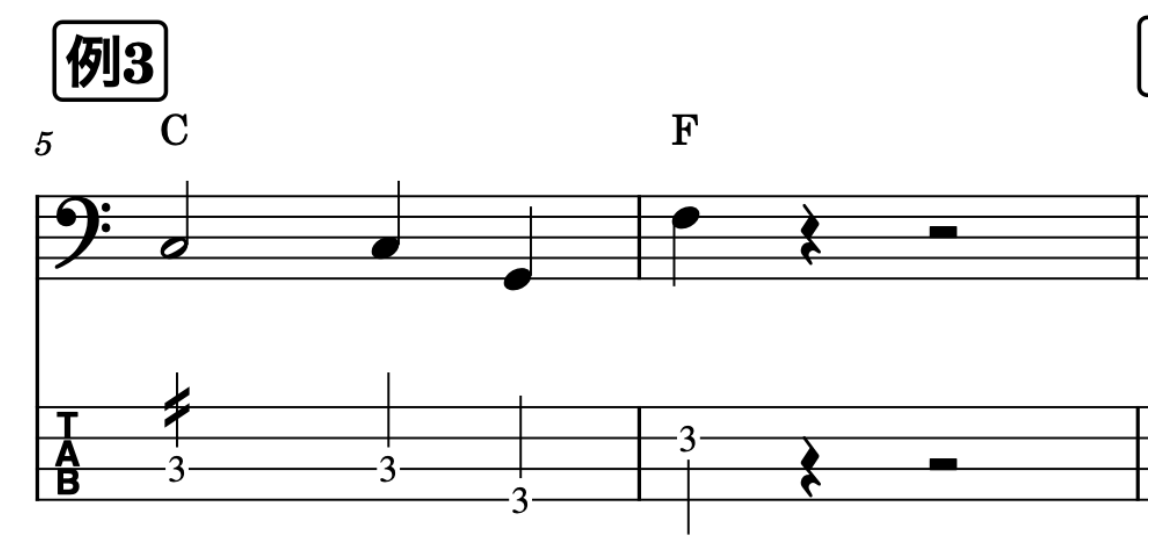
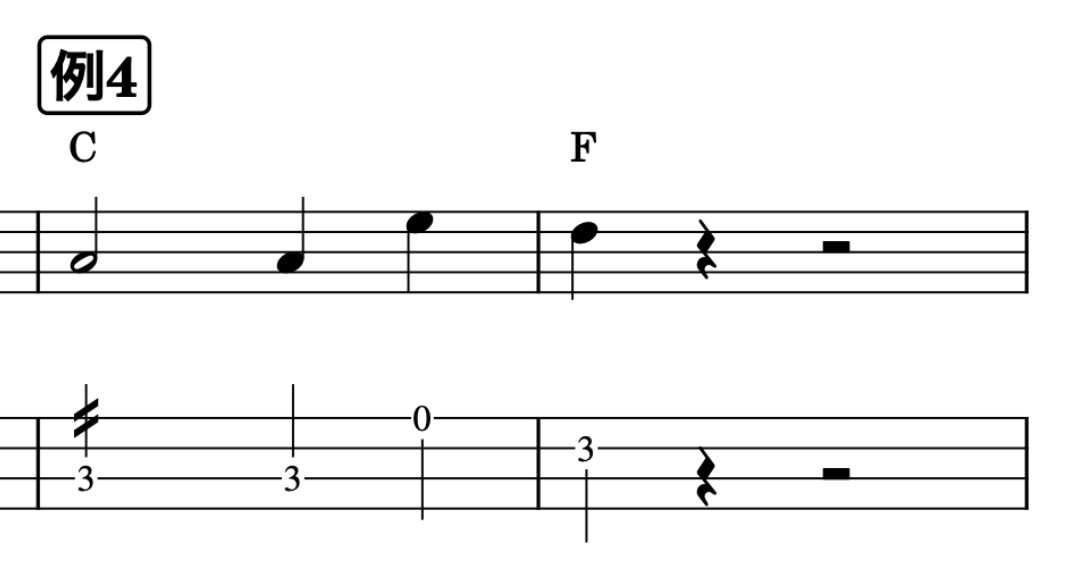
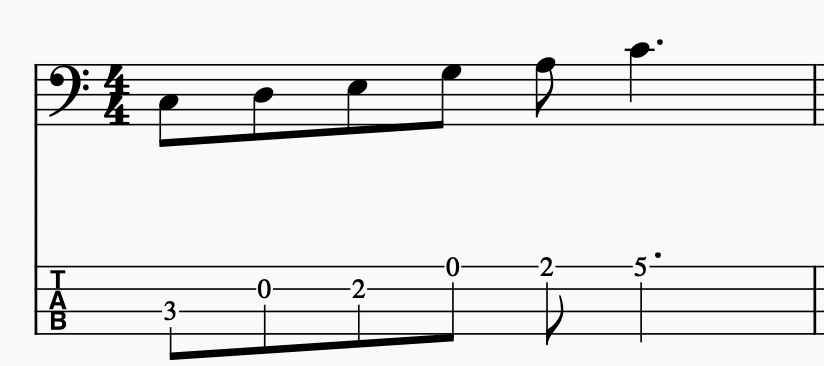
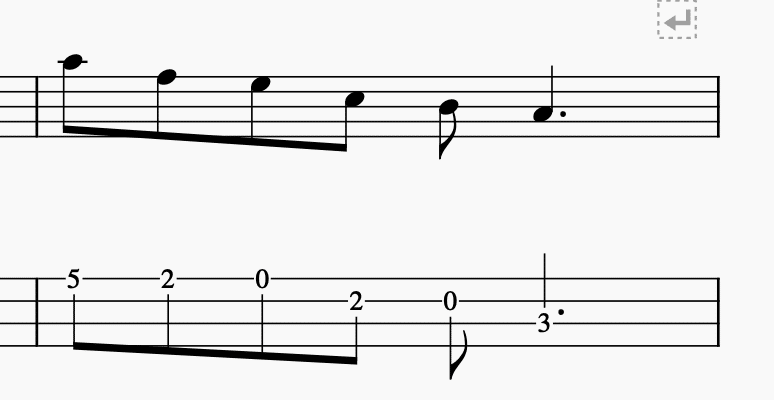
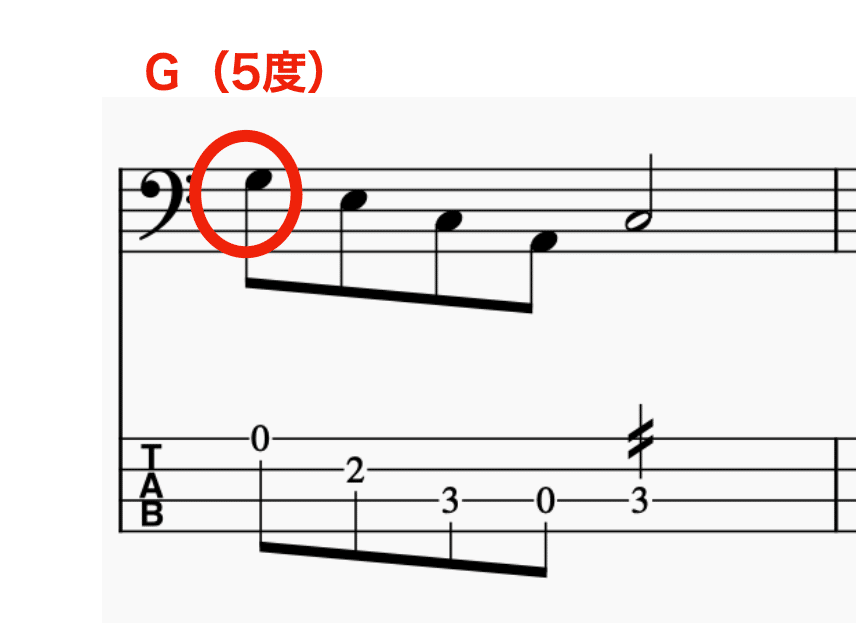
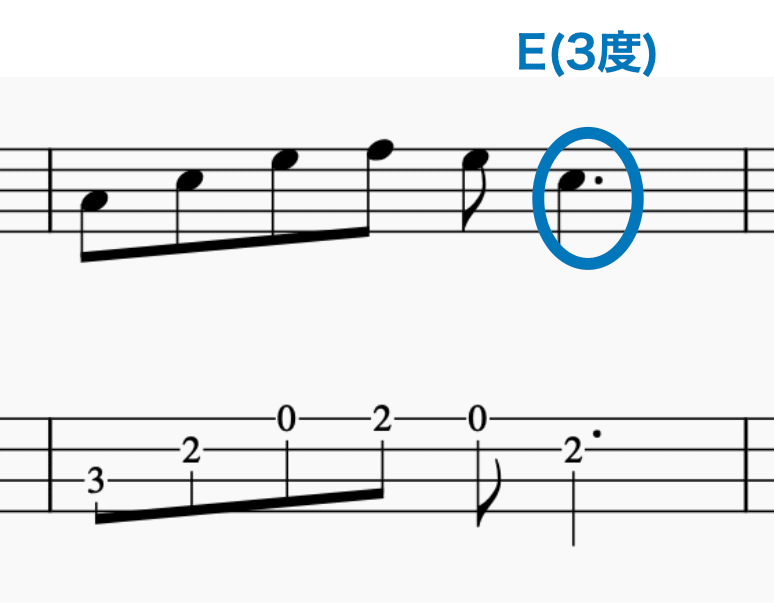
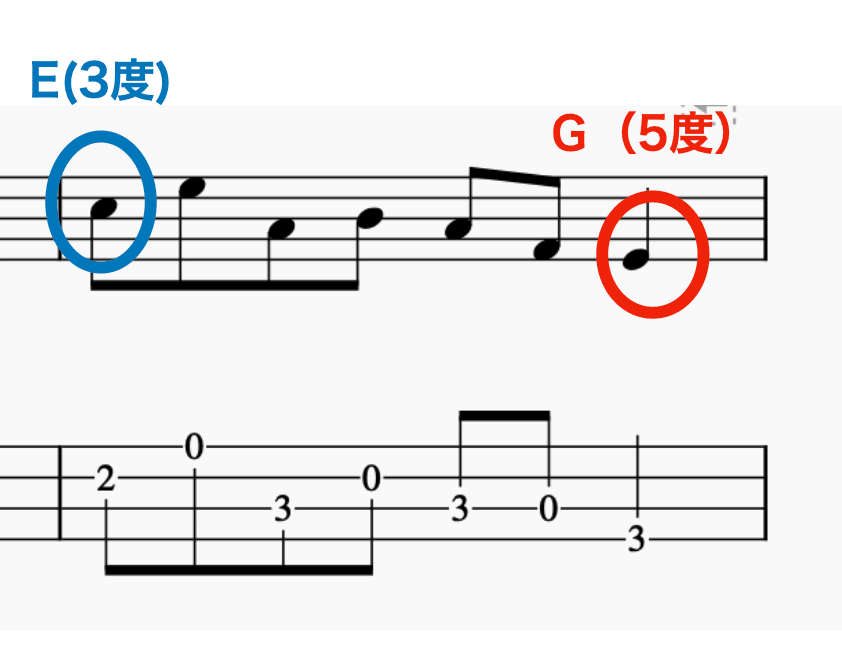
Take a C chord, for example. The 3rd — E — is available as the 2nd string, 2nd fret, or as the open 4th string. The 5th — G — is available as the 2nd string, 5th fret, or the 4th string, 3rd fret.
Theoretically, either choice is “correct.” But when you’re actually building a line, the deciding factor is playability.
Take this example: both versions pass through E on their way to landing on F, but when you actually play them, Example 1 feels noticeably more natural and easier to play.
Similarly, when moving from G to F, going from the open 4th string to the 4th string’s 3rd fret is the smoother fingering choice.
In other words, whether you go above or below with the 3rd or 5th really is case-by-case. Don’t just decide based on harmony or theory alone — factor in how easy it is to actually finger.
Working out the most playable fingering for your own lines on your own takes a lot of trial and error — a teacher can often spot the smoother option immediately.
Want Personalized Feedback on Your Playing?
This is exactly the kind of thing that’s hard to fix alone — and where having a teacher makes all the difference.
At Line on Bass, I offer an online lesson service where you send me a video of your playing, and I give you specific, detailed feedback — every single day if you want.
Students from around the world are using this to fix exactly these kinds of issues and steadily improve their jazz bass skills.
This article is written by Toru Hoshino, a jazz bassist and instructor based in Japan who teaches online lessons to students worldwide. In this article, he answers a question about how to keep pentatonic licks from sounding like a nursery rhyme.
Today’s question:
“How do I keep my pentatonic improvising from sounding like a children’s song?”
Pentatonic scales get talked about constantly, but depending on how you use them, they really can end up sounding like a simple folk tune or nursery rhyme.
For example, take a C major pentatonic scale and play it like this:
C-D-E-G-A-C (3rd string, 3rd fret up to 1st string, 5th fret)
C-A-G-E-D-C (1st string, 5th fret down to 3rd string, 3rd fret)
Try playing it straight up and down like that, with a bit of a bounce. Doesn’t it start to sound a little like a folk tune or nursery rhyme?
That’s not a coincidence — the five-note pentatonic scale really is heavily used in folk music and children’s songs, so it’s natural that it comes across that way.
That said, when you hear a great player use a pentatonic scale, it sounds completely different — genuinely cool. So with that in mind, here are three ways to dress up your pentatonic playing so it doesn’t sound naive.
How to Keep Pentatonic Licks From Sounding Like a Nursery Rhyme
1. Don’t treat the root as your anchor point
2. Start and land phrases on the 3rd or 5th
3. Work in the ♭7th or minor 3rd
1. Don’t Treat the Root as Your Anchor Point
In a C major pentatonic scale, you’ve got five notes: C-D-E-G-A.
The “straight up, straight down” patterns from earlier — C-D-E-G-A-C and C-A-G-E-D-C — both treat C, the root, as the anchor the phrase is built around.
Simply not anchoring your phrase around the root already goes a long way toward losing that nursery-rhyme quality.
So what should you do instead? Let’s get specific.
2. Start and Land Phrases on the 3rd or 5th
Starting and ending your phrases on the scale’s 3rd or 5th (rather than the root) tends to sound better. For example:
G-E-C-A-C… (starting the phrase on the 5th, G)
C-E-G-A-G-E… (ending the phrase on the 3rd, E)
E-G-C-D-C-A-G… (starting on the 3rd, ending on the 5th)
Shaping your phrases this way takes them even further from that simple, naive sound.
3. Work in the ♭7th or Minor 3rd
This one’s a slightly more advanced technique, but working in the ♭7th or minor 3rd makes your pentatonic playing sound noticeably cooler right away.
This particular technique is a bit much to fully explain in text, so this is one case where a demonstration genuinely helps — it’s the kind of thing that’s much easier to grasp by ear once you hear exactly what those added notes do to the line.
Used well, this technique can shift the whole character of your pentatonic playing — from something that leans folk and nursery-rhyme-like, toward something that sounds more like blues or country. It’s a great way to make pentatonic playing sound genuinely cool.
Hopefully this gives you some useful ideas for keeping your pentatonic playing from sounding too simple.
Hearing exactly when a phrase tips into “nursery rhyme” territory takes a trained ear — and that’s exactly the kind of thing a teacher can flag immediately in your own playing.
Want Personalized Feedback on Your Playing?
This is exactly the kind of thing that’s hard to fix alone — and where having a teacher makes all the difference.
At Line on Bass, I offer an online lesson service where you send me a video of your playing, and I give you specific, detailed feedback — every single day if you want.
Students from around the world are using this to fix exactly these kinds of issues and steadily improve their jazz bass skills.
This article is written by Toru Hoshino, a jazz bassist and instructor based in Japan who teaches online lessons to students worldwide. In this article, he breaks down the real differences between upright bass and electric upright bass.
This one’s for anyone thinking, “Should I get an upright bass, or an electric upright bass?”
I get asked “are upright bass and electric upright bass actually different?” constantly in lessons — and yes, they’re completely different instruments.
The short version: neither is “better” or “worse.” It comes down to this:
For authenticity: upright bass
For convenience: electric upright bass
What’s the Difference in Naming?
Let’s start by sorting out the terminology.
Upright Bass
In classical music, this is also called a “double bass” or “contrabass.”
Electric Upright Bass
Also called a “silent upright bass,” or abbreviated “EUB.”
What’s the Difference in Sound?
The sound is different.
Upright Bass
This is the instrument’s natural, acoustic sound.
Electric Upright Bass
This one is an electronically amplified sound.
Neither is better or worse. Which one you choose comes down entirely to personal taste — pick whichever matches the tone you’re going for right now. That said, there are real practical differences in portability, how it fits your situation, and visual presence, so let’s go through those.
Pros and Cons of Each
Upright Bass: Pros
Loud Natural Volume
Thanks to its large, hollow wooden body, an upright bass is genuinely loud acoustically. In a small enough venue, you can play unamplified and still be heard clearly by the audience, with the rest of the ensemble balancing around you.
Looks Great
A grand piano, an upright bass, and a drum kit together — there’s something great about that visual. Personally, it’s one of the more beautiful sights in the world, in my opinion.
Upright Bass: Cons
Heavy
It’s heavy and a real hassle to transport. Stations without an elevator will make you want to complain out loud. I’ve actually written before about everything I keep in mind when carrying an upright bass on the train — it’s a big enough headache that it became its own blog post.
Hard to Find a Place to Practice
Because the natural volume is so loud, you have to be picky about where you practice. Thin-walled apartments will get you noise complaints fast.
Electric Upright Bass: Pros
Easy to Transport
It packs down dramatically smaller (for example, the Yamaha SLB200V).
Some models even break down to fit into a backpack-style case. The body is generally much more compact than an upright bass, making it far easier to transport.
Practice Anywhere
Because the natural acoustic volume is so quiet, you can practice at home without issue.
Electric Upright Bass: Cons
Can’t Be Played Unamplified
Since the natural volume is so quiet, you absolutely need an amp to perform with it.
Less “Authentic” Feel Than an Upright Bass
It just doesn’t carry the same sense of authenticity as a real upright bass. Some players are particular about the acoustic texture of a real upright’s natural sound, and some don’t like how the amplified electronic tone blends with an acoustic piano. A lot of people will tell you the real wood instrument is simply better.
So, once again:
For authenticity: upright bass
For convenience: electric upright bass
Weigh these factors against your own situation, and if you’re seriously considering a purchase, it’s well worth having a thorough conversation with a music shop before you commit.
Whichever instrument you choose, the thing that actually moves your playing forward is consistent feedback — which is exactly what a teacher provides.
Want Personalized Feedback on Your Playing?
This is exactly the kind of thing that’s hard to fix alone — and where having a teacher makes all the difference.
At Line on Bass, I offer an online lesson service where you send me a video of your playing, and I give you specific, detailed feedback — every single day if you want.
Students from around the world are using this to fix exactly these kinds of issues and steadily improve their jazz bass skills.
This article is written by Toru Hoshino, a jazz bassist and instructor based in Japan who teaches online lessons to students worldwide. In this article, he shares a way to build chord recognition skills without even touching your instrument.
Normally, practice means picking up your bass and making sound. But there are plenty of days when work or errands make that impossible.
Here’s a way to train your ear, your theory knowledge, and your sense of the fretboard, all at once — without an instrument in hand.
The method is genuinely simple:
1. Loop a recording of a chord progression (for example, Dm → G7 → C)
2. While following the chords, say the note names and scale degrees to yourself in your head
3. Picture the fretboard positions and imagine your fingering
That’s it.
Here’s the important part, though: not many people actually do this properly. That’s exactly because it’s mentally tiring.
But that’s also exactly why it makes such a big difference when you actually do it. Of course, if you’re working through this on your own, you’ll need to set your own tempo and practice routine.
Still, if you commit to this kind of focused “mental workout,” it leads to real growth in:
Breaking free from relying on tab
Stronger chord recognition
Better walking bass and improvisation skills
It doesn’t matter where you are or how much time you have — you can do this one anywhere. Give it a try.
Building chord recognition like this on your own takes real discipline — a teacher can check whether what you’re hearing in your head actually matches what you’d play.
Want Personalized Feedback on Your Playing?
This is exactly the kind of thing that’s hard to fix alone — and where having a teacher makes all the difference.
At Line on Bass, I offer an online lesson service where you send me a video of your playing, and I give you specific, detailed feedback — every single day if you want.
Students from around the world are using this to fix exactly these kinds of issues and steadily improve their jazz bass skills.
This article is written by Toru Hoshino, a jazz bassist and instructor based in Japan who teaches online lessons to students worldwide. In this article, he recommends the free notation software he’s used for years.
One question I get a lot is: “What notation software do you use?” Here’s my answer, along with what I like about it.
The software I use is called MuseScore.
It’s free on both Mac and Windows, and I’ve used it for years. It’s apparently usable from phones and tablets too, but I mainly work with it on a PC.
Here are the three things I like most about it:
1. Automatic tab conversion
2. Playback of whatever you write
3. Choice of instrument tone for playback
1. Automatic Tab Conversion
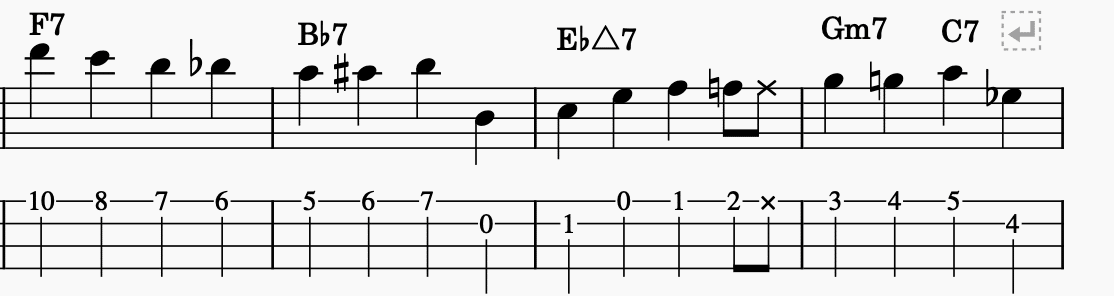
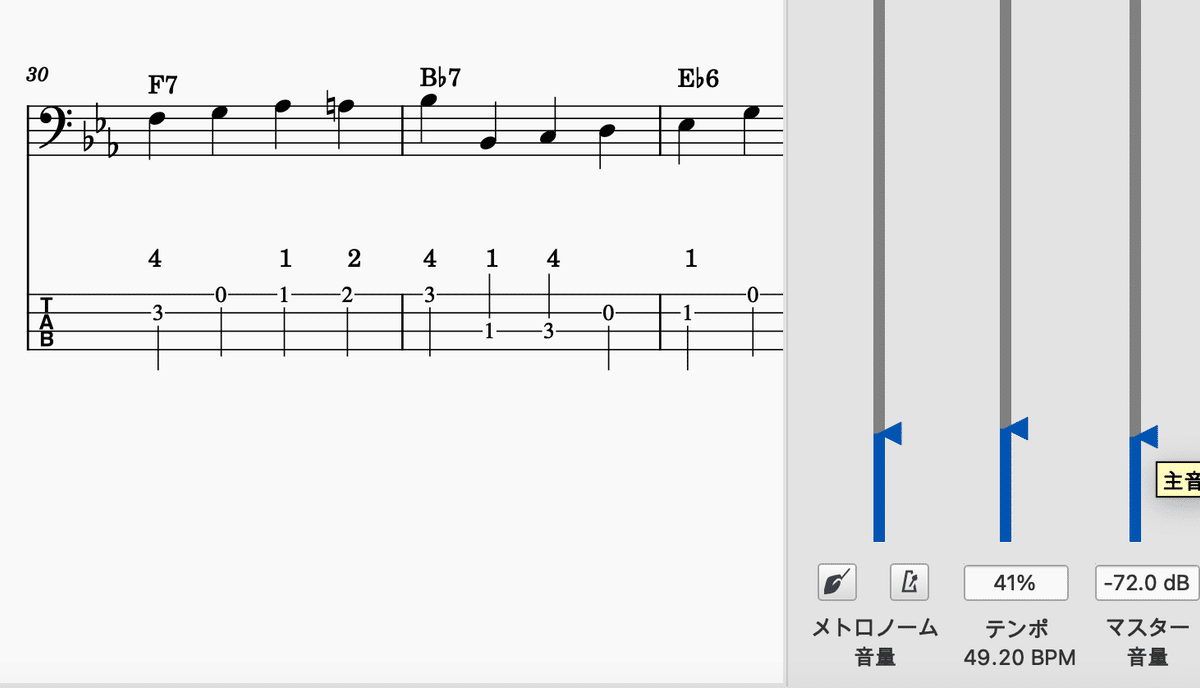
Whatever bass line you input gets automatically converted into tab. Input a C note, for example, and it automatically maps it to the 5th fret on the 3rd string for you.
2. Playback of Whatever You Write
Whatever you write can be played back instantly, so you can check how a phrase or bass line feels without having your instrument in hand.
I also like that you can input chords and have the chord backing play back with one click.
3. Choice of Instrument Tone
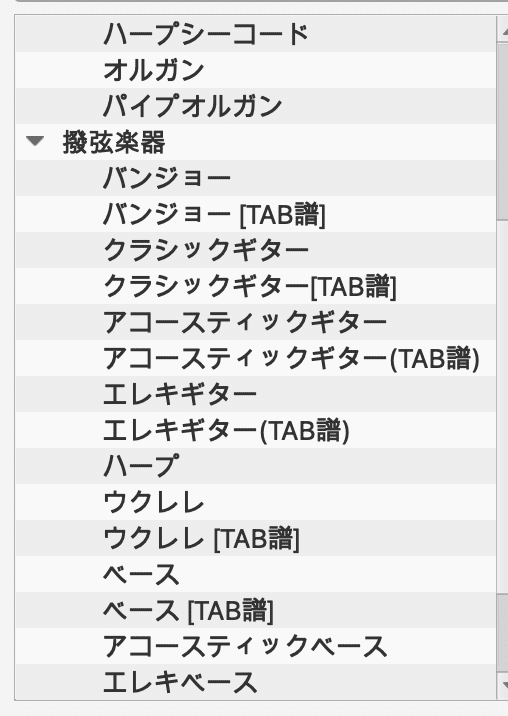
You can also pick the playback tone by instrument — piano, bass, guitar, and so on. For bass specifically, you can choose between electric and upright tone.
Every piece of sheet music I publish on YouTube is made with this software. Since it’s free, if you’re on the hunt for good notation software, it’s well worth trying.
Writing out your own bass lines is great practice — having someone check whether what you wrote actually works musically is exactly where a teacher comes in.
Want Personalized Feedback on Your Playing?
This is exactly the kind of thing that’s hard to fix alone — and where having a teacher makes all the difference.
At Line on Bass, I offer an online lesson service where you send me a video of your playing, and I give you specific, detailed feedback — every single day if you want.
Students from around the world are using this to fix exactly these kinds of issues and steadily improve their jazz bass skills.
This article is written by Toru Hoshino, a jazz bassist and instructor based in Japan who teaches online lessons to students worldwide. In this article, he breaks down a walking bass line he recorded on upright bass for the jazz standard “Someday My Prince Will Come.”
A Walking Bass Line Over “Someday My Prince Will Come”
What I Was Thinking About While Building This Line
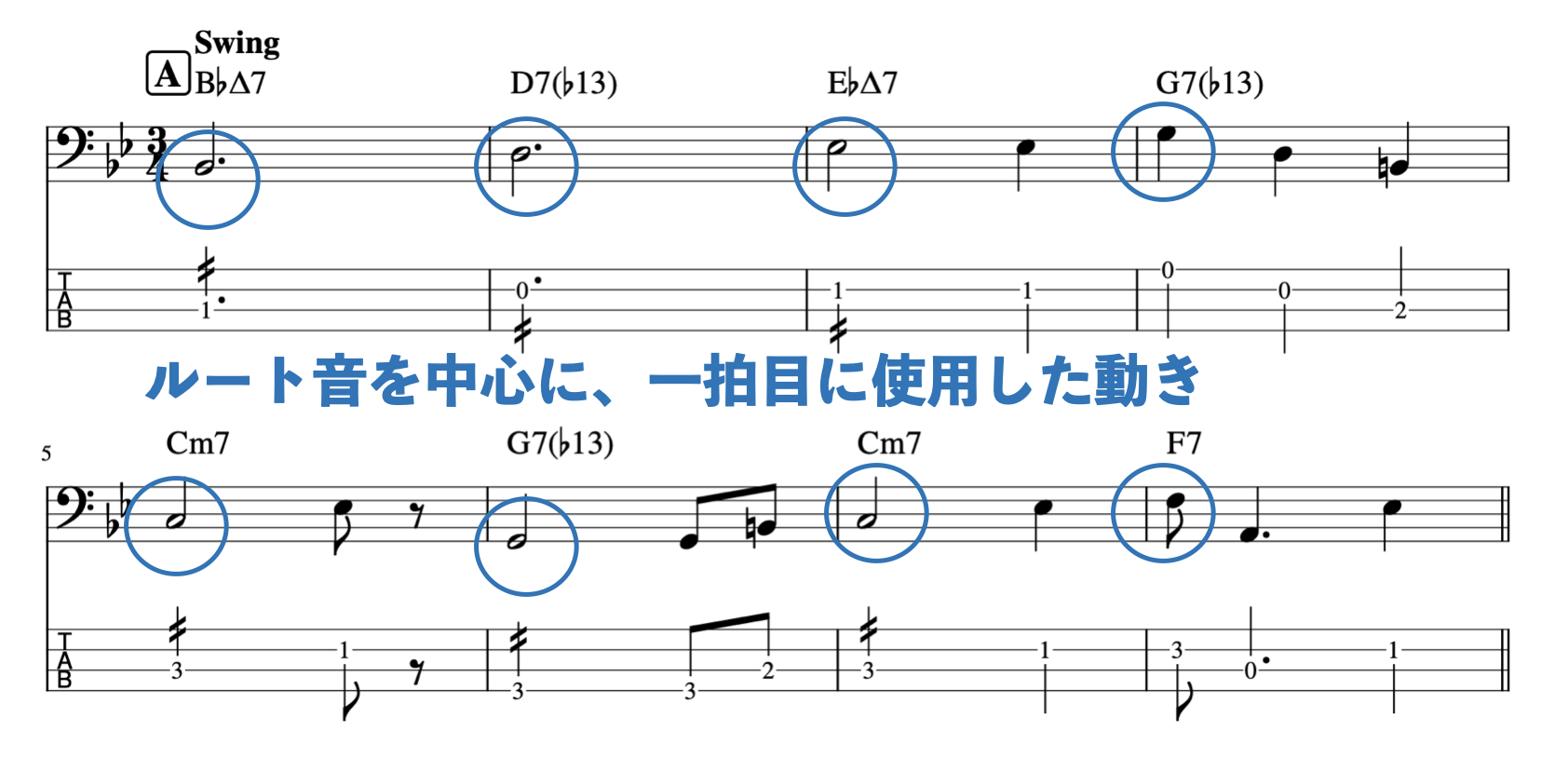
1. Root-Centered Motion
I anchored beat 1 of each bar with the root for stability, while keeping beats 2 onward from feeling overstuffed — letting the line breathe rather than cramming in too much motion. Instead of moving busily through every beat, I focused on letting the chord’s foundational tones ring out longer, which gives the phrase more room to relax.
I also used rests deliberately to create some space, which keeps the line feeling like it swings even though it’s quite simple.
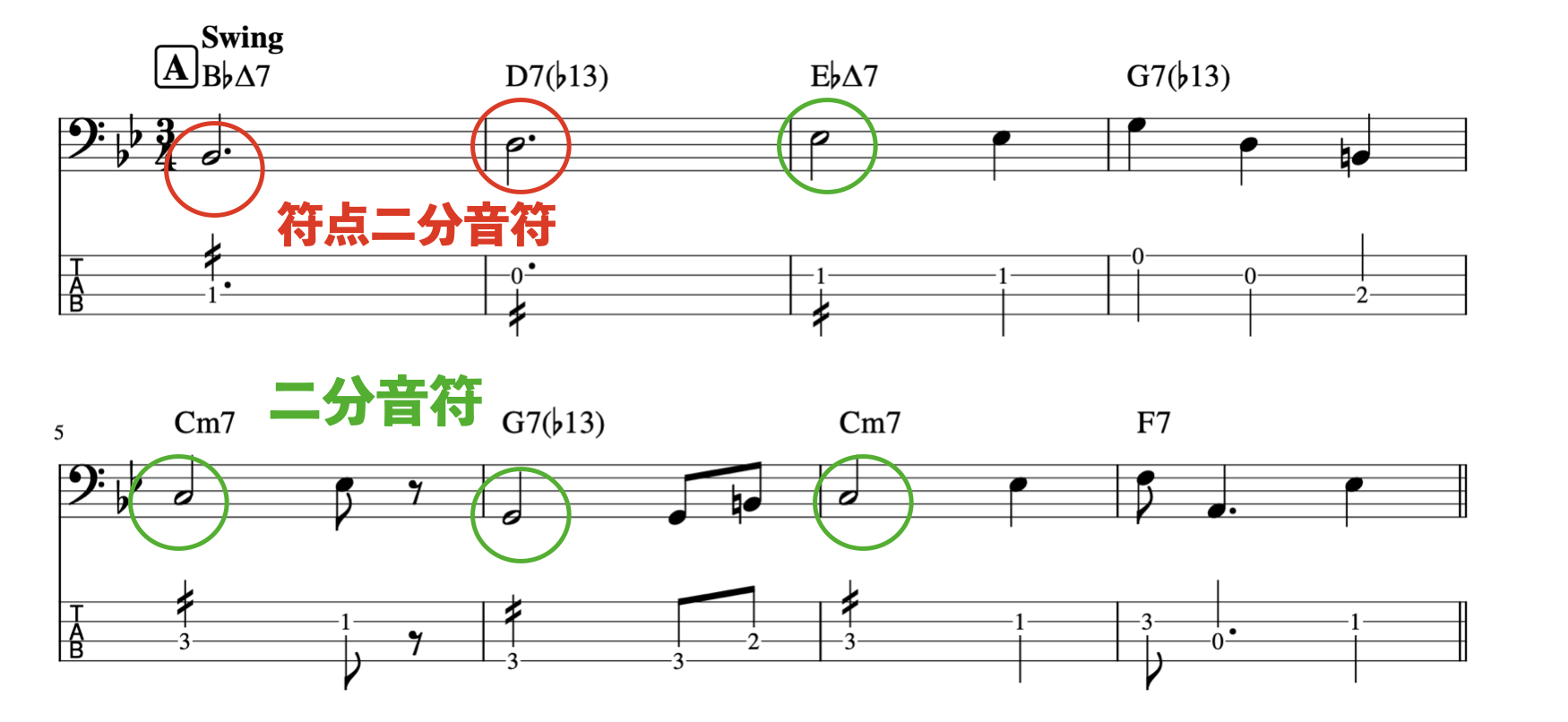
2. Half Notes and Dotted Half Notes
By building the line mostly around half notes and dotted half notes, I kept it flowing without feeling choppy. With the root solidly on beat 1, I prioritized “letting the note ring” over constant movement, which gives the whole phrase a relaxed, unhurried quality.
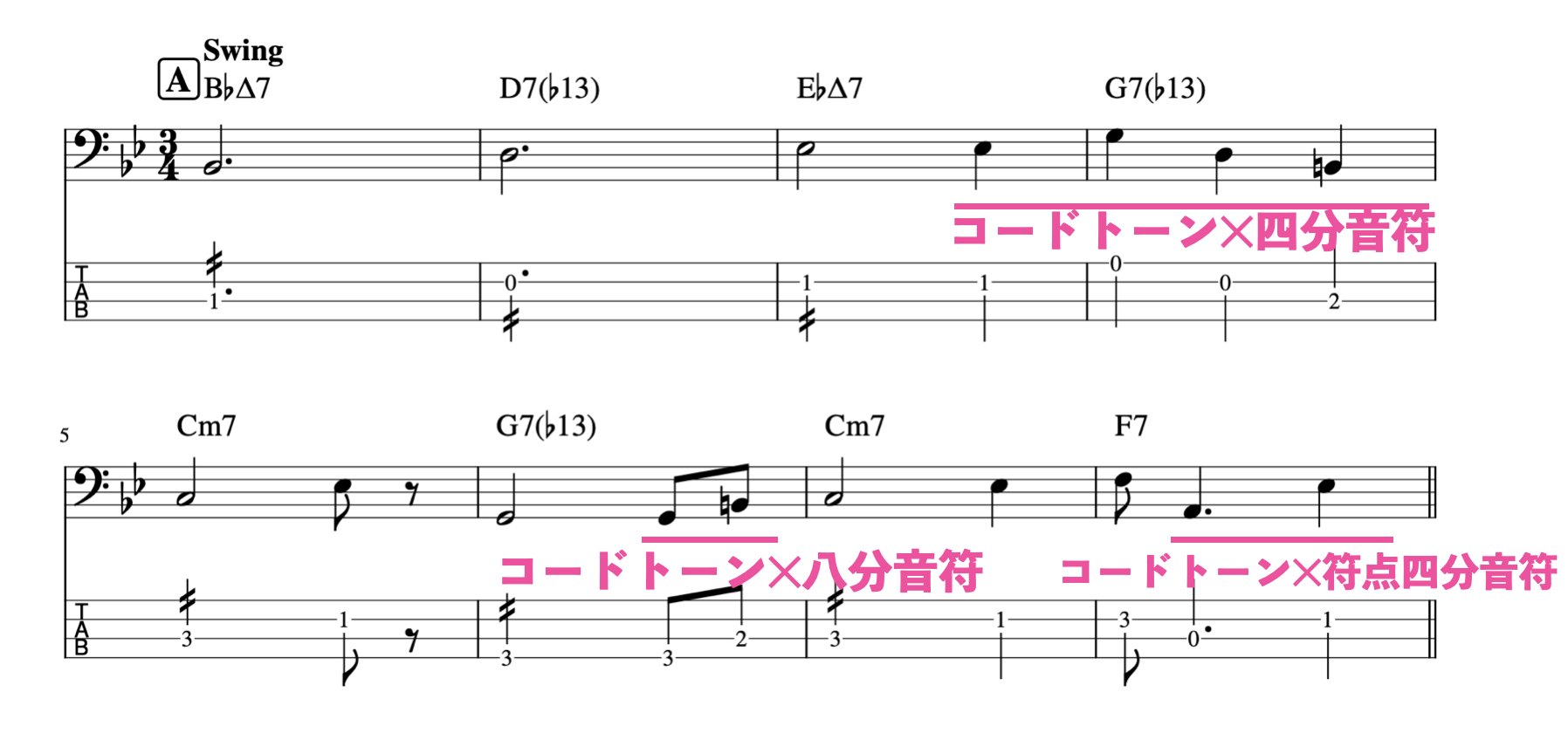
3. Where to Add Fills
With the root and half notes forming the foundation, I added “fills” only where they were needed. For example, using quarter-note chord tones to keep the motion going, eighth notes to add a bit of movement, or dotted quarters to add some rhythmic punch. The root and chord tones stay at the center of the phrase throughout, with short fills slipped in between — adding variation to the line without losing its simplicity.
A Reference Recording
The reference recording for this one is Miles Davis’s “Someday My Prince Will Come.” On this track, the bassist holds the root down firmly while weaving in just the right amount of understated fills, supporting the whole tune’s swing feel.
Listen for how the bass line places the root firmly on beat 1 for stability, then adds small quarter-note chord tones and eighth-note motion from beat 2 onward to avoid sounding monotonous, while still flowing naturally. Notice too how the occasional dotted rhythm gives the phrase its own subtle lilt.
It’s simple, but the way rests and held notes are used to create space is what makes the fills land so effectively. When you practice this, rather than just copying the notes, it helps to really listen for that balance — building a solid foundation on the root, and adding variation only where it’s needed.
Hopefully this gives you something useful for your own playing.
Hearing exactly where to add a fill — and where to leave space instead — is something a teacher can point out immediately in your own playing.
Want Personalized Feedback on Your Playing?
This is exactly the kind of thing that’s hard to fix alone — and where having a teacher makes all the difference.
At Line on Bass, I offer an online lesson service where you send me a video of your playing, and I give you specific, detailed feedback — every single day if you want.
Students from around the world are using this to fix exactly these kinds of issues and steadily improve their jazz bass skills.
This article is written by Toru Hoshino, a jazz bassist and instructor based in Japan who teaches online lessons to students worldwide. In this article, he recommends seven practice gadgets worth trying when you need a change of pace.
1. A Ukulele Bass
The first time I saw one of these, I thought “wait, this exists?” It’s a compact bass with an acoustic-style build — perfect when you want to play quietly and casually. Affordable too, and great for quick practice sessions or just changing things up.
2. “CamScanner” for Organizing Sheet Music
If your sheet music pile is getting out of control, this is for you. It lets you manage all your paper sheet music from your phone or iPad in one place. It’s free, so if you use a tablet, it’s worth trying.
3. “Bag on Bag”
An add-on bag that clips onto your gig bag in one motion. Handy for carrying a change of clothes or small items for the studio without extra hassle.
4. Headphone Covers
These protect the headphones you use for practice, helping prevent the foam from cracking and extending their life.
A cleaner you apply to your strings to slow down their degradation. With string prices on the rise, this is a great way to keep your tone fresh without burning through cash.
A wall mount you can install with just a couple of screws to hang your bass up. Works fine in a rental apartment too, and it’s sturdy.
A Rain Cover for Your Bass
Stay worry-free even in the rain — this is a dedicated rain cover that goes over your whole case. It protects your case from rain and humidity, making it a solid ally when you’re transporting a bass you care about. Great for biking or walking to lessons or rehearsal without worrying about getting soaked.
Highly water-resistant, protects your case fully
Folds up small for easy carrying
Great for biking or walking
That’s seven practice gadgets worth trying when you want a little change of pace. Add a bit of variety to your daily routine and keep things fun.
Gadgets like these make practice more enjoyable — but real progress comes from someone who can tell you exactly what to work on next.
Want Personalized Feedback on Your Playing?
This is exactly the kind of thing that’s hard to fix alone — and where having a teacher makes all the difference.
At Line on Bass, I offer an online lesson service where you send me a video of your playing, and I give you specific, detailed feedback — every single day if you want.
Students from around the world are using this to fix exactly these kinds of issues and steadily improve their jazz bass skills.