This article is written by Toru Hoshino, a jazz bassist and instructor based in Japan who teaches online lessons to students worldwide. In this article, he breaks down seven different ways to build a walking bass line over the same chord progression.
The progression used throughout this lesson is Em7 → A7 → Dm7 → G7, looped over and over. Trying out different approaches to walking bass on a single repeating progression is a great way to expand your vocabulary — work this into your daily practice and you’ll start hearing a lot more options open up in your own lines.
Performance Video: 7 Variations on a 4-Beat Bass Line (With Tab)
What I Was Focused on in Each Variation
1. Building from Chord Tones (0:32)
The most basic foundation for any walking bass line is chord tones. Start by balancing the root, 3rd, 5th, and 7th of each chord as you build your line — this is the base that every other approach builds on.

2. Adding Scales (0:46)
Layering scale tones on top of chord tones smooths out the line’s motion. With more notes available, you get more freedom and a more natural-sounding flow.

3. Reaching Into a Slightly Higher Register (1:03)
Try working in the 7th–11th fret range. Once you’re comfortable using the mid-register and not just the low end, your range of variations multiplies.

4. Syncopation (1:16)
Adding syncopation injects rhythmic motion into an otherwise quarter-note-driven line. Weaving in eighth notes or dotted quarters against the 4-beat feel creates a much more expressive rhythmic character.

5. Working in Ghost Notes (1:32)
Ghost notes — non-pitched percussive hits — add a percussive nuance to your rhythm. Even a small amount goes a long way toward boosting the groove and feel of the line.

6. High-Position Approaches (1:48)
One of walking bass’s flashier techniques is approaching a chord from a high position on the neck. It looks effortless when done well, but it isn’t something you can improvise cold — it takes some dedicated prep work before you can use it freely.

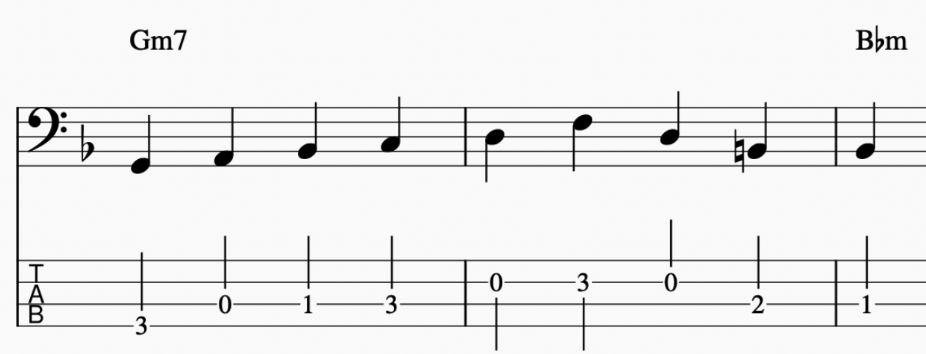
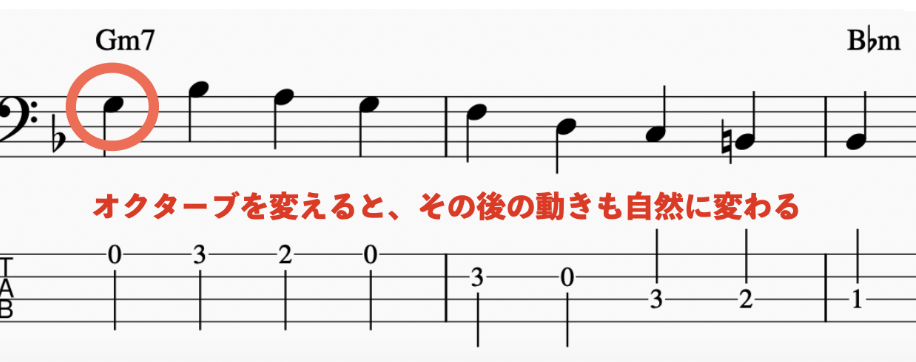
7. Starting the Bar on a Note Other Than the Root (2:02)
You don’t always have to land on the root on beat 1. Starting from a different chord tone — say, the 3rd or the 5th — makes the line flow more smoothly and gives it a more distinctly jazz-like character.

A lot of players assume the root has to land on beat 1 — and as a foundation, that’s absolutely correct. But once you’re comfortable with the basics, starting on the 3rd or 5th instead, in service of a smoother line, becomes a real option. I find this works especially well in jazz walking bass compared to rock or funk lines. That said, treat this as something to add once your fundamentals are solid, not something to reach for right away.
Summary
Walking bass opens up once you start combining chord tones, scales, register choices, rhythmic devices, ghost notes, position shifts, and approach notes. Try working these seven techniques into your practice a little at a time, and you’ll steadily build out your own bag of tricks.
A Question I Got Afterward
“What should I do when I can’t think of a walking line in the middle of a session?”
This depends a lot on your current skill level, but the most important thing is usually: don’t try to do anything too advanced right out of the gate.
People often imagine walking bass requires a constant variety of note choices and rhythms — and sure, if you listen to a great player, that’s exactly what you hear. But early on, just being able to use:
- The root
- The 5th
- The octave
- Chromatic approach notes
is enough to build a line that sounds reasonably convincing. I’d recommend prioritizing getting comfortable with just these first. If you push yourself to play something unusual too soon, your time can fall apart and your rhythm gets shaky.
In an actual session, a steady, in-tune line matters a lot more than a clever one — and it’s what the rest of the band is actually counting on you for. Once you’ve got some breathing room, start layering in 3rds and 7ths, and gradually expand your note choices from there.
Working through all seven of these on your own is a lot to juggle — a teacher can usually tell you exactly which one to focus on next for your playing specifically.
Want Personalized Feedback on Your Playing?
This is exactly the kind of thing that’s hard to fix alone — and where having a teacher makes all the difference.
At Line on Bass, I offer an online lesson service where you send me a video of your playing, and I give you specific, detailed feedback — every single day if you want.
Students from around the world are using this to fix exactly these kinds of issues and steadily improve their jazz bass skills.