Posted on Leave a comment

The Harmonic Minor Scale on Bass, Explained

This article is written by Toru Hoshino, a jazz bassist and instructor based in Japan who teaches online lessons to students worldwide. In this article, he breaks down how to play the harmonic minor scale on bass.

You may have come across the terms “harmonic minor” or “melodic minor” in a method book, but a lot of players aren’t quite sure what they actually are or where you’re supposed to use them.

Let’s get into the details.

An Overview of the Harmonic Minor Scale

This shape here is what’s called the “natural minor scale” — your standard minor scale.
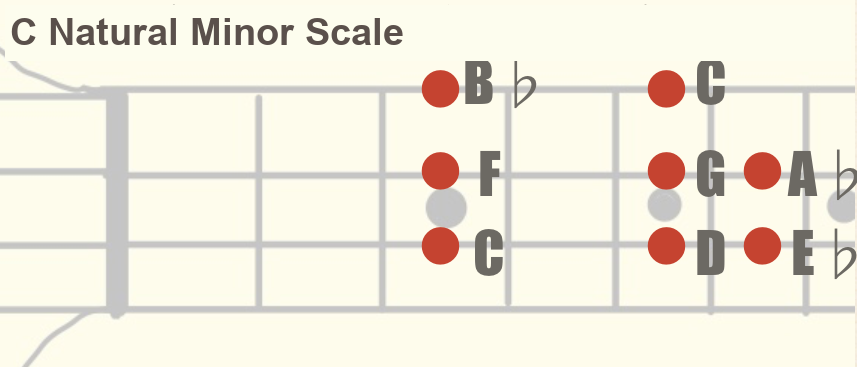
Raise the 7th note of the natural minor by a half step, and you get the harmonic minor scale.
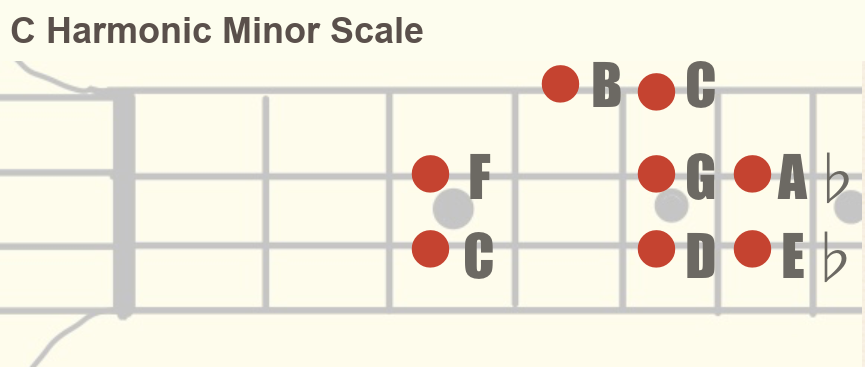
What makes this harmonic minor scale distinctive is the sound created between B and A♭.

Here’s what it sounds like when I emphasize the B and A♭:

Try playing this scale yourself and really listen for that A♭-to-B sound.

At this point you might be thinking: “Okay, that’s what the book says, and I get how the shape differs from the natural minor scale — but where would I actually use harmonic minor?”

Let’s get into that.

How to Think About Using Harmonic Minor

Let’s try playing harmonic minor over a static Cm progression — a single minor chord with no other chord changes.

Here’s an approach that emphasizes the A♭ and B notes while moving up and down the scale.

That really locks in with the chord, doesn’t it?

When You Think “Harmonic Minor Might Fit This Tune”

Harmonic minor is an approach I personally reach for a lot whenever I run into a chord that’s basically just “one minor chord held for a while” like this — and it’s a common device in jazz improvisation generally.

It’s rare to see harmonic minor explicitly written into a chart (like a “Cm△7” symbol) — it’s really more a matter of:

“This tune feels like it could take harmonic minor,” and then just going for it on your own judgment.

From a theory standpoint: thinking of C natural minor as a four-note chord gives you C, E♭, G, B♭. Thinking of C harmonic minor as a four-note chord gives you C, E♭, G, B — and you might assume that clashes. But that clash is actually considered part of its character.

That said, harmonic minor is a strong-flavored scale. Using it well requires understanding its sound and judging for yourself whether it actually fits the tune.

If it sounds good to you, go ahead and use it freely.

For reference, jazz standards where I personally reach for it a lot include:

“Softly, as in a Morning Sunrise”
“Blue Bossa”
“You’d Be So Nice to Come Home To”

Lastly, here’s harmonic minor played over a progression like the one used in “Softly, as in a Morning Sunrise.” The earlier example packed notes in pretty mechanically, so this time I focused more on leaving space.

Listen for that A♭-and-B sound as a reference point.

I hope this gives you a useful new color to reach for in your solos — and once the sound feels familiar, getting feedback on how you’re actually applying it is the natural next step.

Want Personalized Feedback on Your Playing?

This is exactly the kind of thing that’s hard to fix alone — and where having a teacher makes all the difference.

At Line on Bass, I offer an online lesson service where you send me a video of your playing, and I give you specific, detailed feedback — every single day if you want.

Students from around the world are using this to fix exactly these kinds of issues and steadily improve their jazz bass skills.

Check Out the Lesson Service →

Posted on Leave a comment

An Easy F Blues Bass Solo Using the Minor Pentatonic

This article is written by Toru Hoshino, a jazz bassist and instructor based in Japan who teaches online lessons to students worldwide.

Have you ever gone to a jam session and gotten called on for a bass solo you had no idea how to play?

When you’re just starting out, you really have no idea what you’re even supposed to do during a bass solo.

This article is for:

  • Anyone playing jazz for the first time
  • Anyone just starting out on jazz bass
  • Anyone who has absolutely no idea how to approach a bass solo

This time, I want to introduce a note set that lets you sound convincingly “bluesy” with very little effort, over an F blues chord progression: the minor pentatonic.

An F Blues Bass Solo Using “Minor Pentatonic + ♭5”

Here’s an F blues solo I played using this approach.

Doesn’t that have a bit of a “bluesy” sound to it?

This is a scale (a set of notes) that makes a blues tune sound the part.

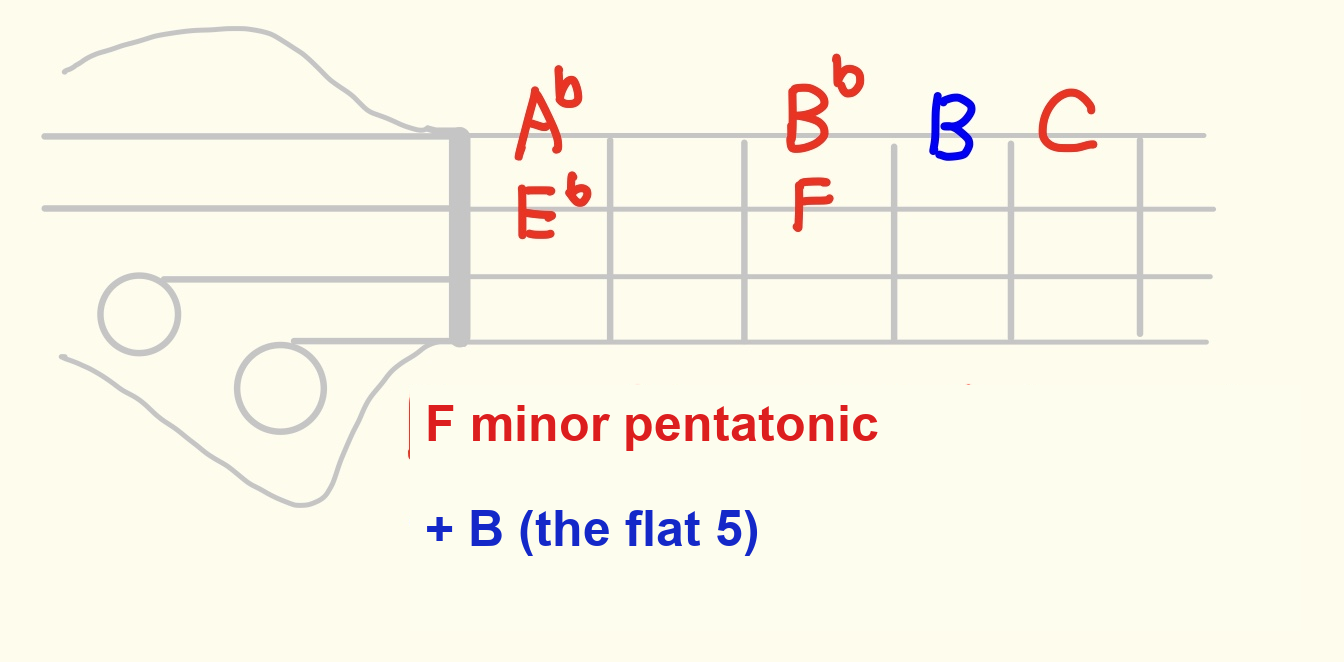
The notes I’m playing are just these six:

F (root)
A♭ (minor 3rd)
B♭ (4th)
B (♭5)
C (5th)
E♭ (minor 7th)

That’s it.

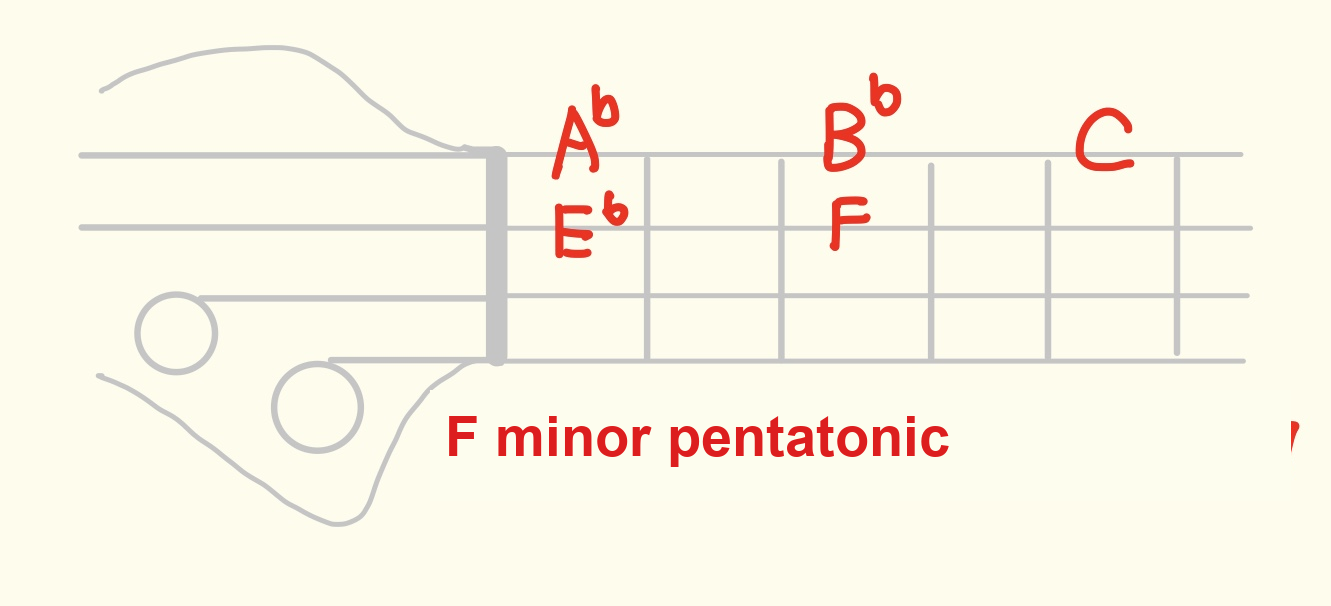
F’s minor pentatonic scale is:

F (root)
A♭ (minor 3rd)
B♭ (4th)
C (5th)
E♭ (minor 7th)

— those 5 notes. Mix in:

the note B (F’s ♭5), and you get that bluesy sound.

The full name is something like “minor pentatonic scale plus flat 5,” but that’s a mouthful, so I’ll just call it the “minor pentatonic” here.

The defining feature of this minor pentatonic is:

It sounds convincingly “bluesy” no matter where you start or stop.

Example: Phrases You Can Use

I built some phrases by combining these six notes.

• Starting on B:

Moving: B → B♭ → A♭ → F.

• Holding the B note:

Moving: F → A♭ → B♭ → B.

• Starting on A♭:

Moving: A♭ → F → E♭ → F.

• Holding the A♭ note:

Moving: F → B → B♭ → A♭.

And just combining those four phrases together gets you this:

— and it already sounds convincingly “bluesy.”

Taking It Further

From here on is the advanced section.

Blues bass solos often go on for several choruses.

Staying in just one position the whole time takes a fair amount of rhythmic variation to keep interesting, so let’s expand your options by adding positions an octave below and an octave above.

The Pentatonic Scale, an Octave Down and an Octave Up

If you broaden your view like this, here’s how many positions become available to you:

Memorizing all of it is a lot, so personally, I mostly rely on the range highlighted in yellow here:

How to Add Variation Using Register

Let’s try adding variation by changing register.

For example, play around the 3rd and 4th strings in the low frets for the first chorus.

For the second chorus, move to the low frets on the 1st and 2nd strings.

For the third chorus, play slightly higher notes on the 1st and 2nd strings.

Also keep your note density lower toward the beginning and build it up toward the end.

Shaping the dynamics this way makes the whole thing sound a lot more polished.

Notes That Sound Distinctly “Bluesy”

Looking at the fretboard below, which spots do you think sound like a distinctly “bluesy” color?

I ask this in lessons fairly often, and most people point to these two circled notes.

Relative to the root F, these two circled notes are called “blue notes” (yes, as in the name of the famous jazz club).

Using these blue notes makes it much easier to get that gritty, “bluesy” feeling into your sound.

Some F blues tunes that come up often at sessions include:

“Now’s the Time”
“Straight, No Chaser”
“Bags’ Groove”
“Billie’s Bounce”
“Au Privave”

“Bags’ Groove” in particular has a tempo that isn’t too fast, and plenty of phrasing worth studying, so definitely give it a listen.

I hope this gives you a solid starting point for your next blues solo — and once the minor pentatonic feels comfortable, getting feedback on how you’re actually applying it is the natural next step.

Want Personalized Feedback on Your Playing?

This is exactly the kind of thing that’s hard to fix alone — and where having a teacher makes all the difference.

At Line on Bass, I offer an online lesson service where you send me a video of your playing, and I give you specific, detailed feedback — every single day if you want.

Students from around the world are using this to fix exactly these kinds of issues and steadily improve their jazz bass skills.
Check Out the Lesson Service →

Posted on Leave a comment

A Bass Solo Over ‘All of Me’: Phrasing Breakdown

This article is written by Toru Hoshino, a jazz bassist and instructor based in Japan who teaches online lessons to students worldwide. In this article, he plays and breaks down a bass solo improvised over the chord progression to “All of Me”.

A Bass Solo Over “All of Me”

Here’s a solo I played over it.

Let me walk through the phrasing and the thinking behind how I built it.

What I Focused On While Building This Solo

Connecting the First Note of Each Bar Through Chord Tones

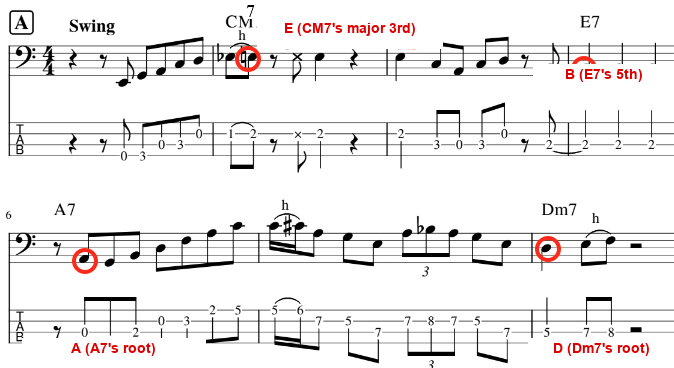
My basic approach was to connect the first note of each new bar using a chord tone from that bar’s chord.

Bar 1 starts on the major 3rd of CM7, E. From there, I connect to the 5th of E7 in bar 3, B. Then bar 5 connects to the root of A7, A… and so on.

Leaning Heavily on Hammer-Ons

Hammer-ons are key to getting that jazz phrasing to feel right. I use them a lot, even just in the first half.

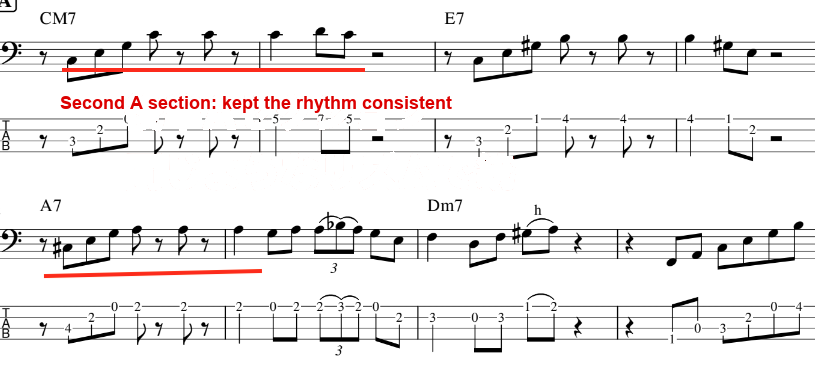
Repeating a Similar Rhythmic Pattern

For the first eight bars of the second A section, I built the phrasing around a repeating rhythmic pattern, to give that stretch a sense of cohesion.

Adding the ♭9 Over Dominant Seventh Chords

For example, over the A7 in bar 6 of the A section, I add the ♭9, B♭.

And over the G7 in bar 8 of the B section, I add its ♭9, A♭.

Adding the ♭9 over dominant 7th chords like this is a very common approach in jazz phrasing.

There are some other go-to phrases worth covering too.

Go-To Phrases Worth Having for Sessions

Go-To Phrase #1

In bars 1–2 of the C section, there’s an F△7 → Fm7 progression. This is a phrase I reach for often whenever a progression like this moves between the major and minor version of the same key.

It moves: 5th → 3rd → 2nd → root → 5th → ♭3rd → 2nd → root.

I cover this same-key major/minor approach in more depth in another video:

Go-To Phrase #2

Over the Dm7 → G7 in the C section, I use the phrase below — a classic “two-five phrase” that’s great for creating a sense of resolution, and one I reach for constantly.

I hope these phrases find their way into your own playing — and turning ideas like these into something you can pull off confidently on the spot is exactly the kind of thing that benefits from outside feedback.

Want Personalized Feedback on Your Playing?

This is exactly the kind of thing that’s hard to fix alone — and where having a teacher makes all the difference.

At Line on Bass, I offer an online lesson service where you send me a video of your playing, and I give you specific, detailed feedback — every single day if you want.

Students from around the world are using this to fix exactly these kinds of issues and steadily improve their jazz bass skills.
Check Out the Lesson Service →

Posted on Leave a comment

Triads: How to Break Free From One-Scale Improv Soloing

This article is written by Toru Hoshino, a jazz bassist and instructor based in Japan who teaches online lessons to students worldwide. In this article, he shares how using triads — not just scales — can take your improvised bass solos to the next level.

This article is for you if:
✅️ You’re not sure how to structure an improvised solo
✅️ You want fresh ideas for building solo lines
✅️ You’re just getting started with jazz bass

Triad Soloing: The Big Picture

This time, we’re going to practice building improvised solos using triads.

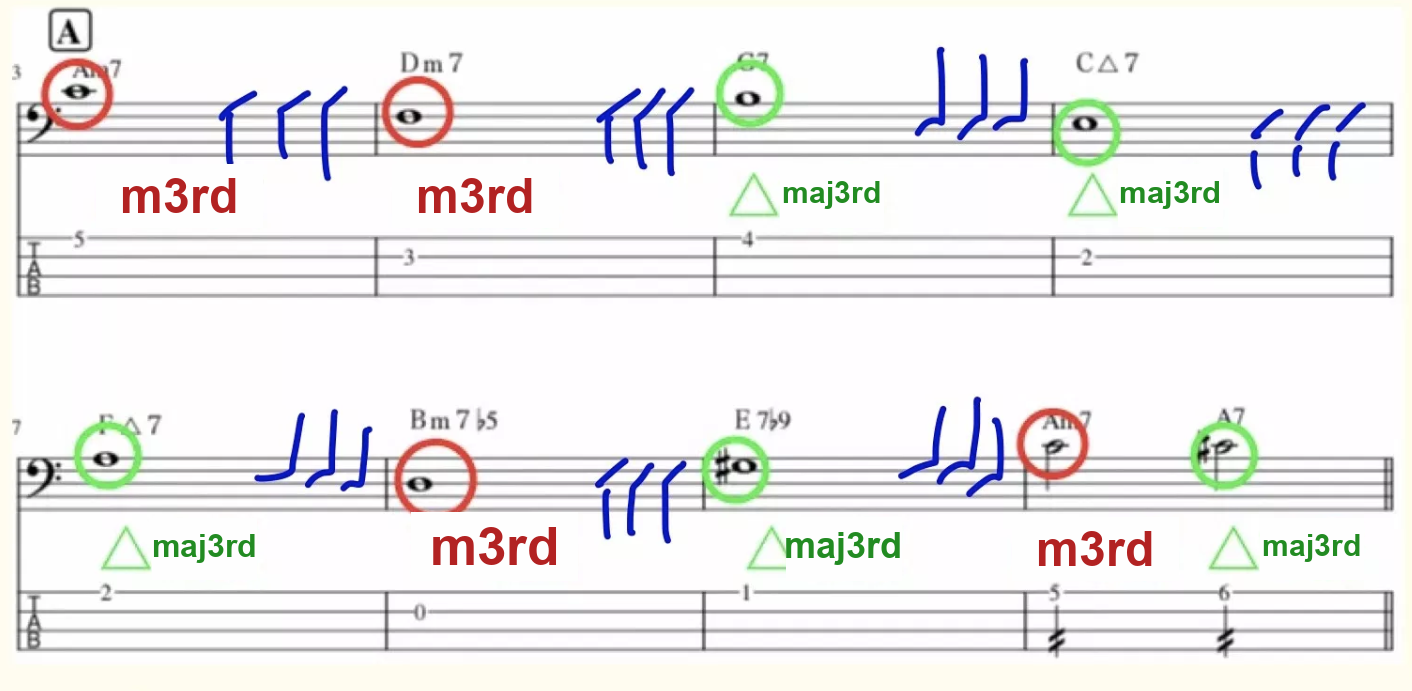
In a previous lesson, I explained that if you can instantly picture the 3rd of each chord as it goes by, and connect those 3rds together, your lines start to sound melodic.

But I never actually explained what notes you should use to connect those 3rds together. That’s what we’re covering today.

Notation showing minor 3rd and major 3rd connections between chords


↑ That’s the idea from last time — using the 3rd of each chord as an anchor point. This time, we’ll take it further: use the notes of the triad to connect one 3rd to the next.

What Is a Triad, and Why Does It Matter for Improvising?

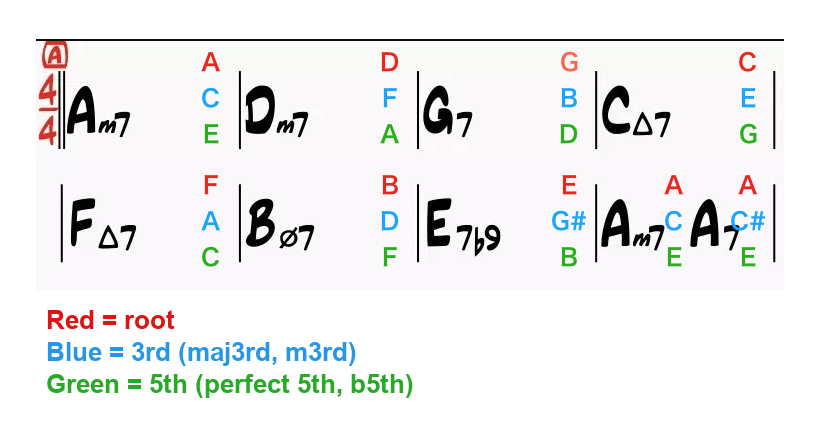
Chord tones are usually described as the root, 3rd, 5th, and 7th. From here on, we’ll focus specifically on the three notes that make up the basic triad: the 1st, 3rd, and 5th.

This three-note chord — root, 3rd, and 5th — is called a “triad.”

Here’s what the triad looks like for each chord in this progression:

Triad chart showing root, 3rd, and 5th for each chord

Now, start each bar on the 3rd of the chord, and connect those notes using the triad. It sounds like this:

(Example 1)

(Example 2)

As I mentioned last time, just connecting the 3rds and filling in the notes between them more or less freely will already sound reasonably good. But doesn’t it feel like the sound gets a lot more solid and intentional once you connect them specifically through the triad?

To be clear, an improvised solo doesn’t have to be built entirely out of triads. But being conscious of the triad really helps in situations like:

When you want to bring out the chord sound more clearly

When you want to weave in tension notes

When you want your solos to break free from the “one scale fits all” approach

Keeping the triad in mind matters for all of these.

The Skeleton of the Chord: What the Triad Does for You

Again — an improvised solo doesn’t have to be built only from triads.

If you’ve got a C△7 chord, you might play the diatonic scale (do-re-mi-fa-so-la-ti-do), or you might play a pentatonic line (do-re-mi-so-la-do). Both are valid.

That said, the more your phrase leans on do-mi-so (the triad notes) and sticks close to the triad, the more clearly you bring out that chord’s sound.

Notation example leaning into the C major 7 triad, with root, 3rd, and 5th marked

On the other hand, the further you deliberately steer away from do-mi-so — avoiding the triad on purpose — the softer, hazier, or more “floating” the line will sound.

Notation example deliberately avoiding the C major 7 triad, with root, 3rd, and 5th marked

Which approach you prefer is really a matter of taste and expression — there’s no right answer. But either way, being aware of where the triad sits is what gives you control over that expression.

So the main point of this article is simply this: the triad is genuinely important when it comes to improvising.

Triads in Action: Real Jazz Tunes

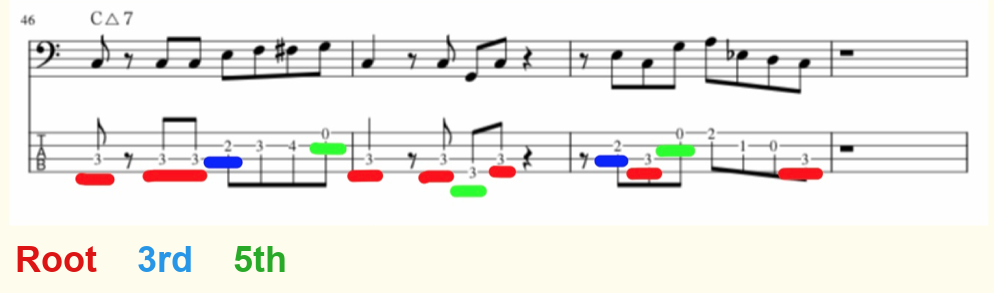
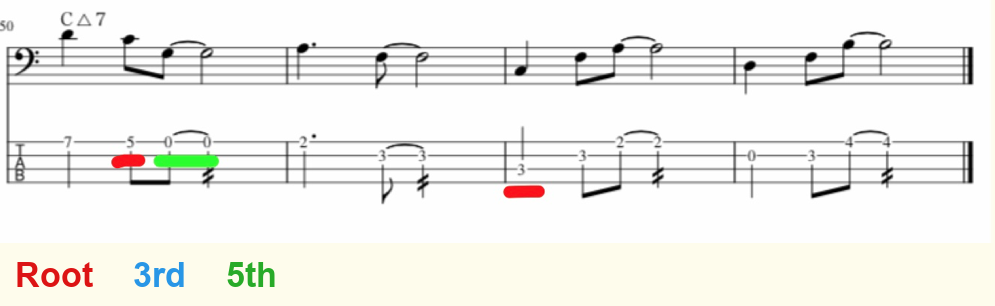
Plenty of jazz tunes use approaches built around triads. In the notation below:

Red lines mark the root (1st) of the chord
Blue lines mark the 3rd
Green lines mark the 5th

· I Mean You

· Confirmation

· Doxy

You’ve probably heard lines like these before without realizing it.

So, to sum up: being able to use triads confidently is a genuinely important skill when it comes to playing improvised solos. Next time, we’ll get into concrete practice methods for actually putting triads to use.

Want Personalized Feedback on Your Playing?

Hearing the difference between a triad-anchored line and a scale-only line is one thing — actually hearing it in your own playing and fixing it is a different challenge entirely, and it’s exactly where a second pair of ears makes the biggest difference.

This is exactly the kind of thing that’s hard to fix alone — and where having a teacher makes all the difference.

At Line on Bass, I offer an online lesson service where you send me a video of your playing, and I give you specific, detailed feedback — every single day if you want.

Students from around the world are using this to fix exactly these kinds of issues and steadily improve their jazz bass skills.

Check Out the Lesson Service →

Posted on Leave a comment

Bass Solos Over Jazz Standards: A Roundup

This article is written by Toru Hoshino, a jazz bassist and instructor based in Japan who teaches online lessons to students worldwide. In this article, he rounds up bass solo performances and breakdowns over several famous jazz standards.

This is a roundup of videos and articles where I play and break down bass improv solos over well-known jazz standards.

Whether you have no idea where to even start with a jazz bass solo, or you’re just looking for fresh phrase ideas, hopefully there’s something useful here.

A Bass Solo Over an F Blues Progression

This one walks through a beginner-friendly way to build a solo using the minor pentatonic scale — it’s a breakdown of the construction, not a polished performance.

Difficulty: ★☆☆☆☆

A Bass Solo Over “Autumn Leaves”

One chorus of improv over the chord progression of this jazz standard staple.

Difficulty: ★★☆☆☆

A Bass Solo Over “All of Me”

A bass improv solo over the progression of this popular jazz standard.

Difficulty: ★★★☆☆

A Bass Solo Over “Fly Me to the Moon”

Another staple tune — one chorus of solo, plus a breakdown of how the solo was put together.

Difficulty: ★★★★☆

A Bass Solo Over “Days of Wine and Roses”

Another staple tune. For a full notation and performance breakdown, see this article.

Difficulty: ★★★☆☆

A Bass Solo Over “The Girl from Ipanema”

A bossa nova staple that comes up constantly at sessions. For a full notation and performance breakdown, see this article.

Difficulty: ★★☆☆☆

Bassists Get Called On to Solo at Jazz Sessions Too

A lot of bassists have never soloed at all — I was exactly the same before I started going to jazz sessions.

But back when I could barely keep up playing roots and 5ths, let alone anything prepared, getting told “alright, take a solo” was genuinely rough.

Soloing obviously isn’t something you pick up overnight, and it takes real practice — but branching out into practice beyond just bass lines is what deepened my chord vocabulary and understanding, and made playing music a lot more fun along the way.

Breaking a solo down on paper gets you only so far — getting real-time feedback on whether your own phrasing choices actually land is exactly where a teacher accelerates things.

Want Personalized Feedback on Your Playing?

This is exactly the kind of thing that’s hard to fix alone — and where having a teacher makes all the difference.

At Line on Bass, I offer an online lesson service where you send me a video of your playing, and I give you specific, detailed feedback — every single day if you want.

Students from around the world are using this to fix exactly these kinds of issues and steadily improve their jazz bass skills.

Check Out the Lesson Service →

Posted on Leave a comment

Breaking Down a Bass Solo Over ‘Days of Wine and Roses’

This article is written by Toru Hoshino, a jazz bassist and instructor based in Japan who teaches online lessons to students worldwide. In this article, he breaks down a bass solo he played over “Days of Wine and Roses,” focusing on the trickiest transition in the tune.

I played a bass improv solo over the chord progression of “Days of Wine and Roses” (with notation, and a performance video included).

Breaking down the whole chart would make this way too long, so this time I’m covering two things: roughly what mindset I played the whole solo with, and a closer look at the trickiest transition in the tune — bar 1 into bar 2, F△7 into E♭7.

A Bass Solo Over “Days of Wine and Roses”

Keeping “Space” in Mind Throughout

The main thing I focused on was leaving room — space over phrasing. The idea is that even a fairly plain phrase can sound great as long as there’s real space around it.

I was especially deliberate about not filling every moment with notes, particularly at the start of the solo.

Breaking Down the F△7 → E♭7 Transition

Chorus 1, Pass 1 — around 0:23

I’m barely playing anything here — this is exactly the “space” idea from above in action. That said, I’m still keeping the E♭ chord tones in mind the whole time. Since the F△7 diatonic color is so dominant overall, I wanted to make the non-diatonic E♭7 color stand out clearly by contrast.

Bass line emphasizing E flat chord tones over the F major 7 to E flat 7 transition

Chorus 1, Pass 2 — around 0:31

Here I’m using the 3rd of F△7, the note A, as the motif. Approaching A from a half step below — G♯ — was meant to add a touch of bittersweet sweetness to the line.

A phrase approaching the 3rd of F major 7 from a half step below

Chorus 2, Pass 1 — around 1:01

This one’s inspired by the opening of Paul Chambers’ solo on “Straight, No Chaser.” It’s not a direct copy though — bar 2 leans into the E♭ chord color instead.

A phrase inspired by Paul Chambers' solo on Straight No Chaser

For reference, check out this recording around the 8:03 mark.

Chorus 2, Pass 2 — around 1:50

This is almost entirely an E♭7 chord-tone approach. Beyond just the E♭ itself, the 6th of the chord, D♭, really brings out this chord’s distinct character too.

An E flat 7 chord-tone phrase emphasizing the 6th

Hopefully this is useful for your own daily practice.

Hearing a tricky transition broken down on paper is one thing — actually getting it to land convincingly in real time is exactly where a teacher’s ear speeds things up.

Want Personalized Feedback on Your Playing?

This is exactly the kind of thing that’s hard to fix alone — and where having a teacher makes all the difference.

At Line on Bass, I offer an online lesson service where you send me a video of your playing, and I give you specific, detailed feedback — every single day if you want.

Students from around the world are using this to fix exactly these kinds of issues and steadily improve their jazz bass skills.

Check Out the Lesson Service →

Posted on Leave a comment

Is It Okay to Play Prepared Phrases at a Jam Session?

This article is written by Toru Hoshino, a jazz bassist and instructor based in Japan who teaches online lessons to students worldwide. In this article, he answers a common question: is it okay to play phrases you wrote out and prepared in advance at a jam session?

Here’s a question I get a lot: “Is it okay to play phrases I wrote out and prepared ahead of time at a session?”

People who are working on improvising often ask something like: “I can’t come up with phrases on the spot at all, so I’ve been playing lines I wrote out on paper beforehand — is it okay to play those at a session? Doesn’t that defeat the whole point of improvising?”

It’s true that playing something you wrote out in advance isn’t, strictly speaking, improvising in the purest sense. But as a practice method — writing out phrases and training yourself to release them naturally within a chord progression — that’s completely fine.

“Does this note actually fit over this chord?”
— deliberately checking that is genuinely valuable.

Sure, it’d be great if cool phrases just came out of nowhere with zero thought. But that’s not realistic starting out, so when you’re working on this on your own, really listen to how each note sounds against the chord — trust your own ear, even if it’s just “I like how that sounds” or “hm, not so much” — and once you land on something that feels good, repeat it until it’s second nature, then practice it in different keys so it gradually becomes part of your vocabulary.

When you’re just starting this process, the cool phrasing you’re imagining won’t come easily. But by steadily grinding through this process, your ability to respond to chords on the fly builds up bit by bit. So if you’ve ever felt like “I have no idea what to play when I’m improvising,” try writing out phrases specifically for the spots that aren’t working yet — it’s a genuinely effective approach.

A Recommended App

If you’re working on improvising on your own, the app iReal Pro is incredibly useful.

It lets you play backing tracks for over 1,400 jazz standards, in any tempo or key you want.

Definitely worth checking out.

Writing out phrases is a great way to build vocabulary on your own — but knowing which of those phrases are actually worth keeping is exactly the kind of judgment a teacher can speed up.

Want Personalized Feedback on Your Playing?

This is exactly the kind of thing that’s hard to fix alone — and where having a teacher makes all the difference.

At Line on Bass, I offer an online lesson service where you send me a video of your playing, and I give you specific, detailed feedback — every single day if you want.

Students from around the world are using this to fix exactly these kinds of issues and steadily improve their jazz bass skills.

Check Out the Lesson Service →

Posted on Leave a comment

Stuck in One-Pattern Pentatonic Phrasing? Try This

This article is written by Toru Hoshino, a jazz bassist and instructor based in Japan who teaches online lessons to students worldwide. In this article, he shares a few ideas for breaking out of repetitive, one-pattern pentatonic phrasing.

“Whenever a major pentatonic scale comes up, I get stuck playing the same shape and end up with phrases like C-D-E-G-A-C going up, or C-A-G-E-D-C coming back down — and that’s it. Got any ideas for breaking out of that?”

This article is for anyone who’s run into that exact wall.

Where Phrase Ideas Tend to Get Stuck

When you’re stuck for phrase ideas, it’s often because you’re only thinking about movement in one direction.

Example 1

C-D-E-G-A-C — just moving steadily upward.

What if you took everything from the 3rd note onward — E, G, A, C — and dropped it down an octave, like this?

Completely different feel, right?

Example 2

C-A-G-E-D-C — just moving steadily downward.

Now try dropping just the final C down by a whole step:

The descending pentatonic phrase with the final note lowered a whole step

Again — totally different character.

Here’s an applied phrase built on that idea — could work nicely over a tune like “All of Me”:

An applied pentatonic phrase for All of Me

How to Think About It Once Phrasing Starts Feeling Repetitive

E shows up in more than one place on the neck.

Multiple positions for the note E on the fretboard

So does A.

Multiple positions for the note A on the fretboard

“Yeah, obviously” — you might be thinking. But here’s the thing: once you’ve got a handful of notes lined up in your head, it’s surprisingly easy to forget that those other positions even exist.

When you’re still getting your bearings, it’s important to learn fixed, go-to shapes first. But:

Important

Once you’re more comfortable, start paying attention to “what note am I actually playing right now”

and when things start feeling repetitive, ask yourself:

“What if I played that same note an octave away?” or “What if I played that same note on a different string?”

Keeping that in mind is a reliable way to break out of one-pattern phrasing.

Recognizing in the moment which alternate position would actually sound better is exactly the kind of real-time decision a teacher can help sharpen.

Want Personalized Feedback on Your Playing?

This is exactly the kind of thing that’s hard to fix alone — and where having a teacher makes all the difference.

At Line on Bass, I offer an online lesson service where you send me a video of your playing, and I give you specific, detailed feedback — every single day if you want.

Students from around the world are using this to fix exactly these kinds of issues and steadily improve their jazz bass skills.

Check Out the Lesson Service →

Posted on Leave a comment

A Bass Solo Over ‘The Girl from Ipanema’, Broken Down

This article is written by Toru Hoshino, a jazz bassist and instructor based in Japan who teaches online lessons to students worldwide. In this article, he breaks down a bass improv solo he played over one chorus of “The Girl from Ipanema.”

“The Girl from Ipanema” comes up constantly at jam sessions, so here’s a breakdown of a bass solo I played over one chorus of its chord progression.

When you search for improv solos online, you’ll find tons of players doing insanely fast runs and high-register fireworks — amazing to watch, but honestly, “too good to copy” for a lot of players. So for this one, I deliberately kept the approach simple and accessible, even for someone relatively early in their playing.

A Bass Solo Over “The Girl from Ipanema”

Here are 2 things I focused on overall.

1. Using a Unified Rhythm Pattern Built From Chord Tones (e.g. Section A, bars 9–12 / Section B, bars 1–4)

Here are bars 9–12 of section A. The rhythm pattern in bars 9 and 10 is identical, and the same goes for bars 11 and 12.

A repeated chord-tone rhythm pattern over a ii-V progression

Only the actual notes change — they’re simply the chord tones of whatever chord is underneath at that moment.

2. Adding Occasional 16th Notes for a Sense of Speed (e.g. Section A, bar 5 / Section B, bar 5)

When soloing, it’s easy to fall into a rut of just quarter notes and eighth notes. So I deliberately worked in some 16th notes throughout — it adds a real sense of forward motion.

A 16th-note run added for a sense of speed

Hopefully this is useful as a reference for your own playing.

Breaking down a solo on paper is one thing — getting that same rhythmic confidence into your own playing in real time is exactly where a second set of ears helps the most.

Want Personalized Feedback on Your Playing?

This is exactly the kind of thing that’s hard to fix alone — and where having a teacher makes all the difference.

At Line on Bass, I offer an online lesson service where you send me a video of your playing, and I give you specific, detailed feedback — every single day if you want.

Students from around the world are using this to fix exactly these kinds of issues and steadily improve their jazz bass skills.

Check Out the Lesson Service →

Posted on Leave a comment

2 Things I Look for When Arranging a Pop Song Into Jazz

This article is written by Toru Hoshino, a jazz bassist and instructor based in Japan who teaches online lessons to students worldwide. In this article, he shares two things he looks for when arranging a pop song into a jazz version.

It’s cool to take a famous song and turn it into a jazz arrangement, but the truth is, not every song actually works as a jazz arrangement. When I’m arranging a pop song into jazz, I personally make the call based on two things:

Does it have a ii-V progression?
What’s the section structure?

Let’s get into what that actually means.

Does It Have a ii-V Progression?

A ii-V (or ii-V-I) progression has some real advantages:

It’s easy to lay a jazz-sounding melody over it
It’s easy to lay tension chords over it
It’s easy to lay a walking bass line over it

Since most readers here are bassists, let’s focus on that last point — how easy it is to build a walking bass line over it.

Here’s an example of a ii-V-I progression:

An example ii-V-I bass line over Dm7-G7-Cmaj7

Play through it and you’ll see — it’s incredibly easy to build a walking bass line over this. Compare that to a common pop chord movement, the IV-V-I progression (not usually called that, but bear with me):

An example bass line over an F-G-C (IV-V-I) progression

This kind of progression just doesn’t pair as naturally with a walking bass line. Play through it and you’ll notice — it’s not necessarily wrong, but it’s genuinely hard to build a smooth, connected flow.

So: when arranging a pop song into jazz, it’s worth checking whether the chord progression contains a ii-V movement somewhere in it.

The Section Structure

Chord tones

“Section” here just means things like the verse or the chorus. Pop songs commonly follow a flow like:

Intro → Verse → Pre-chorus → Chorus

Jazz tunes, on the other hand, tend to follow forms like:

ABAC
(e.g. “Fly Me to the Moon,” “All of Me”)

or

AABC
(e.g. “Autumn Leaves”)

AABA
(e.g. “It’s Only a Paper Moon,” “Take the ‘A’ Train”)

In other words, I tend to gravitate toward pop songs that happen to follow one of these jazz-friendly structural formats.

Spotting these structural cues in theory is one thing — actually getting a walking bass line to flow naturally through an arrangement like this is exactly where a teacher’s feedback speeds up the process.

Want Personalized Feedback on Your Playing?

This is exactly the kind of thing that’s hard to fix alone — and where having a teacher makes all the difference.

At Line on Bass, I offer an online lesson service where you send me a video of your playing, and I give you specific, detailed feedback — every single day if you want.

Students from around the world are using this to fix exactly these kinds of issues and steadily improve their jazz bass skills.

Check Out the Lesson Service →