Posted on Leave a comment

Build Chord Recognition Without Even Touching Your Instrument

This article is written by Toru Hoshino, a jazz bassist and instructor based in Japan who teaches online lessons to students worldwide. In this article, he shares a way to build chord recognition skills without even touching your instrument.

Normally, practice means picking up your bass and making sound. But there are plenty of days when work or errands make that impossible.

Here’s a way to train your ear, your theory knowledge, and your sense of the fretboard, all at once — without an instrument in hand.

The method is genuinely simple:

1. Loop a recording of a chord progression (for example, Dm → G7 → C)

2. While following the chords, say the note names and scale degrees to yourself in your head

3. Picture the fretboard positions and imagine your fingering

That’s it.

Here’s the important part, though: not many people actually do this properly. That’s exactly because it’s mentally tiring.

But that’s also exactly why it makes such a big difference when you actually do it. Of course, if you’re working through this on your own, you’ll need to set your own tempo and practice routine.

Still, if you commit to this kind of focused “mental workout,” it leads to real growth in:

  • Breaking free from relying on tab
  • Stronger chord recognition
  • Better walking bass and improvisation skills

It doesn’t matter where you are or how much time you have — you can do this one anywhere. Give it a try.

Building chord recognition like this on your own takes real discipline — a teacher can check whether what you’re hearing in your head actually matches what you’d play.

Want Personalized Feedback on Your Playing?

This is exactly the kind of thing that’s hard to fix alone — and where having a teacher makes all the difference.

At Line on Bass, I offer an online lesson service where you send me a video of your playing, and I give you specific, detailed feedback — every single day if you want.

Students from around the world are using this to fix exactly these kinds of issues and steadily improve their jazz bass skills.
Check Out the Lesson Service →

Posted on Leave a comment

“Avoid Notes” Aren’t Forbidden — They Just Need Careful Handling

This article is written by Toru Hoshino, a jazz bassist and instructor based in Japan who teaches online lessons to students worldwide. In this article, he answers a question he gets constantly: what’s the deal with “avoid notes”?

One question I get asked a lot in lessons is about avoid notes.

For example, in a C major scale, you can use:

C D E F G A B C

Of these, the note F is the avoid note.

Wait — isn’t an avoid note supposed to be a note you’re not allowed to use?

But if F is part of the C major scale in the first place, can you use it or not? That’s exactly the part that confuses people.

Strictly speaking, the right way to think about it is:

You’re not forbidden from using it — you just need to be a little careful about how you use it.

An avoid note, fundamentally, is a note that makes it harder for the listener to feel the chord’s harmony.

A C chord has its own distinct “C chord” sound — but if you emphasize the avoid note too much, that C-chord sound gets harder to convey.

That said, using F as a decorative tone or a passing tone is completely fine. Here are some concrete examples.

A Good Way to Use an Avoid Note in a Walking Bass Line

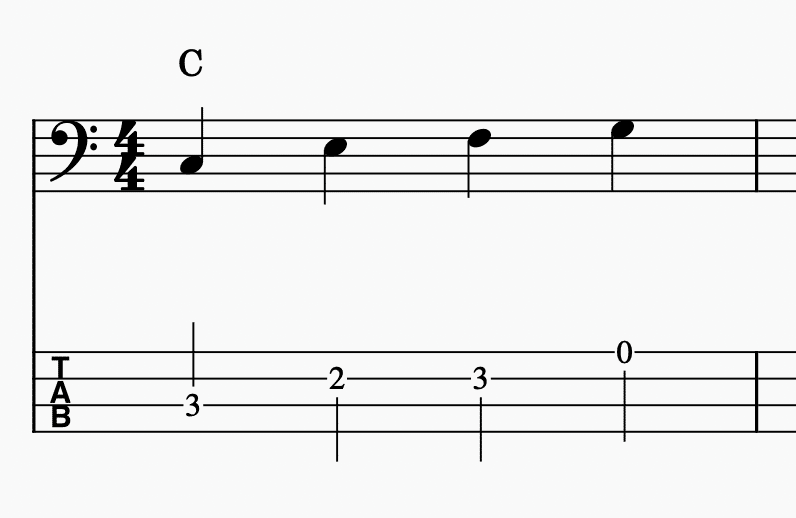
Say you’re over a C chord, playing four quarter notes in the bar:

C E F G

Used this way, as a passing tone, it works fine.

F used as a passing tone in a walking bass line over a C chord, without being emphasized

The F here isn’t being emphasized.

A Less Good Way to Use an Avoid Note in a Walking Bass Line

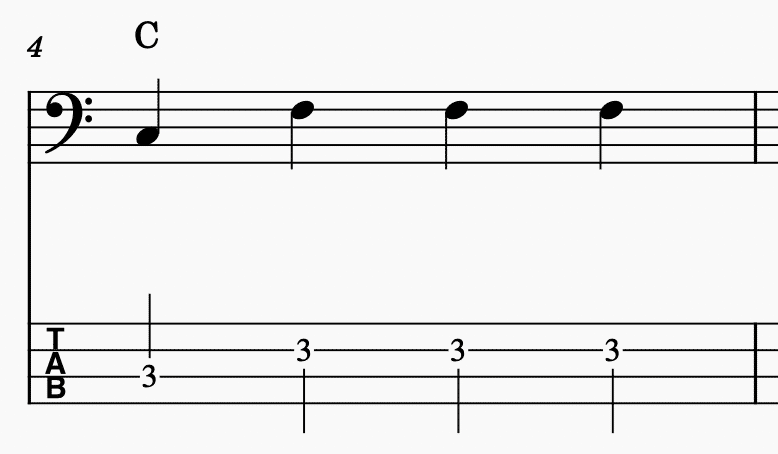
Now say you’re over the same C chord, playing four quarter notes:

C F F F

Like this — with almost no chord tones present and the F note emphasized heavily — the harmony becomes hard to read.

F overused and emphasized in a walking bass line over a C chord, making the harmony unclear

So this is exactly what people mean by “it’s not forbidden, it just needs careful handling.”

Understanding the theory behind avoid notes is one thing — actually hearing when you’re overusing one in your own lines is exactly the kind of thing a teacher catches immediately.

Want Personalized Feedback on Your Playing?

This is exactly the kind of thing that’s hard to fix alone — and where having a teacher makes all the difference.

At Line on Bass, I offer an online lesson service where you send me a video of your playing, and I give you specific, detailed feedback — every single day if you want.

Students from around the world are using this to fix exactly these kinds of issues and steadily improve their jazz bass skills.
Check Out the Lesson Service →

Posted on Leave a comment

What a Saxophone Solo Can Teach You About Phrasing Like a Jazz Player

This article is written by Toru Hoshino, a jazz bassist and instructor based in Japan who teaches online lessons to students worldwide. In this article, he breaks down three phrasing tricks borrowed from a classic saxophone solo.

The tune featured here is the jazz classic “Cool Strutin’.” The melody performance starts at 2:09 in the clip below:

You can find the original recording here — well worth checking out.

Studying phrases from other instruments — not just bass, but horns and everything else — is a great way to expand your sense of rhythm and phrasing. Here are the three things that make this particular line sound so good:

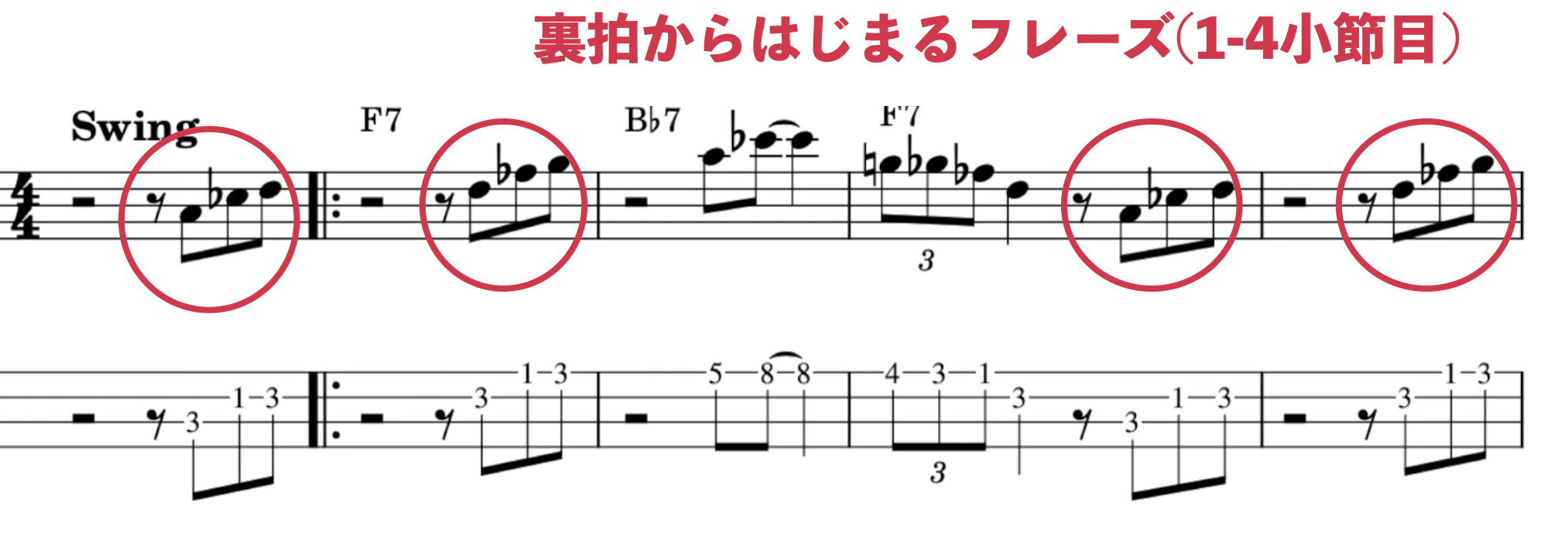
1. Starting Phrases on the Off-Beat

One of the biggest ingredients in sounding genuinely “jazz” is starting a phrase on the off-beat. You don’t always have to start there, but coming in off the beat creates a natural sense of swing and feel.

A phrase that starts on the off-beat across four measures

In fact, the original melody of this tune is full of phrases anchored on off-beats — that’s a big part of what gives it such a distinctive jazz feel.

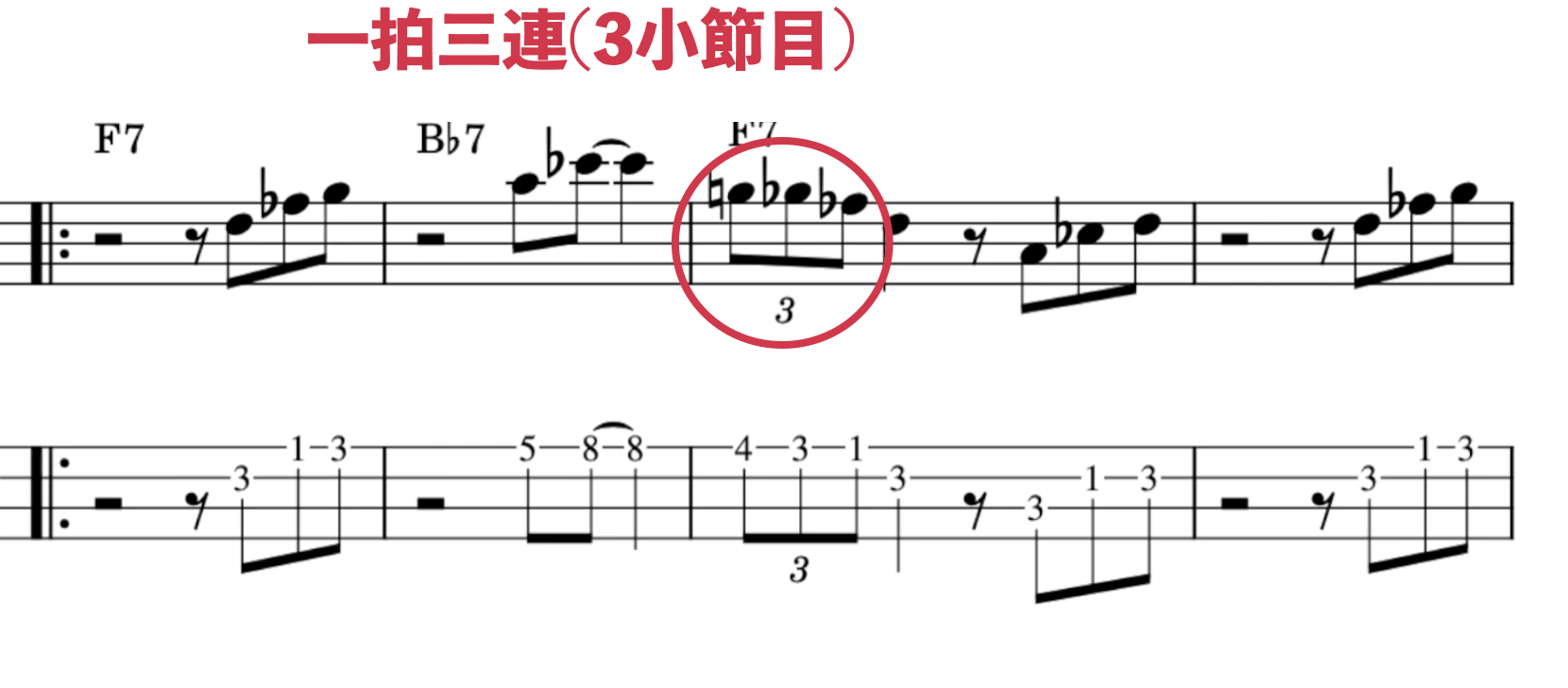
2. Using Eighth-Note Triplets

An eighth-note triplet on a single beat gives a phrase tightness and bounce. Land it with good timing, and that fine-grained rhythmic detail tightens up the whole sound.

A phrase using an eighth-note triplet on a single beat

Working this in deliberately throughout a solo keeps things from sounding monotonous and pushes the line further into jazz-specific phrasing.

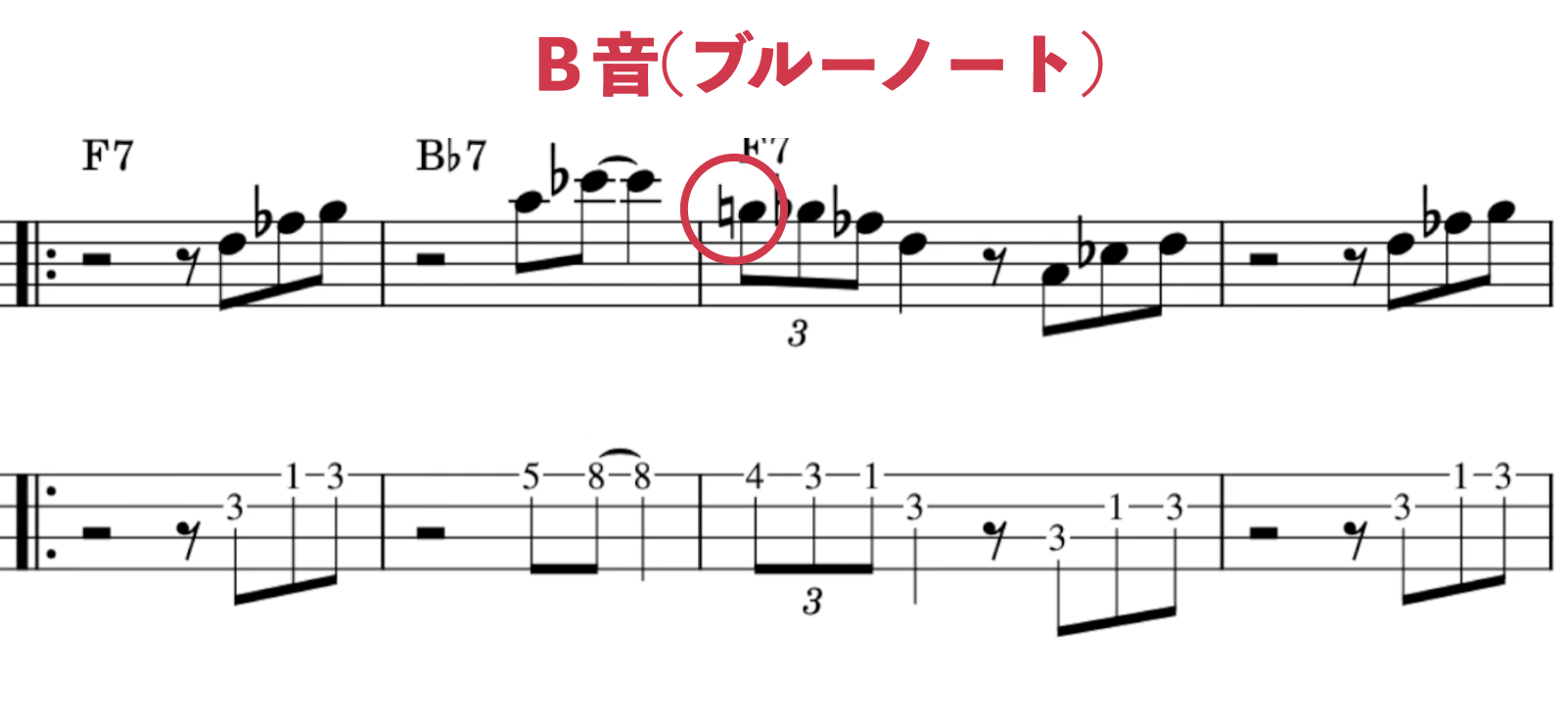
3. Working in a Blue Note

For a blues tune in F like this one, the most effective blue note to reach for is the note B.

A phrase that adds the note B as a blue note over an F blues

This tune’s melody is mostly built from the F minor pentatonic scale — F, A♭, B♭, C, E♭ — but adding that B note on top instantly gives it a much bluesier sound.

This “pentatonic plus blue note” feel is something you really have to play and feel for yourself rather than just understand intellectually — go try landing that B note and feel how bluesy it sounds.

Borrowing phrasing like this from another instrument is a great habit — but knowing exactly how to adapt it onto your own bass lines is exactly the kind of thing a teacher can speed up dramatically.

Want Personalized Feedback on Your Playing?

This is exactly the kind of thing that’s hard to fix alone — and where having a teacher makes all the difference.

At Line on Bass, I offer an online lesson service where you send me a video of your playing, and I give you specific, detailed feedback — every single day if you want.

Students from around the world are using this to fix exactly these kinds of issues and steadily improve their jazz bass skills.
Check Out the Lesson Service →

Posted on Leave a comment

Stuck for Ideas in Your Solo? Try Motif Development

This article is written by Toru Hoshino, a jazz bassist and instructor based in Japan who teaches online lessons to students worldwide. In this article, he shares a simple approach for when you blank on what to play in a solo.

In a free one-on-one bass consultation, I got this question: “I just end up going back and forth across scales, and my solos never really lock in.” One approach I suggested as a fix was something called “motif development.”

Here’s roughly what that looks like:

  • ① C–E♭–C–B♭
  • ② C–E♭–F–E♭
  • ③ C–B♭–G–F–E♭–F–E♭

Three short motifs sharing a rhythmic shape, with the rests in each one circled

The rests in each motif are circled above — the rhythm stays consistent across all three, while the notes shift slightly each time.

Play one rhythmic idea, then repeat a similar rhythm with slightly different notes, then on the third pass, stretch it into a slightly longer phrase. Doing this gives your solo a sense of consistency while still keeping it moving forward — and you never run out of ideas. This is sometimes called a “motif development phrase.”

If you tend to run out of ideas mid-solo, this is well worth trying out in your own playing.

Running out of ideas mid-solo is exactly the kind of moment where a teacher’s input pays off — they can point you toward the next move in real time.

Want Personalized Feedback on Your Playing?

This is exactly the kind of thing that’s hard to fix alone — and where having a teacher makes all the difference.

At Line on Bass, I offer an online lesson service where you send me a video of your playing, and I give you specific, detailed feedback — every single day if you want.

Students from around the world are using this to fix exactly these kinds of issues and steadily improve their jazz bass skills.
Check Out the Lesson Service →

Posted on Leave a comment

You Know Your Scales — Here’s How to Actually Use Them in a Solo

This article is written by Toru Hoshino, a jazz bassist and instructor based in Japan who teaches online lessons to students worldwide. In this article, he explains the one idea that turns “just running scales” into phrases that actually sound like jazz.

Take a ii–V–I progression. You’ve got scales available for each chord:

  • Dm7 → D Dorian
  • G7 → G Mixolydian
  • CΔ7 → C Ionian

But just running up and down those scales evenly won’t sound like jazz on its own.

What actually matters is where you land.

The move I’d recommend: land on a chord tone right on beat 1 of each chord.

Take this phrase, for example:

A ii-V-I phrase landing on the 3rd of G7 and CMaj7, with a chromatic approach note circled before the final landing

The landing notes — B (the 3rd of G7) and E (the 3rd of CΔ7) — are circled in red above, with a chromatic approach note circled in blue right before the final landing.

Landing the phrase on the 3rd of G7 (B) and the 3rd of CΔ7 (E) instantly gives it a much stronger sense of the chord changes than just running scales would. Adding a chromatic note right before that final landing pushes the jazz feel even further.

Text can only explain so much of this kind of note-choice thinking, so I also made a video breaking it down in detail: “6 Steps to Playing Phrases That Actually Sound Like Jazz.”

  • Step 1: Long-tone approach to the 3rd
  • Step 2: Chromatic approach
  • Step 3: Chord tones
  • Step 4: Eighth-note approach
  • Step 5: Off-beat placement
  • Step 6: Tensions

Working through these one at a time, understanding the sound and the scale degree of each note as you go, will get you playing genuine jazz phrases even if you’re entirely self-taught.

This kind of note-by-note decision-making is exactly where a second opinion helps most — a teacher can confirm in seconds whether a landing note is doing what you think it’s doing.

Want Personalized Feedback on Your Playing?

This is exactly the kind of thing that’s hard to fix alone — and where having a teacher makes all the difference.

At Line on Bass, I offer an online lesson service where you send me a video of your playing, and I give you specific, detailed feedback — every single day if you want.

Students from around the world are using this to fix exactly these kinds of issues and steadily improve their jazz bass skills.

Check Out the Lesson Service →

Posted on Leave a comment

Why Memorized Jazz Phrases Feel Robotic at First (And Why That’s Normal)

This article is written by Toru Hoshino, a jazz bassist and instructor based in Japan who teaches online lessons to students worldwide. In this article, he shares why newly learned jazz phrases always feel a little mechanical at first — and why that’s actually a sign you’re on the right track.

Why “Playing in Shapes” Is a Phase Everyone Goes Through

I was catching up with a jazz guitarist friend of mine who lives in New York, over Zoom. We’ve known each other since our days living in Japan, so the conversation wandered, and at some point it turned into a real discussion about music.

“Whenever I try to use a phrase I picked up at a session, it ends up coming out as just a ‘shape’ or a finger position — it doesn’t feel musical at all. How do I actually understand it on a theoretical level while still using it in real playing?”

That was the question on the table. We talked it through, and the conclusion we landed on was pretty simple.

“Yeah, there’s just no way around that at first.”

A phrase you just learned is always going to feel like you’re snapping a block into place — playing it “as a shape” is completely natural at that stage. But if you avoid using it because of that, it’ll never become part of your own musical language.

In the end, the only way through is to keep using the phrases you want to play. Even when it goes wrong, even when it feels off, you just keep trying — there’s no shortcut.

The ideal, of course, is for a phrase to come out naturally in the flow of the music rather than being forced in. But getting there means passing through a slightly unnatural-feeling stage first. That part isn’t optional — it’s part of the process.

Shape → feels off → trial and error → gradually more natural. That accumulation is what eventually turns into a genuinely musical phrase.

If you’re in that place right now — “I’ve learned the phrase, but it feels awkward and I don’t love using it” — that’s actually a sign you’re growing. Hang on to that discomfort, and keep trying it anyway.

This in-between stage is exactly the kind of thing that’s hard to judge for yourself — a teacher can usually tell right away whether you’re on track or stuck.

Want Personalized Feedback on Your Playing?

This is exactly the kind of thing that’s hard to fix alone — and where having a teacher makes all the difference.

At Line on Bass, I offer an online lesson service where you send me a video of your playing, and I give you specific, detailed feedback — every single day if you want.

Students from around the world are using this to fix exactly these kinds of issues and steadily improve their jazz bass skills.

Check Out the Lesson Service →

Posted on Leave a comment

Is Jazz Improvisation Really About Natural Talent?

This article is written by Toru Hoshino, a jazz bassist and instructor based in Japan who teaches online lessons to students worldwide. In this article, he answers a question he gets all the time: is improvising really just about natural talent?

Is Jazz Improvisation Really About Natural Talent?

Today I want to answer a question I get a lot: “Isn’t improvising really just about having natural talent?”

When you hit a wall with improvising or walking bass, it’s easy to think “I guess I just don’t have the talent for this.” I’ll say it flat out: talent has nothing to do with it. I don’t even use the word “talent” in my lessons.

What actually matters far more is the order you tackle things in.

Say someone with zero foundational knowledge jumps straight into copying a Jaco Pastorius phrase. Even if they manage to copy it, ask them to play over just the chords on their own, and they’re not going to sound anything like Jaco. But that’s not because they lack talent — it’s because they skipped way too many steps.

There’s nothing wrong with picking up the bass because “Jaco is so cool!” — but a lot of his vocabulary is genuinely advanced. Without the foundational knowledge, working on advanced phrases just leaves you thinking, “this sounds cool, but I have no idea why.”

It’s a bit like watching a foreign film without subtitles before you even know “I,” “you,” or “this is.”

But if you go through the right steps in the right order, you can absolutely reach the place most players want to be: reading a chord chart and playing off it, without leaning on tab.

I spent years playing nothing but punk rock myself. By working through things step by step, I’m now able to improvise at jam sessions around town.

It’s not about talent. Set that word aside, and when you feel stuck, ask instead: am I actually working through this in the right order? That’s the more useful question.

Figuring out which step you’re actually missing is hard to see from the inside — but it’s usually obvious to a teacher listening from the outside.

Want Personalized Feedback on Your Playing?

This is exactly the kind of thing that’s hard to fix alone — and where having a teacher makes all the difference.

At Line on Bass, I offer an online lesson service where you send me a video of your playing, and I give you specific, detailed feedback — every single day if you want.

Students from around the world are using this to fix exactly these kinds of issues and steadily improve their jazz bass skills.

Check Out the Lesson Service →

Posted on Leave a comment

The Secret Behind a Solo That Makes the Crowd Go “Yeah!”

This article is written by Toru Hoshino, a jazz bassist and instructor based in Japan who teaches online lessons to students worldwide. In this article, he points out what actually makes a solo land with an audience — and it’s not what you’d expect.

The Moment a Solo Makes the Crowd Go “Yeah!”

While giving feedback on students’ improvised solos, I noticed something: the moments where I catch myself saying “oh, that’s nice” aren’t when someone’s packing every beat with eighth notes. They’re almost always moments where the silence lands at exactly the right time.

That clicked for me again today while listening to a recording — there’s a moment in a Christian McBride solo where you can hear someone in the audience (or maybe a bandmate) blurt out “yeah!” without thinking. It happens around 1:12 in this video.

The audience couldn’t have known a pause was coming right there — there’s no way to predict that in an improvised solo. And yet, someone reacted out loud, instantly. I think that’s what “good space” really means.

When you’re copying a phrase, paying attention to the actual notes obviously matters. But it might be worth paying just as much attention to where the greats leave space, or where a phrase really lands — looking at it that way can change what you start to notice.

I still want to aim for that same kind of space and timing in my own playing.

Man, what a great recording. I’ve loved this one for years — I guess this is what people mean by “swinging.” Give it a listen if you haven’t already.

Putting in the reps matters, but soaking in great music matters just as much. 🙂

Timing and space like this are notoriously hard to judge in your own playing — it’s exactly the kind of thing a second pair of ears catches instantly.

Want Personalized Feedback on Your Playing?

This is exactly the kind of thing that’s hard to fix alone — and where having a teacher makes all the difference.

At Line on Bass, I offer an online lesson service where you send me a video of your playing, and I give you specific, detailed feedback — every single day if you want.

Students from around the world are using this to fix exactly these kinds of issues and steadily improve their jazz bass skills.

Check Out the Lesson Service →

Posted on Leave a comment

What Is Improvisation, Really? (And Where to Start)

This article is written by Toru Hoshino, a jazz bassist and instructor based in Japan who teaches online lessons to students worldwide. In this article, he answers a question he gets often: what does “improvisation” actually mean, and where should you start?

What Is Improvisation, Really?

I recently got asked: “Is improvising about coming up with something completely new on the spot, something you never planned? Or is it really just using phrases and licks you’ve copied from other players?”

The honest answer is: both.

But if it were only the first one, total chaos would count as “improvisation” too. My son is about to turn two, and he loves banging on the piano just for fun — that’s technically improvised. But it’s not music.

And as the second part of the question suggests, using phrases and licks you’ve copied is genuinely important too. The catch is, if you copy them with zero underlying knowledge, your fingers might learn to move, but you won’t be able to apply what you learned anywhere else.

So the real goal is building up enough musical knowledge that the right phrase shows up naturally, at the right moment, when you need it.

If you’re just starting out with jazz improvisation, by far the best first step is:

Learning your chord tones.

If you see F7 and your fingers know F–A–C–E♭, or you see Dm7 and your fingers know D–F–A–C — being able to play the chord tones the moment you see the chord symbol is a smooth first step into improvising.

If you want to join sessions, want to try improvising, or just don’t know where to start — start with chord tones.

Where Do I Start With Chord Tones?

That said, “where do I actually start” is a fair question, so I made a video for it. Getting chord tones to come to mind instantly when you see a chord takes repetition and practice.

So here’s a no-instrument-required brain-training video you can do anywhere. A chord shows up on screen, and a few seconds later, the chord tones appear. There are 30 questions in total — repeat it regularly if you want to build up your ability to react to chords on the fly.

Subscribe to my YouTube channel here for more videos like this.

Things like chord-tone recall are easy to drill on your own, but hard to know if you’re actually applying correctly — that’s exactly where having someone check your playing helps.

Want Personalized Feedback on Your Playing?

This is exactly the kind of thing that’s hard to fix alone — and where having a teacher makes all the difference.

At Line on Bass, I offer an online lesson service where you send me a video of your playing, and I give you specific, detailed feedback — every single day if you want.

Students from around the world are using this to fix exactly these kinds of issues and steadily improve their jazz bass skills.

Check Out the Lesson Service →

Posted on Leave a comment

A Jazz Bass Lick for 2-Bar Major Chords (Chromatic Approach Notes, George Mraz Style)

This article is written by Toru Hoshino, a jazz bassist and instructor based in Japan who teaches online lessons to students worldwide. In this article, he breaks down a slick-sounding lick you can use any time a major chord holds for two bars.

Who This Article Is For

  • You’re not sure how to build your own improvised solo phrases
  • You want to bring great bassists’ approaches into your own playing
  • You want to expand your vocabulary of solo lines
  • You want to understand how to build jazz phrases around chord tones

Work through the phrase in this article, and you’ll pick up one solid approach for soloing over a major chord that lasts two bars. It transposes easily, so you can apply it to all kinds of tunes — stick with this one to the end.

Where This Comes From

This is a phrase you can use in jazz chord progressions whenever a major chord — like CΔ7 or C7 — holds for two bars. Have a listen to 1:21–1:30 in the video below first.

Album: Manhattan Trinity
Bassist: George Mraz

How the Phrase Is Built

Here’s the approach over a CΔ7 chord:

Diagram showing chromatic approach notes around chord tones over CMaj7

  • ① Play the 3rd (E), drop a half step, then come back to the 3rd (E) — red line
  • ② Play the root (C), drop a half step, then come back to the root (C) — blue line
  • ③ Play the 5th (G), drop a half step, then come back to the 5th (G) — green line
  • ④ Play the 3rd (E) an octave down, drop a half step, then come back to the 3rd (E) — red line

It’s basically weaving through the chord tones. Give it a try with your own hands if you can!

If you played all three of those target notes exactly the same way each time, it wouldn’t be wrong — but it would lose a lot of its style.

Diagram comparing a flatter version of the same phrase

Transposed and Applied

Here’s this same idea — weaving through chord tones using a half-step below each one — transposed and applied elsewhere. This is the chord progression for the jazz standard “Just Friends.”

The same chromatic approach-note idea applied to the chord progression of Just Friends

This works over plenty of tunes, so give it a try in your own playing.

Phrases like this one are easy to get almost right but hard to really nail on your own — exactly the kind of detail a teacher can catch instantly.

Want Personalized Feedback on Your Playing?

This is exactly the kind of thing that’s hard to fix alone — and where having a teacher makes all the difference.

At Line on Bass, I offer an online lesson service where you send me a video of your playing, and I give you specific, detailed feedback — every single day if you want.

Students from around the world are using this to fix exactly these kinds of issues and steadily improve their jazz bass skills.

Check Out the Lesson Service →