This article is written by Toru Hoshino, a jazz bassist and instructor based in Japan who teaches online lessons to students worldwide.
Have you ever gone to a jam session and gotten called on for a bass solo you had no idea how to play?
When you’re just starting out, you really have no idea what you’re even supposed to do during a bass solo.
This article is for:
- Anyone playing jazz for the first time
- Anyone just starting out on jazz bass
- Anyone who has absolutely no idea how to approach a bass solo
This time, I want to introduce a note set that lets you sound convincingly “bluesy” with very little effort, over an F blues chord progression: the minor pentatonic.
Contents
An F Blues Bass Solo Using “Minor Pentatonic + ♭5”
Here’s an F blues solo I played using this approach.

Doesn’t that have a bit of a “bluesy” sound to it?
This is a scale (a set of notes) that makes a blues tune sound the part.
The notes I’m playing are just these six:

F (root)
A♭ (minor 3rd)
B♭ (4th)
B (♭5)
C (5th)
E♭ (minor 7th)
That’s it.
F’s minor pentatonic scale is:
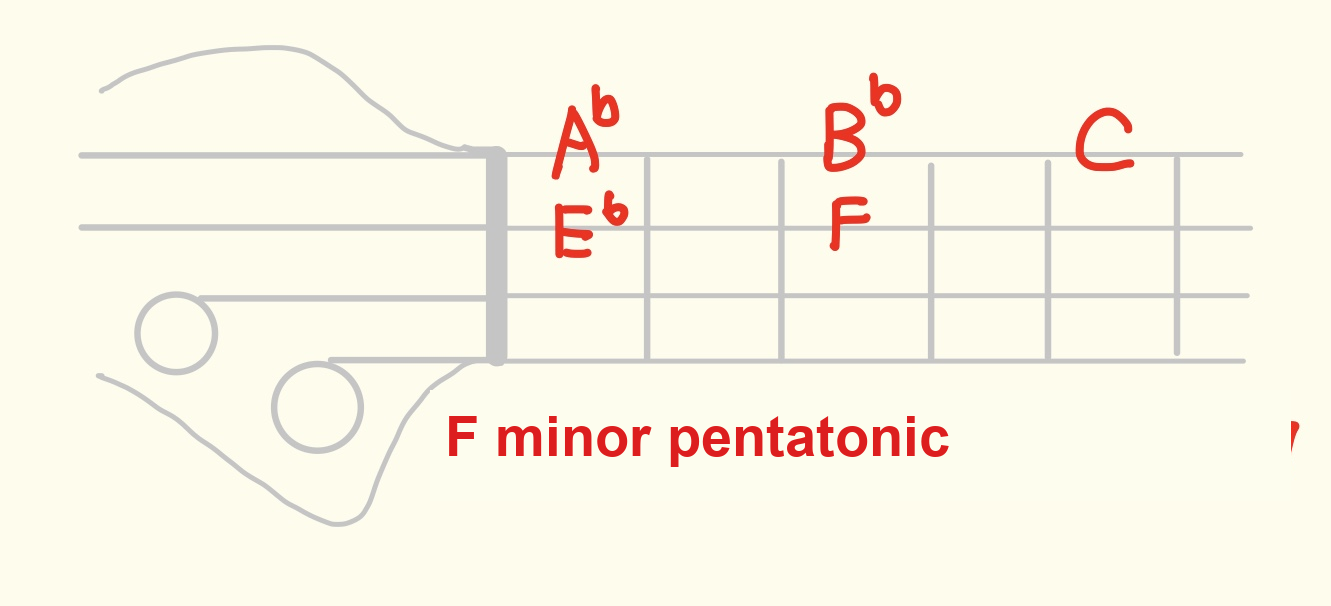
F (root)
A♭ (minor 3rd)
B♭ (4th)
C (5th)
E♭ (minor 7th)
— those 5 notes. Mix in:
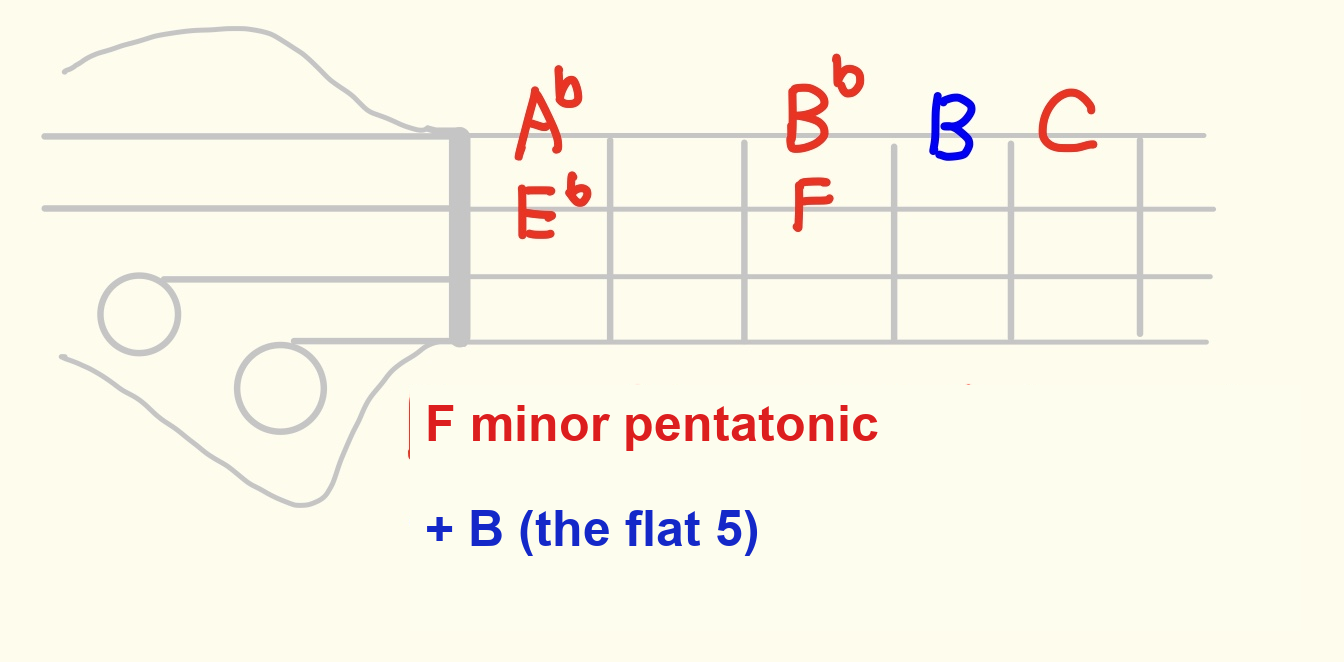
the note B (F’s ♭5), and you get that bluesy sound.
The full name is something like “minor pentatonic scale plus flat 5,” but that’s a mouthful, so I’ll just call it the “minor pentatonic” here.
The defining feature of this minor pentatonic is:
It sounds convincingly “bluesy” no matter where you start or stop.
Example: Phrases You Can Use
I built some phrases by combining these six notes.
• Starting on B:
Moving: B → B♭ → A♭ → F.
• Holding the B note:
Moving: F → A♭ → B♭ → B.
• Starting on A♭:
Moving: A♭ → F → E♭ → F.
• Holding the A♭ note:
Moving: F → B → B♭ → A♭.
And just combining those four phrases together gets you this:
— and it already sounds convincingly “bluesy.”
Taking It Further
From here on is the advanced section.
Blues bass solos often go on for several choruses.
Staying in just one position the whole time takes a fair amount of rhythmic variation to keep interesting, so let’s expand your options by adding positions an octave below and an octave above.
The Pentatonic Scale, an Octave Down and an Octave Up
If you broaden your view like this, here’s how many positions become available to you:

Memorizing all of it is a lot, so personally, I mostly rely on the range highlighted in yellow here:

How to Add Variation Using Register
Let’s try adding variation by changing register.
For example, play around the 3rd and 4th strings in the low frets for the first chorus.

For the second chorus, move to the low frets on the 1st and 2nd strings.

For the third chorus, play slightly higher notes on the 1st and 2nd strings.

Also keep your note density lower toward the beginning and build it up toward the end.
Shaping the dynamics this way makes the whole thing sound a lot more polished.
Notes That Sound Distinctly “Bluesy”
Looking at the fretboard below, which spots do you think sound like a distinctly “bluesy” color?

I ask this in lessons fairly often, and most people point to these two circled notes.

Relative to the root F, these two circled notes are called “blue notes” (yes, as in the name of the famous jazz club).
Using these blue notes makes it much easier to get that gritty, “bluesy” feeling into your sound.
Some F blues tunes that come up often at sessions include:
“Now’s the Time”
“Straight, No Chaser”
“Bags’ Groove”
“Billie’s Bounce”
“Au Privave”
“Bags’ Groove” in particular has a tempo that isn’t too fast, and plenty of phrasing worth studying, so definitely give it a listen.
I hope this gives you a solid starting point for your next blues solo — and once the minor pentatonic feels comfortable, getting feedback on how you’re actually applying it is the natural next step.
Want Personalized Feedback on Your Playing?
This is exactly the kind of thing that’s hard to fix alone — and where having a teacher makes all the difference.
At Line on Bass, I offer an online lesson service where you send me a video of your playing, and I give you specific, detailed feedback — every single day if you want.
Students from around the world are using this to fix exactly these kinds of issues and steadily improve their jazz bass skills.