This article is written by Toru Hoshino, a jazz bassist and instructor based in Japan who teaches online lessons to students worldwide. In this article, he answers a student’s question: how do you build a walking bass line when the same chord lasts for two bars in a row?
I got this question from a student:
“When the same chord continues for two bars, how should I play over it?”
So I put this article together to answer it.
In jazz standards, you’ll often run into chord progressions where the same chord lasts two bars or more. A lot of people aren’t sure how to approach that, so let’s dig in.
Contents
Building a Bass Line When the Same Chord Lasts Two Bars
Say you’ve got a progression like C–C–D–D.
As a general rule, you want the first note of each bar to be the root. But if you do that here…

…it ends up sounding like this. And honestly, this doesn’t really show off what makes a walking bass line work.
In a case like this, it helps to think of the first two bars as one unit, and aim for:
connecting the first note of bar 1 to the root of bar 3, using all 8 notes across those two bars as one continuous line.
Thinking of it that way makes it much easier to create a smooth, flowing line.
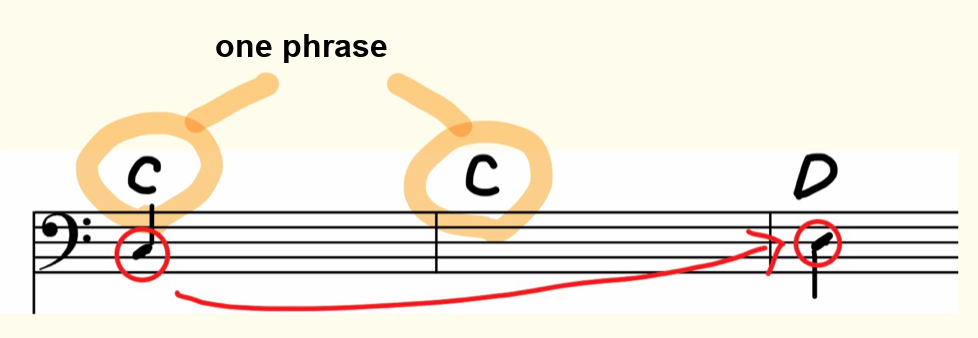
So at this point you might be thinking: “okay, what about something like this instead?”

And yeah, in theory that’s exactly the idea. That said, running straight up “do-re-mi-fa-so-la-ti-do” like that is a little too plain and predictable, so let’s add a bit more flavor to it.
With that in mind, let’s pull a few real examples from actual jazz standards and see how this plays out in practice.
Three Real Examples of Two-Bar Chord Walking Lines
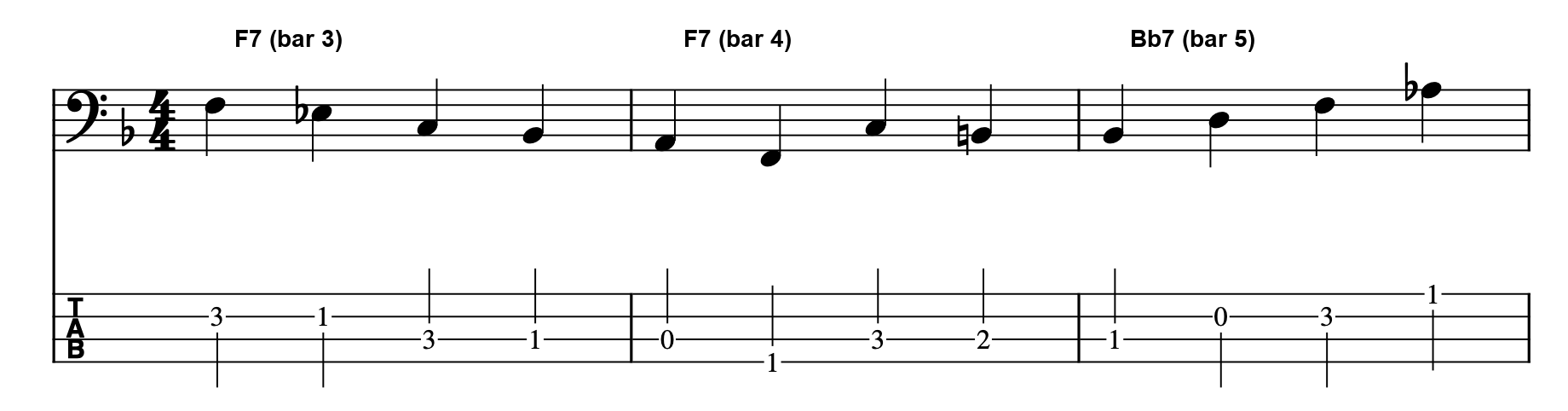
Bars 3–5 of an F Blues

The Key Idea
F7 lasts through both bar 3 and bar 4 here. Rather than starting bar 4 on the root, F, I deliberately started it on the major 3rd, A.
The line is already descending from the F at the start of bar 3, and by not interrupting that descent, the motion carries smoothly straight through into bar 4.
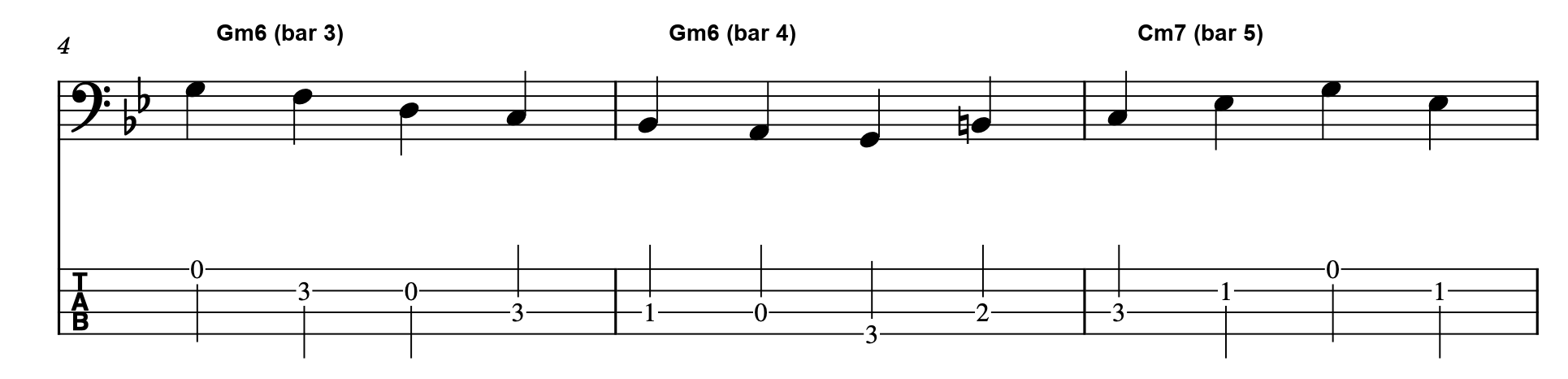
The B Section of Autumn Leaves, Bars 3–5

The Key Idea
Gm6 lasts through bar 3 and bar 4 of the B section here. Instead of starting bar 4 on the root, G, I started it on the minor 3rd, B♭.
The line is descending from the G on the first string in bar 3, and keeping that downward motion going lets it flow smoothly into bar 4 as well.
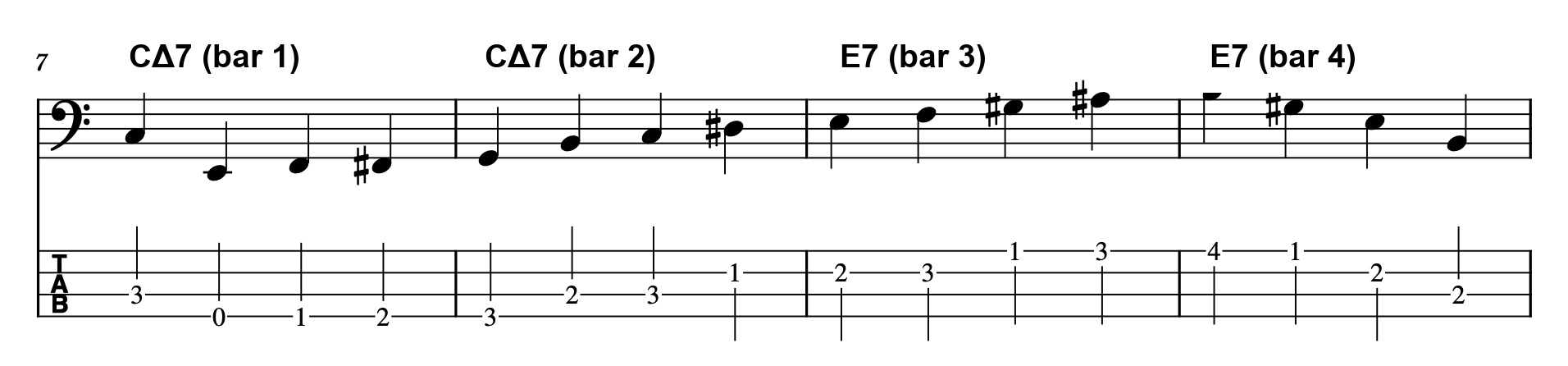
Bars 1–3 of All of Me

The Key Idea
Starting on C at the top of bar 1, I jump down to the open E string on the 4th string as the second note, then climb back up from there into the root, E, at the start of bar 3.
If you’ve ever been unsure how to build a bass line when the same chord sticks around for two bars or more, give this approach a try.
Want Personalized Feedback on Your Playing?
Figuring out which chord tone to land on at the start of a long static chord — and whether your line actually flows smoothly into it — is much easier to judge with a second pair of ears.
This is exactly the kind of thing that’s hard to fix alone — and where having a teacher makes all the difference.
At Line on Bass, I offer an online lesson service where you send me a video of your playing, and I give you specific, detailed feedback — every single day if you want.
Students from around the world are using this to fix exactly these kinds of issues and steadily improve their jazz bass skills.