This article is written by Toru Hoshino, a jazz bassist and instructor based in Japan who teaches online lessons to students worldwide. In this article, he reviews a compact preamp pedal that gets surprisingly close to an upright bass tone on electric bass.
Today I want to talk about a pedal that gets you closer to an upright bass sound: the OneControl Crimson Red Bass Preamp.
The video I posted reviewing this pedal got an unusually large number of views in a short time — that’s never happened to me before — so I wanted to write it up properly here as well.
Contents
A Pedal That Gets You Closer to an Upright Bass Tone: OneControl Crimson Bass Preamp
After actually using this pedal for a while, there are three things I really liked about it:
1. It suits walking bass really well
2. It doesn’t make your tone sound cheap
3. It’s tiny and easy to carry around
Let me walk through each of these, and along the way I’ll also answer some questions I got from readers and viewers after the video went up.
1. It Suits Walking Bass Really Well
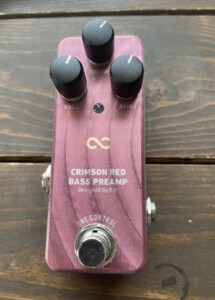
I think this is a sound that’s genuinely well suited to walking bass.
A lot of people associate walking bass with upright bass specifically. Plenty of people play walking lines on electric bass these days too, of course — but if your strings sound too bright and modern, it can end up missing that “upright bass feel” people are often going for.
This pedal gives you a warm low end that really holds down the bottom, so the tone pairs really well with walking bass lines.
2. It Doesn’t Make Your Tone Sound Cheap
Another thing I like is that it doesn’t cheapen your sound.
I was a little worried going in that it might turn everything muddy and kill the definition in the tone. But in practice, it colors the sound without losing much of the original character.
The fact that it doesn’t sound cheap once you engage the effect is a real point in its favor.
3. It’s Tiny and Easy to Carry Around
Last point: the size.
It’s genuinely small — smaller than a smartphone.

That makes it easy to throw in a bag, and it’ll work great in a studio setting too.
It only has three knobs — VOLUME, GAIN, and BRILL — so it’s simple and easy to dial in.
That covers the review itself. Now let’s get into some questions I received from readers and viewers after the video went up.
Reader and Viewer Questions
Q: The design of the Crimson Bass Preamp I’m about to buy looks a little different from the one in your video. What’s going on there?
A: It’s probably just been redesigned since I filmed. Kaz Kawamura, the head of One Control, actually shared my video and mentioned it might be the first video out there featuring the new design — so I think the version I reviewed is the newer one, and other versions you might see online could be the earlier design.
Q: How does it sound through a silent upright bass?
A: It pairs really well with a silent upright too — you get a nice, rich low end out of it.
Q: Does it actually sound like a real upright bass?
A: Not exactly, no. An upright bass produces sound through its body, while an electric bass produces sound through an amp — so fundamentally, they’re never going to sound identical.
That said, what this pedal gives you is great in its own right. I did a quick before-and-after comparison playing through it in the video, which is worth checking out if you want to hear the difference for yourself.
So, that covers three things I really liked about this preamp pedal that gets you closer to an upright bass tone.
If you’re after that upright feel, there are other routes too — fret wraps, flatwound strings, and so on — but those change your sound pretty dramatically. A pedal like this is a much smaller commitment if you just want to dip a toe in. Worth giving a try.
Want Personalized Feedback on Your Playing?
Gear can get you part of the way to a great walking bass tone, but it’s your actual line construction and feel that does most of the work — and that’s much easier to dial in with outside feedback.
This is exactly the kind of thing that’s hard to fix alone — and where having a teacher makes all the difference.
At Line on Bass, I offer an online lesson service where you send me a video of your playing, and I give you specific, detailed feedback — every single day if you want.
Students from around the world are using this to fix exactly these kinds of issues and steadily improve their jazz bass skills.