This article is written by Toru Hoshino, a jazz bassist and instructor based in Japan who teaches online lessons to students worldwide. In this article, he shares what actually changed in his playing style after switching to 5-string bass.
If you’ve only ever played a 4-string bass, you’ve probably wondered what a 5-string is actually like to play — I was right there too.
I haven’t been playing 5-string for all that long myself, but it’s been about five years since I started using one regularly. And in that time, one thing about my playing style changed significantly compared to my 4-string days: my right hand.
Specifically, when finger-picking, I stopped resting my right hand on top of the pickup. That’s the single biggest change.
Back when I only played 4-string, my approach was:
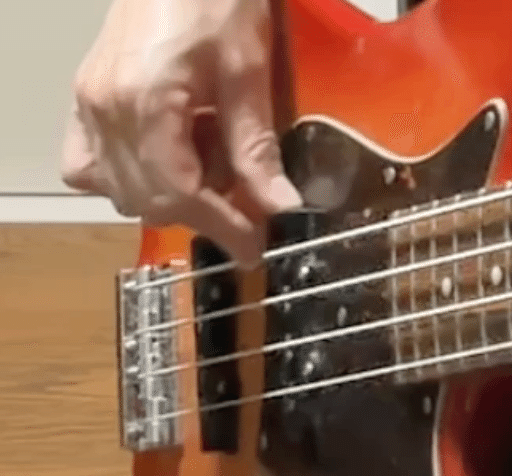
Playing the 3rd/4th strings → right hand resting on the pickup
Playing the 1st/2nd strings → right hand resting on the 4th string
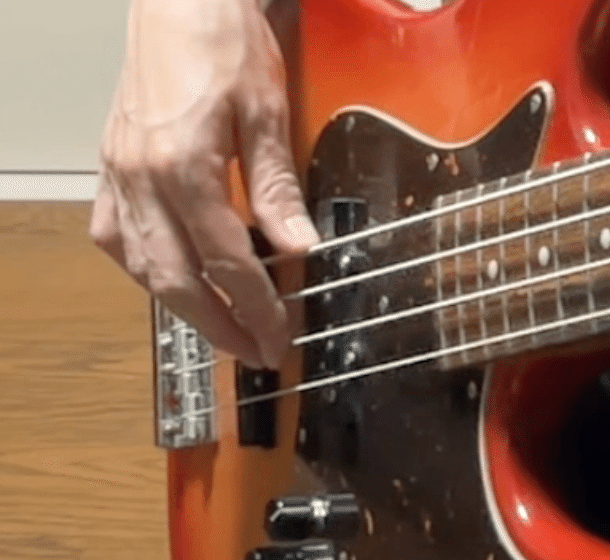
That was roughly my style. But since picking up the 5-string, I now keep my thumb off both the strings and the pickup entirely, resting it lightly against the strings instead.
Here’s roughly what that looks like:
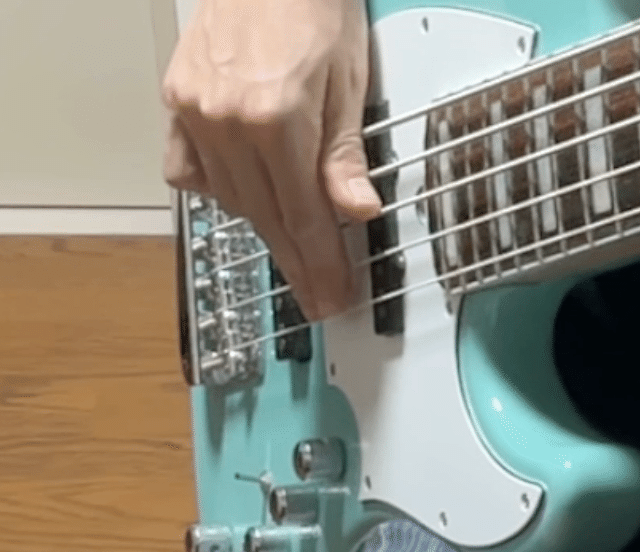
The reason I landed on this form is that my old approach made muting genuinely difficult on a 5-string.
With 5 strings, resting your hand on the pickup puts you a long way from the 1st string, and there are more strings you need to mute at any given time — which meant I was constantly relying on my right thumb for muting, and before I knew it, I’d drifted away from the pickup entirely.
These days, I find myself lifting my thumb off the pickup even on 4-string basses fairly often too (depending on the phrase). But this new approach has genuinely made muting easier than it used to be.
I originally picked up the 5-string simply because more of my students were playing one, but it turned into an unexpected discovery, and I’m having a lot of fun with 5-string bass these days.
For what it’s worth, I barely ever actually play that 5th string itself!
A shift like this in your right-hand form is hard to evaluate just by feel — having a teacher watch your hand position directly is the fastest way to tell if it’s actually working for you.
Want Personalized Feedback on Your Playing?
This is exactly the kind of thing that’s hard to fix alone — and where having a teacher makes all the difference.
At Line on Bass, I offer an online lesson service where you send me a video of your playing, and I give you specific, detailed feedback — every single day if you want.
Students from around the world are using this to fix exactly these kinds of issues and steadily improve their jazz bass skills.