This article is written by Toru Hoshino, a jazz bassist and instructor based in Japan who teaches online lessons to students worldwide. In this article, he shares one move that instantly adds a jazz flavor to phrases over a ii-V-I progression.
The “ii-V-I” progression is one of the most common chord movements in jazz — things like:
Dm7 → G7 → C△7
Cm7 → F7 → B♭△7
Fm7 → B♭7 → E♭△7
It comes up constantly, so it’s worth having a variety of go-to moves over it. Here’s one approach that instantly gives a phrase that “jazz” quality:
- Use the ♭9th over the dominant chord
- Land on the 3rd over the tonic chord
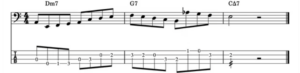
Here’s a phrase I built around exactly that idea:
Contents
A Quick Word on “Dominant” and “Tonic”
Before getting into the specific notes, a quick word on “dominant” and “tonic” — these refer to a chord’s harmonic function. In a progression like Dm7 → G7 → C△7 (in the key of C), G7 is the dominant and C△7 is the tonic.
Using the ♭9th Over the Dominant
In the phrase above, the circled note is the “♭9th.”
“♭9th” sounds complicated, but it’s simply the note a half step above the chord’s root.
Working this ♭9th note into a dominant chord is what gives a phrase that distinctly “jazz” edge.
Landing on the 3rd Over the Tonic
After creating that edge over the dominant, if you then land your phrase on the 3rd of the tonic chord, the tension built up over the dominant resolves, and the phrase wraps up with a clean, pleasing harmony.
Building up your freedom to weave moves like “use the ♭9th over the dominant” and “land on the 3rd over the tonic” into your improvising is a great way to expand your vocabulary.
Hearing exactly where to place a ♭9th so it lands with intention rather than just sounding off is the kind of judgment that’s hard to self-assess — a teacher catches it instantly.
Want Personalized Feedback on Your Playing?
This is exactly the kind of thing that’s hard to fix alone — and where having a teacher makes all the difference.
At Line on Bass, I offer an online lesson service where you send me a video of your playing, and I give you specific, detailed feedback — every single day if you want.
Students from around the world are using this to fix exactly these kinds of issues and steadily improve their jazz bass skills.