Hi, everyone.
I’m Toru Hoshino, an upright and electric bassist and instructor based in Tokyo.
From January 2012 to January 2013, I spent a year in New York on what I’d call a jazz training pilgrimage.
Even now, I still get students mentioning they read my old blog about that year of struggling through New York. So this is a column written while looking back on that time.

Contents
How Was Studying in New York?
If you ask me how it went, I’d say it was great. I had all kinds of experiences there.
In my case, I went over not as a music student, but technically as a language student. At the time, I hadn’t saved up nearly enough money to go to a music school — especially a jazz program — and actually live there.
There’s no shortage of places calling themselves “jazz schools,” but the unofficial ones, while cheaper, can’t issue the visa you need for a long-term stay.
From what I found, the legitimate jazz schools in New York ran anywhere from about $15,000 to $30,000 a year — and that’s before living expenses and rent.
New York’s cost of living is high, so even being frugal, you’d probably need something like $45,000 just to get by.
On top of that, I heard the workload at these schools is heavy, a part-time job would be tough to manage, and a lot of them are strict about who they even let in.
Once the numbers got that far out of reach, I gave up on the idea of going to music school entirely.
A language school was a different story, though. The visa requirements weren’t nearly as strict, and the one I ended up attending cost roughly $4,000–$5,000 a year.
So my plan was: study English, practice jazz on the side, hit jam sessions, and grind it out.
So How Was the Jazz Scene in America?

People still ask me what the New York jazz scene was actually like. Here’s a taste of what I went through.
The Time I Walked Up to Smalls and Turned Around

I went to the famous Manhattan jam session house, Smalls. But I got so nervous my legs went stiff and started shaking, and I walked right up to the door and then went home.
On the train ride back, with nobody around to even hear me, I desperately tried to convince myself it was because my stomach hurt, or my head hurt — anything but the truth.
Finally Walking Into Smalls and Joining a Session


I’d heard the weekday early-evening session at Smalls had a lower barrier to entry than the late-night one, so I finally joined in. Even so, it was on a completely different level than anything I was ready for. Usually it’s rare for the bass player to get to call a tune, but…
I told them “I’m a beginner” and basically forced my way into picking a tune myself.
Getting Scolded for Looking at iReal Pro
There was no music stand set up in front of the bass player at Smalls, so whenever a tune got called that I didn’t know, I’d set my iPhone down by my feet and sneak glances at the chart.
The host bassist caught me and told me, “You’re supposed to have the tunes memorized.”
Almost Nobody Was Reading Charts
I was shocked by how few people were actually playing off sheet music. Everyone had an insane number of tunes memorized. People would casually call for a transposition on the spot, and everyone else would just as casually deliver.
Watching everyone breeze through an instrumental version of “The Very Thought of You” in the key of A♭ without batting an eye, I remember thinking: there’s no bottom to how deep this goes.
Getting Scolded for Not Knowing Rhythm Changes in Every Key
I was floundering through a rhythm-changes tune in A♭, and got told that you’re supposed to be able to play rhythm changes in every key.
Getting Told to Go Study English Instead of Jazz
Someone called “Caravan,” but somehow I misheard it as “If I Were a Bell” and confidently started playing something completely different. The tune fell apart, and the Black trumpet player on the bandstand at the time gave me a look that said “please, never come back,” and told me…
“You should go study English instead of trying to play jazz.”
I’m not really the type to drown my sorrows in drink, but that night, I did.
The “Conception” Incident
Someone asked me, “Do you know ‘Conception’?” I said “No.”
I didn’t even realize at first that “Conception” was the name of a tune.
They started playing it with only the musicians who could play it from memory. I thought, “wow, what a cool-sounding tune,” and looked it up on iReal Pro afterward — and was floored by how brutally difficult the chord changes were.
Watching a room full of players knock out a tune like that without breaking a sweat, I seriously asked myself whether I should just go home.
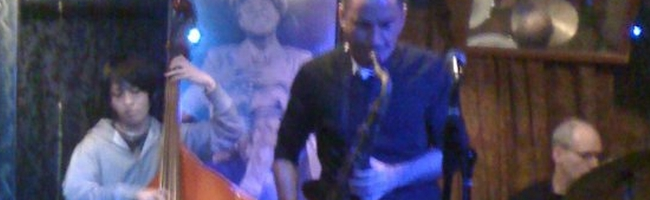
That photo above was taken at Smalls around that time.
Burnout and Homesickness
For the first two months or so, every day looked like that. No friends, completely unable to keep up — I was close to breaking. (At that point I’d only been playing jazz for a little over three years.)
I got homesick and wanted to go back to Japan.
Living costs ran higher than I’d planned for, and with both my finances and my mental state running on empty, I kept spiraling into negative thinking.
The One Sentence That Changed Me

There was one comment that snapped me out of all that moping.
I was having tea with a Japanese woman who’d just become a classmate of mine at the language school. She was a singer who’d flown out to New York with almost no savings.
“First I gotta get a part-time job. Then work hard on my English, work hard on my singing…”
“If you’re doing all that, won’t you have no time to sleep?”
“Then I just won’t sleep — gotta enjoy it! I came all the way out to a city of art, after all.”
For some reason, that line really hit me. Bit by bit, my whole mindset started to shift.
I started thinking, “I came all this way — I shouldn’t narrow my world down. I should actually enjoy living here.”
Money was getting tight too, so I picked up a late-night job at a karaoke bar. Outside of that it was school, practice, and jam sessions three or four nights a week.
I barely slept — plenty of nights I’d only get an hour. My body clock and nervous system were probably a little fried from it, but even so, I sacrificed sleep to make the most of it.
Beyond the music, I picked up all kinds of experiences I’d never had before — working for money, earning tips, hanging out with people from other countries outside of any formal setting.
I kept getting more and more aggressive about it, more forward-looking. I made friends, started a band. Right before I left, I even got to play a few live shows at a local club, and the night before I flew home, we held a CD release event.
(The photo at the top of this article is from the recording studio session around that time.)
Is Studying Abroad Actually Worth It?
Honestly, I don’t know if studying abroad is automatically a good thing. I know plenty of people who went all that way and came home early because it just didn’t suit them.
You have to rebuild from zero the practice environment and the community of fellow musicians that you took for granted back home. More than anything, it takes a kind of relentless drive.
Still, even though it was a genuinely hard experience, looking back now, getting to soak in real, authentic jazz every single day was an incredibly valuable thing to go through.
My whole perspective changed too. I decided that even after coming back to Japan, I wanted to keep a global outlook and get back out into the world every year.
It’s been a little over two years since then. Last year I ran a successful tour in Vietnam.
And this year, I got an offer from a musician friend I knew back when I lived in New York — this time for a gig next door, in Korea.
Today, in fact, I’m playing a live show in a town in Korea called Gumsan.
Those moments where music lets you cross borders like that — they’re pretty special.
Want Personalized Feedback on Your Playing?
This is exactly the kind of thing that’s hard to fix alone — and where having a teacher makes all the difference.
At Line on Bass, I offer an online lesson service where you send me a video of your playing, and I give you specific, detailed feedback — every single day if you want.
Students from around the world are using this to fix exactly these kinds of issues and steadily improve their jazz bass skills.