This is part of an ongoing series on bass solos and improvisation.
This time, I want to share a small but handy trick you can use in your bass solos: the ♭9 (flat ninth).
Contents
What This Article Covers
This article is written by Toru Hoshino — a jazz bassist and instructor based in Tokyo who has played bass on an estimated 1,000+ jam sessions around the city and continues to perform and teach today. It’s for anyone who:
· Isn’t sure how to put together an improvised solo
· Wants to add some new ideas to their solo vocabulary
· Feels like their phrases never quite sound “jazzy” enough
This time, I’ll explain the ♭9th — a note that comes in incredibly handy over dominant chords in a ii–V–I progression.
First, give it a listen.
A Few Phrases That Use the ♭9th
Example 1
Without the ♭9th

With the ♭9th

Don’t those feel pretty different, even though only one note changed? The first one isn’t bad at all — but the second has a bit more “character” to it.
Let’s look at one more example.
Example 2
Without the ♭9th

With the ♭9th

Just like in Example 1, only one note is different — but again, that distinctive flavor shows up in the second version.
That’s because both of these examples use the ♭9 note.
Put simply, the ♭9th is “the 2nd degree, flatted.” Even more simply: it’s the note right next to the chord’s root on the fretboard.
In Example 1, that’s A♭ against G:

In Example 2, that’s B against B♭:

Point: Adding the ♭9th over a dominant chord is an easy way to bring a real jazz flavor into your sound — and it’s conveniently easy to reach on the bass fretboard too.
Tension Notes and Dominant Motion
In jazz, when a seventh chord resolves through dominant motion, players often reach for tension notes like the ♭9th.
Let’s go over what “tension notes” and “dominant motion” actually mean.
Tension Notes and the ♭9th
A chord is built by stacking notes from a scale every other note. Sometimes that stacking goes beyond one octave — those extra notes are called tension notes.
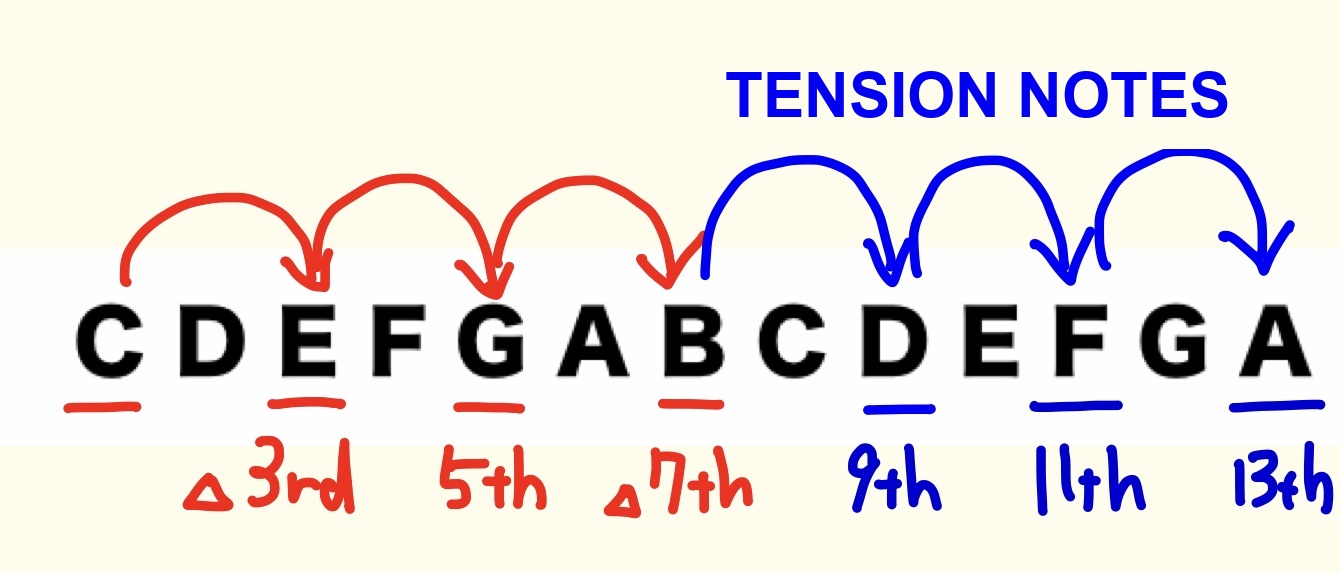
The 9th note here (the D) gets flatted to become the ♭9th.
In this example, against a C, the note D♭ is the ♭9th.
Reading it out like that every time is a bit much, though, so it’s common to just refer to the note right next to the root on the fretboard as the “♭9th” — in other words, the flatted 2nd.

To put it another way — yes, that’s basically it.
What Is Dominant Motion?
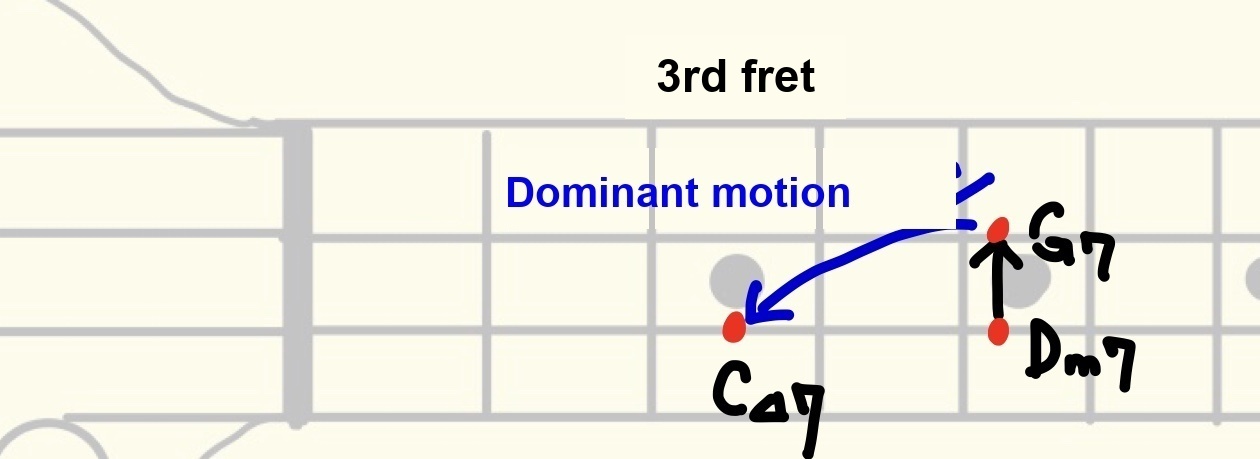
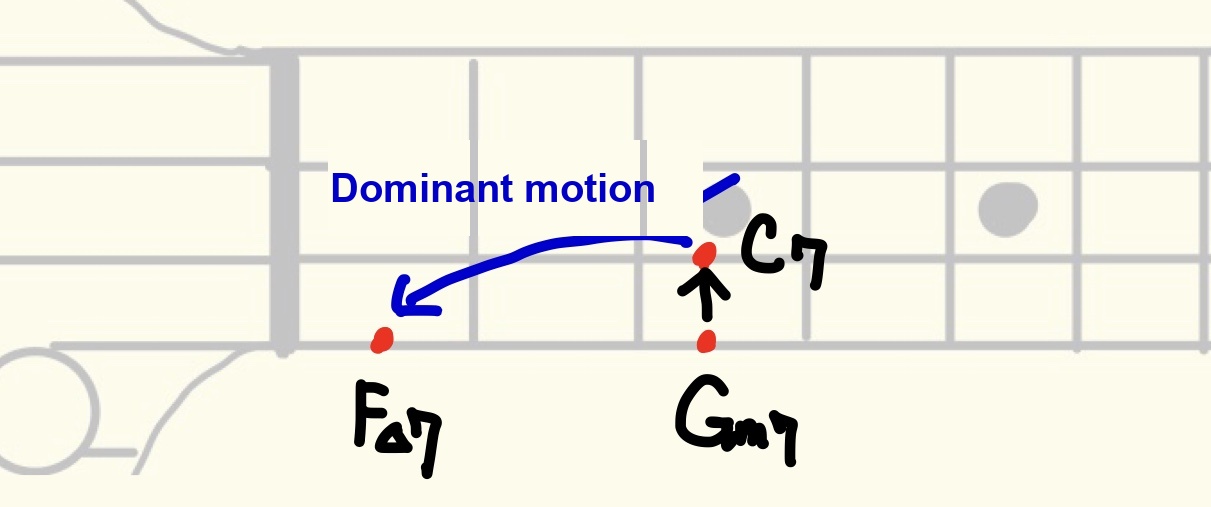
In a ii–V–I progression, the move from the dominant chord to the tonic is called “dominant motion.”
G7 to CΔ7, as dominant motion:
C7 to FΔ7, as dominant motion:
In jazz, this is often where players add real tension to the sound, and tension notes are a common way to do that.
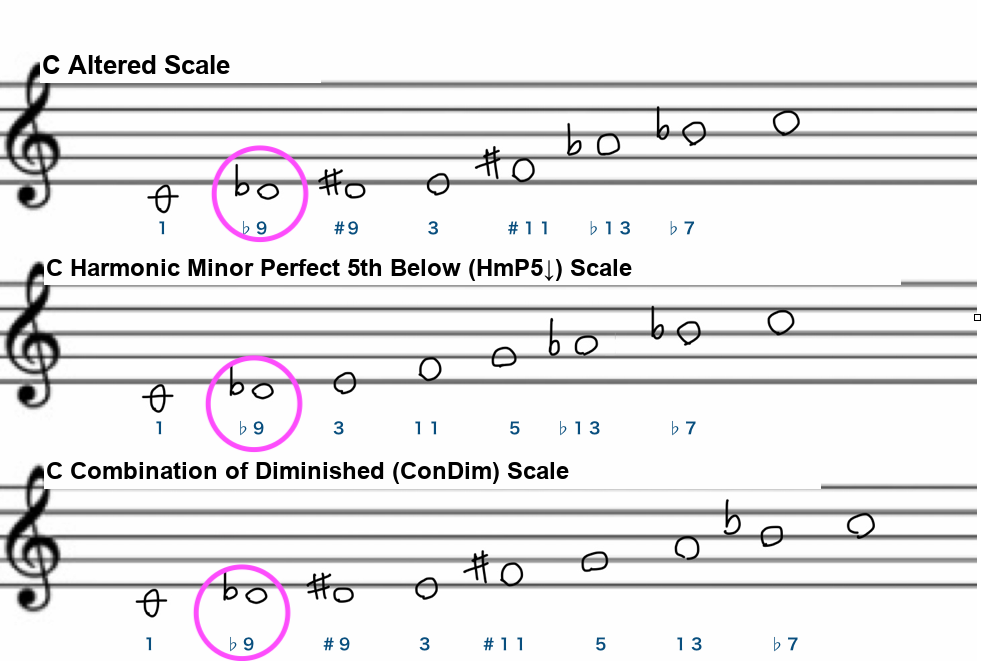
Some of the scales where tension notes show up most are:
Altered Scale
Harmonic Minor Perfect 5th Below Scale
Combination of Diminished (ConDim) Scale
…and the ♭9th shows up in every one of them.
I get it — jumping straight into using these scales fluently can feel like a tall order.
That’s exactly why I’d recommend starting with just the ♭9th — marked in pink in the diagrams above — over dominant seventh chords. It’s far more approachable on the fretboard, and a great first step.
Tips for Using the ♭9th in Your Solos
To really make the ♭9th part of your improvising vocabulary, it helps to build it into muscle memory.
A good way to do that is to start using it outside of your solos too — specifically, while you’re playing walking bass behind someone else.


Used this way, the ♭9th fits naturally into walking bass lines over dominant progressions too. The more your ear gets used to hearing it, the better — so give it a try.
That’s it for this small but handy trick you can use in your bass solos: the ♭9 (flat ninth).
Want Personalized Feedback on Your Playing?
This is exactly the kind of thing that’s hard to fix alone — and where having a teacher makes all the difference.
At Line on Bass, I offer an online lesson service where you send me a video of your playing, and I give you specific, detailed feedback — every single day if you want.
Students from around the world are using this to fix exactly these kinds of issues and steadily improve their jazz bass skills.