Hi, I’m Toru Hoshino, a bass teacher and performer based in Tokyo, playing both upright and electric bass.
In this article, I built a walking bass line over an F blues progression and went through it note by note, explaining the role of every single note.
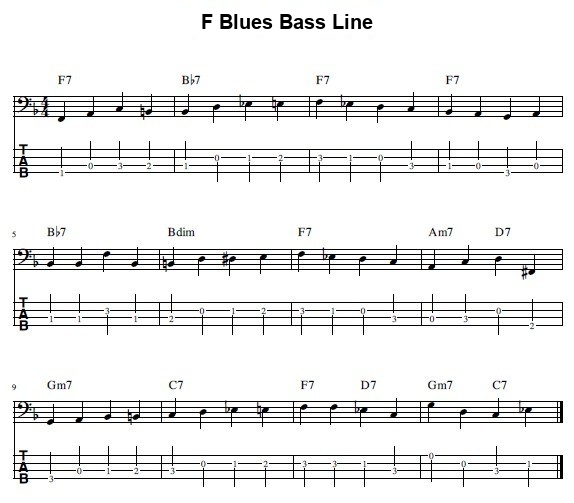
This ended up being a pretty long, in-depth breakdown, going through every note one at a time — so feel free to bookmark it and come back when you have time to read through it properly.
Contents
An F Blues Walking Bass Line, Analyzed One Note at a Time
Here’s a breakdown of every note used in this line.
The First 4 Bars

Bar 1

Note 1: F (the root of F7)
Note 2: A (the major 3rd of F7)
Note 3: C (the 5th of F7)
Note 4: B (a chromatic passing tone connecting note 3, C, to the first note of the next chord, B♭)
Through note 3, we’re using chord tones — root, 3rd, 5th.
Note 4 is a chromatic passing tone, which is what gives the line that jazz-flavored sound.
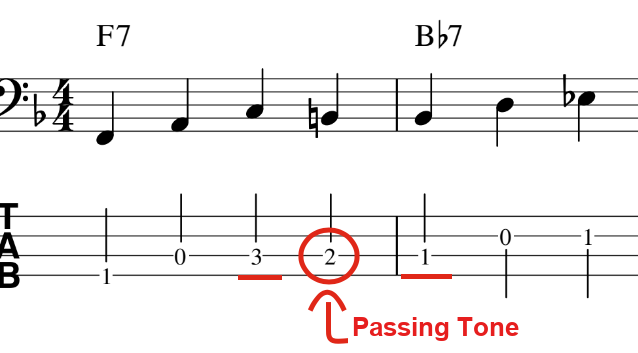
I go into passing tones in a lot more detail in this article:
Passing Tones: A Key Building Block for Jazz Bass Lines
Bar 2

Note 1: B♭ (the root of B♭7)
Note 2: D (the major 3rd of B♭7)
Note 3: E♭ (the 4th of B♭7)
Note 4: E (a chromatic passing tone connecting note 3, E♭, to the first note of the next chord, F)
Bar 2 also uses a chromatic passing tone.
Bar 3

Note 1: F (the root of F7)
Note 2: E♭ (the b7th of F7)
Note 3: D (the 6th of F7)
Note 4: C (the 5th of F7)
Bar 4
Note 1: B♭ (the 4th of F7)
Note 2: A (the major 3rd of F7)
Note 3: G (the 2nd of F7)
Note 4: A (the major 3rd of F7)
Bar 4 is also F7, but I treated bars 3 and 4 as one combined unit over F7, so I didn’t use the root again as the first note of bar 4.
A lot of people get stuck on how to build a bass line when the same chord lasts two bars in a row, so I wrote a dedicated article on that. Worth a look if that’s something you run into:
Walking Bass Lines When One Chord Lasts Two Bars (With 3 Real Examples)
Bars 5–8

Bar 5

Note 1: B♭ (the root of B♭7)
Note 2: B♭ (the root of B♭7)
Note 3: F (the 5th of B♭7)
Note 4: B♭ (the root of B♭7)
Bar 6

※ “Bdim7” is read as “B diminished seventh.”
Note 1: B (the root of Bdim7)
Note 2: D (the minor 3rd of Bdim7)
Note 3: E♭ (the major 3rd of Bdim7)
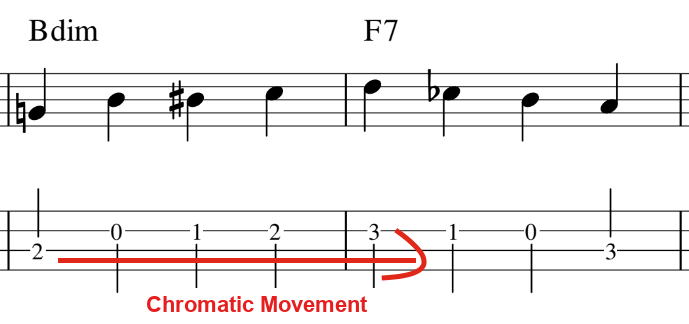
Note 4: E (a chromatic passing tone leading from note 3, E♭, to the first note of the next chord, F)
For note 2, I used D, the major 3rd. That note technically isn’t part of the standard diminished scale, but…
From note 2 of bar 6 (D) all the way to note 1 of bar 7 (F), every note moves chromatically, one half step at a time.
That’s the idea — keeping the line smooth and connected.
Bar 7

Note 1: F (the root of F7)
Note 2: E♭ (the b7th of F7)
Note 3: D (the 6th of F7)
Note 4: C (the 5th of F7)
Same as bar 3.
Bar 8

Note 1: A (the root of Am7)
Note 2: C (the minor 3rd of Am7)
Note 3: D (the root of D7)
Note 4: F♯ (the major 3rd of D7)
Bars 9–12

Bar 9

Note 1: G (the root of Gm7)
Note 2: A (the 2nd of Gm7)
Note 3: B♭ (the minor 3rd of Gm7)
Note 4: B (a chromatic passing tone leading from note 3, B♭, to the first note of the next chord, C)
This is the same passing-tone approach used in the line going from bar 1 into bar 2.
Bar 10

Note 1: C (the root of C7)
Note 2: D (the 2nd of C7)
Note 3: E♭ (the minor 3rd of C7)
Note 4: E (the major 3rd of C7)
C7 is a major-type chord, but I used the same idea here as the move from bar 6 into bar 7:
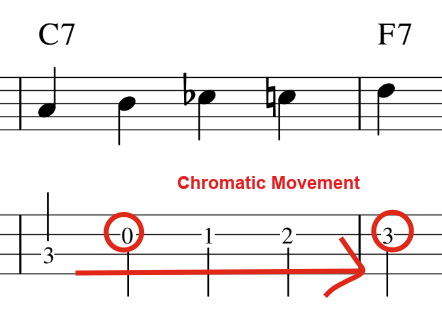
connecting note 2 of bar 10 (D) to note 1 of bar 11 chromatically
to keep the line smooth.
Bar 11

Note 1: F (the root of F7)
Note 2: F (the root of F7)
Note 3: E♭ (the b7th of F7)
Note 4: C (the 5th of F7)
Bar 12

Note 1: G (the root of Gm7)
Note 2: D (the 5th of Gm7)
Note 3: C (the root of C7)
Note 4: E♭ (the minor 3rd of C7)
And that’s every note in this line, explained in full.
I hope this is useful for your practice! ☺
Once You’ve Played It a Few Times, Try Improvising Your Own!
Once you’ve played through this a few times and gotten a feel for it, I’d really encourage you to take a chord chart like the one below and try building your own walking bass line over it on the fly.
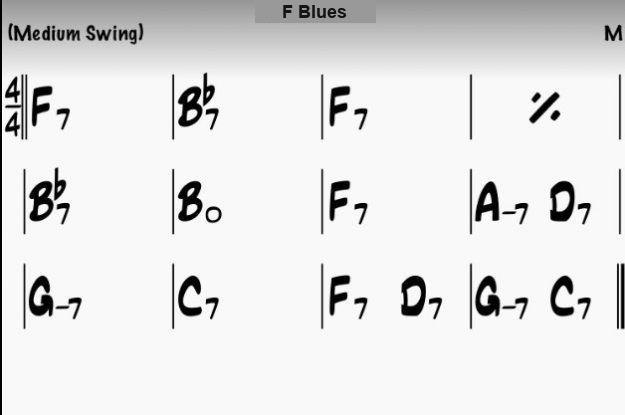
It’s not always obvious how to approach that at first, but breaking it down chord by chord — root, chord tones, and the occasional chromatic passing tone — like we did above is a great place to start.
Thanks so much for reading all the way through!
Want Personalized Feedback on Your Playing?
This is exactly the kind of thing that’s hard to fix alone — and where having a teacher makes all the difference.
At Line on Bass, I offer an online lesson service where you send me a video of your playing, and I give you specific, detailed feedback — every single day if you want.
Students from around the world are using this to fix exactly these kinds of issues and steadily improve their jazz bass skills.