This article is written by Toru Hoshino, a jazz bassist and instructor based in Japan who teaches online lessons to students worldwide. In this article, he clears up three commonly confused points about the 3rd, 5th, and 7th in walking bass.
The 3rd, 5th, and 7th are critical degrees for walking bass, but a lot of players end up holding onto a slightly mistaken understanding of them. This article cleans up three points where I see confusion come up often. Use it as a refresher on the underlying theory.
Here’s what we’ll cover:
- The 3rd is the key note separating major chords from minor chords
- Some chords have a flatted 5th
- Watch the difference between “△7” and “7”
Contents
1. The 3rd Is the Key Note Separating Major and Minor Chords
Let’s start with the basics of the 3rd. Chords broadly fall into two camps: “minor-type” chords and “major-type” chords.
Minor-type chords are the ones with a lowercase “m” next to the letter — “Cm,” “Cm7,” “Cm7(♭5),” and so on.

Major-type chords are the ones without that “m” — “C,” “C△7,” “C7,” and so on.

What actually creates that “m”-or-not difference is the 3rd.
Comparing C and Cm: C is built from C, E, G, while Cm is built from C, E♭, G — the 3rd is the note that’s different.
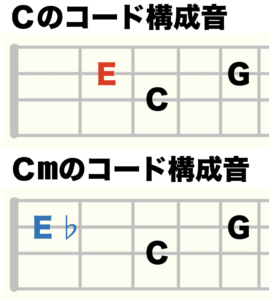
Top: the chord tones of C major. Bottom: the chord tones of C minor — note the E vs. E♭.
Play C and Cm as a chord on a piano, and they sound completely different in character. So when you’re building a bass line around a chord, choosing the right note while staying clear on major versus minor really matters.
2. Some Chords Have a Flatted 5th
One thing that comes up often in jazz: chords with a flatted 5th.
The 5th is easy to visualize and use even if you don’t fully understand the theory behind it — for C, the 5th is G; for D, it’s A.
It’s the note two strings over (toward the thinner strings) and two frets up, or the same fret on the neighboring thicker string.
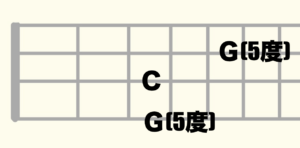
The 5th (G) of a C chord on the fretboard.
But every once in a while, you’ll run into a chord where the 5th is flatted. This is called a “minor seventh flat five” chord, written as “m7(♭5).”
For Cm7(♭5), the 5th becomes G♭ — a half step down from the usual 5th.
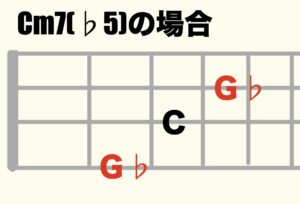
The flatted 5th (G♭) in a Cm7(♭5) chord.
It’s easy to assume the 5th always lives in the same spot, but jazz tunes are full of (♭5) chords like this, so it’s something to watch closely when building a walking bass line.
3. Watch the Difference Between “△7” and “7”
Last up: the difference between “△7” and plain “7.” This is a point I correct often in lessons, and a lot of players mix the two up.
What separates a triangle-7 from a plain 7 is the 7th.
C△7 is built from C, E, G, B. C7 is built from C, E, G, B♭. The 7th is the note that’s different.
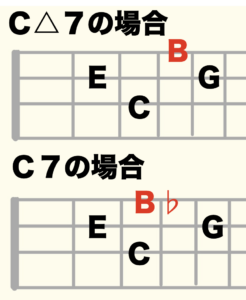
Top: C△7, with B as the 7th. Bottom: C7, with B♭ as the 7th.
It’s just the difference between B and B♭, but a small difference like that has a major effect on the sound — so understanding the △7-versus-7 distinction matters.
That wraps up “the 3rd, 5th, and 7th” — three things well worth knowing if you’re working on walking bass. If you’re just getting into theory, keep this in the back of your mind; it’ll come in handy.
Hopefully this is useful for your daily practice.
These degree-by-degree distinctions are exactly the kind of thing that’s easy to get backwards in your own playing without realizing it — having a teacher check your bass lines catches it fast.
Want Personalized Feedback on Your Playing?
This is exactly the kind of thing that’s hard to fix alone — and where having a teacher makes all the difference.
At Line on Bass, I offer an online lesson service where you send me a video of your playing, and I give you specific, detailed feedback — every single day if you want.
Students from around the world are using this to fix exactly these kinds of issues and steadily improve their jazz bass skills.