This article is written by Toru Hoshino, a jazz bassist and instructor based in Japan who teaches online lessons to students worldwide. In this article, he explains why “note duration” matters so much, and how just evening it out can change the quality of your playing.
In lessons, I often tell students to “hold that note out fully” — and that comment is really about note duration: how long each note actually lasts, not just which note you’re playing or when you start it.
Contents
What Is “Note Duration”?
Put simply, note duration is just how long a note actually lasts.
Written out, it looks roughly like:
An eighth note: “ta”
A quarter note: “taa”
A half note: “taaaa”
A whole note: “taaaaaaa”
What I Often Point Out in Lessons
Most of my students are working on walking bass, so this is a comment I make constantly:
“Pay attention to keeping your note durations even in your walking bass line.”
A walking bass line is typically four quarter notes per bar — “taa, taa, taa, taa.” But once a position shift or a leap enters the picture:
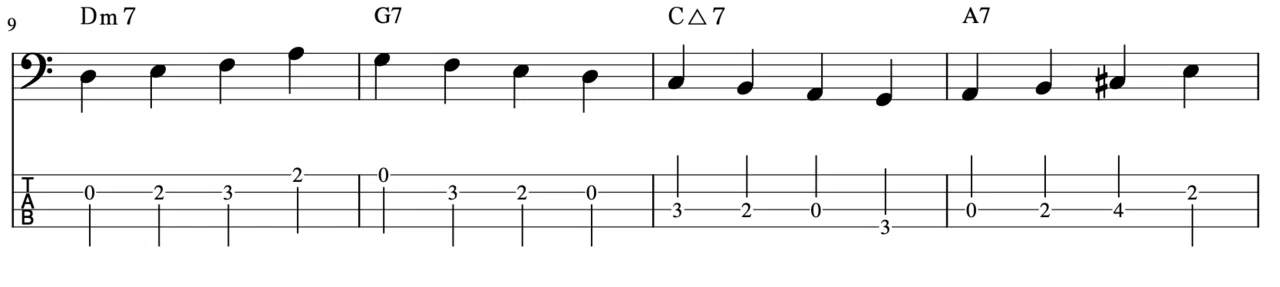
You’ll sometimes hear:
“taa, ‘ta‘, taa, taa”
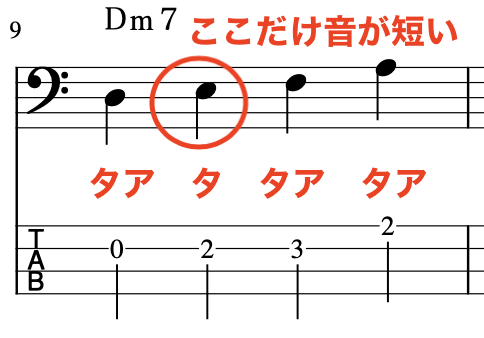
The note circled in red gets cut short during the position shift.
or:
“taa, taa, ‘ta‘, taa”
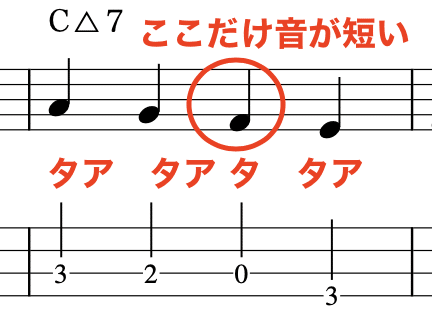
Again, the circled note ends up clipped short — this time on a different beat.
where one single note in the middle of an otherwise even quarter-note flow gets cut noticeably short.
When that happens, the evenness of the note durations breaks down, and that can directly hurt your sense of groove.
So paying attention to whether your note durations stay even is genuinely important.
How Do You Fix It?
Fixing uneven note durations really does require dedicated practice, but more than anything else, I think awareness is what matters most.
Just holding a strong mental intention of “I’m going to play this evenly” while you practice will change your results.
Hearing whether your own note durations are actually even is surprisingly hard to judge by ear alone — it’s exactly the kind of thing a teacher catches instantly from the outside.
Want Personalized Feedback on Your Playing?
This is exactly the kind of thing that’s hard to fix alone — and where having a teacher makes all the difference.
At Line on Bass, I offer an online lesson service where you send me a video of your playing, and I give you specific, detailed feedback — every single day if you want.
Students from around the world are using this to fix exactly these kinds of issues and steadily improve their jazz bass skills.