This article is written by Toru Hoshino, a jazz bassist and instructor based in Japan who teaches online lessons to students worldwide. In this article, he explains when it makes sense to skip the root on the first beat of a bar — and when it doesn’t.
A lot of players want to try skipping the root on the first note of a walking bass bar — it’s a sound a lot of people are drawn to. Here’s an example: in bar 2 below, the chord is C, but the circled first note of that bar isn’t the root.
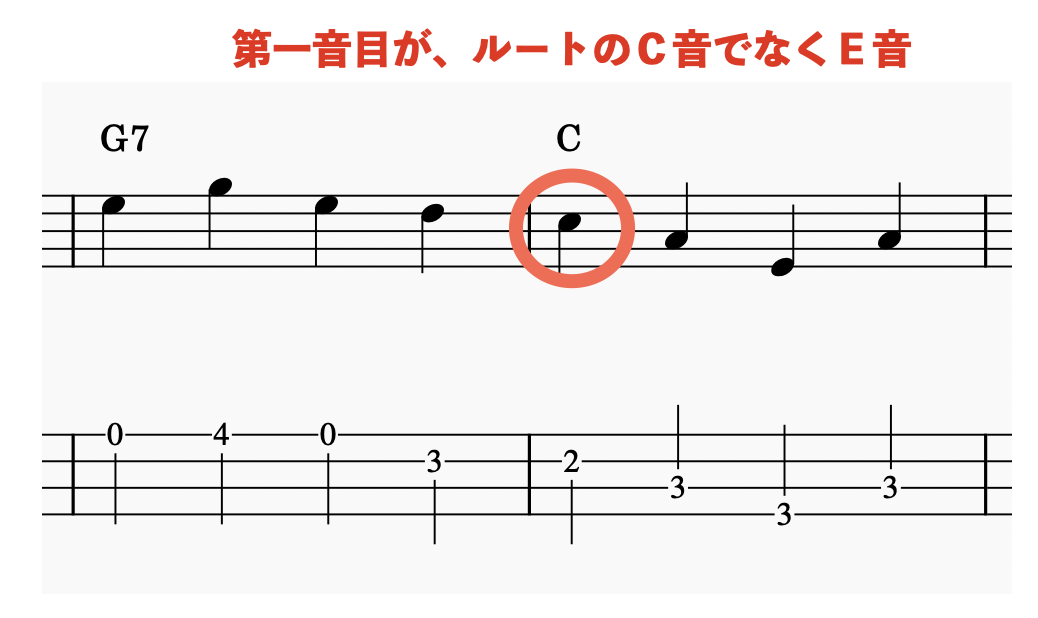
Generally speaking, the first note of a chord should be the root. With that as your baseline, being able to casually pull off a non-root first note can make your line sound stylish and more melodic, depending on how you build it. The 3rd in particular tends to blend in naturally with the backing harmony when you skip the root this way.
There’s one important caveat, though: when you’re playing the melody — the “theme” — keeping the root on beat 1 is usually the better call.
That’s because melodies are usually written with the chord’s root already in mind.
Contents
Melodies Are Usually Built Around the Chord’s Root
Take a look at this:

This is the chord progression for “Fly Me to the Moon.” In this tune, the melody’s 3rd often lands right on the first beat of the bar.
If you then think “let’s skip the root!” and also make the bass line’s first note the 3rd in those same spots, you can end up with two 3rds clashing against each other, which often doesn’t harmonize well and can sound off rather than cool.
Example 1: First Note of Every Bar Played as the 3rd
This is a bass line where every bar’s first note is the 3rd. It’s not exactly wrong, but if you’re going this route, the approach below tends to fit better.
Example 2: First Note of Every Bar Played as the Root
Here I simply played the root straight on the first note. Compared to Example 1, doesn’t this one feel like it fits more naturally?
Conclusion
Keep the root on beat 1 during the melody, and save root-skipping approaches for when you’re improvising, depending on how the music is flowing.
Of course, there are plenty of exceptions to this. But hopefully this gives you a useful way to think about root-skipping approaches on the first beat of a bar.
Knowing exactly when to bend a rule like this one is hard to judge entirely on your own — it’s the kind of nuance a teacher can flag immediately by listening to your playing.
Want Personalized Feedback on Your Playing?
This is exactly the kind of thing that’s hard to fix alone — and where having a teacher makes all the difference.
At Line on Bass, I offer an online lesson service where you send me a video of your playing, and I give you specific, detailed feedback — every single day if you want.
Students from around the world are using this to fix exactly these kinds of issues and steadily improve their jazz bass skills.