This article is written by Toru Hoshino, a jazz bassist and instructor based in Japan who teaches online lessons to students worldwide. In this article, he shares why a small elbow adjustment can solve one of the most common pinky-finger struggles on bass.
“My pinky just won’t reach when I play bass.”
If that’s you, this article walks through a simple way to fix it.
The key is your elbow.
Contents
Push Your Elbow Forward
I posted about this on Twitter recently:
手が小さい女性や、指が短くて小指が届かないという方にヒントで、こんなふうにヒジをくぐっと前に出すようにすると、小指が勝手に乗ってきます。見栄えにも影響しないので、運指がうまくいかないと悩む方は試してみるといいかも! pic.twitter.com/RwahiywUhj
— ほしの🎸元パンベース講師 (@jazzbassisttoru) July 4, 2019
Just a Slight Forward Push of the Elbow
I have a student whose pinky finger is noticeably short, but who still uses it with total confidence. He’s just a regular high school student.

I asked him, “How are you able to use your pinky so well?” — my own fingers happen to be long, so it’s never been something I had to work around.
He said, “When I use my pinky, I push my elbow in pretty hard.”
Here’s roughly what that looks like.
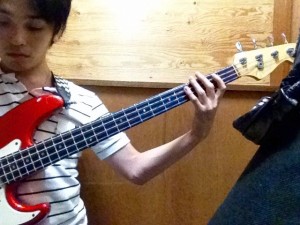
This is a typical playing position:
And here’s the student’s version:
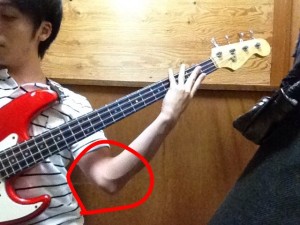
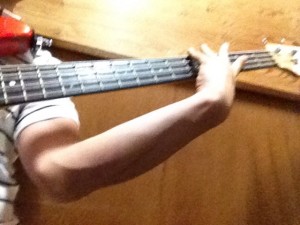
The idea is to push your elbow forward just a little — a gentle nudge, not a hard shove.
Do that, and your pinky lands on the string almost on its own.
If Your Pinky Is Short, Try Pushing Your Elbow Forward
There’s only so much you can do about the actual length of your pinky finger.
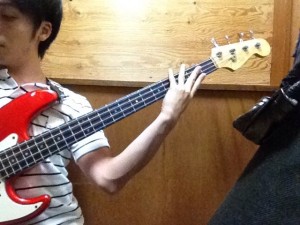
When that’s the issue, try pushing your left elbow forward a bit.
It won’t affect how your form looks, either.
Wrapping Up: Bass Playing Form
Building a form that actually fits your body will speed up your progress.
[PLACEHOLDER — link to the English version of the “bass form” article (right hand, left hand, strap length, angle) once it’s translated]
Thanks so much for reading this far!
Small details like elbow position are exactly the kind of thing that’s hard to judge by watching yourself — but easy to spot with a second pair of eyes.
Want Personalized Feedback on Your Playing?
This is exactly the kind of thing that’s hard to fix alone — and where having a teacher makes all the difference.
At Line on Bass, I offer an online lesson service where you send me a video of your playing, and I give you specific, detailed feedback — every single day if you want.
Students from around the world are using this to fix exactly these kinds of issues and steadily improve their jazz bass skills.