This article is written by Toru Hoshino, a jazz bassist and instructor based in Japan who teaches online lessons to students worldwide. In this article, he breaks down a chord symbol that confuses a lot of newer jazz players: the half-diminished “ø.”
This one’s aimed at jazz beginners or anyone who’s just started studying music theory.
One of the most common questions I get in lessons is about this symbol:

This chord — the circle with a diagonal slash through it — is read as “A minor seven flat five.”
The name’s a mouthful, but it’s also just shorthand for “Am7(♭5).”
What Is a Minor Seven Flat Five?
A minor seven flat five chord is defined by one thing: the 5th of the minor seven chord is flattened.
For example, the chord tones (root, 3rd, 5th, 7th) of Am7 are:
A (root)
C (minor 3rd)
E (5th)
G (minor 7th)
But for Am7(♭5), the chord tones are:
A (root)
C (minor 3rd)
E♭ (diminished 5th)
G (minor 7th)
So the 5th — E versus E♭ — is the difference.
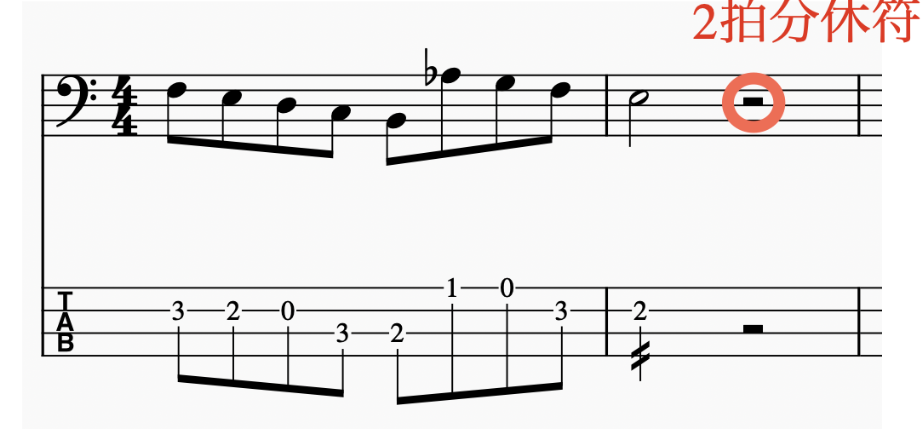
This means if you want to build an eighth-note walking bass line over Am7(♭5) that uses the 5th, you need to move like this:

and not this:

Where Half-Diminished Chords Show Up in Jazz
This part gets a little more theoretical, and some unfamiliar terms may come up, but bear with me.
A very common jazz progression is the “ii-V-I”:
Bm7 → E7 → A△7
That final chord, A△7, functions as the “tonic” — the chord that creates a sense of resolution and stability.
Sometimes, depending on the tune, the tonic ends up being a minor chord instead:
Bm7 → E7 → Am7
In this case, to make the harmonic motion flow more smoothly, it’s common to flatten the 5th of that first minor chord, Bm7:
Bm7♭5 → E7 → Am7
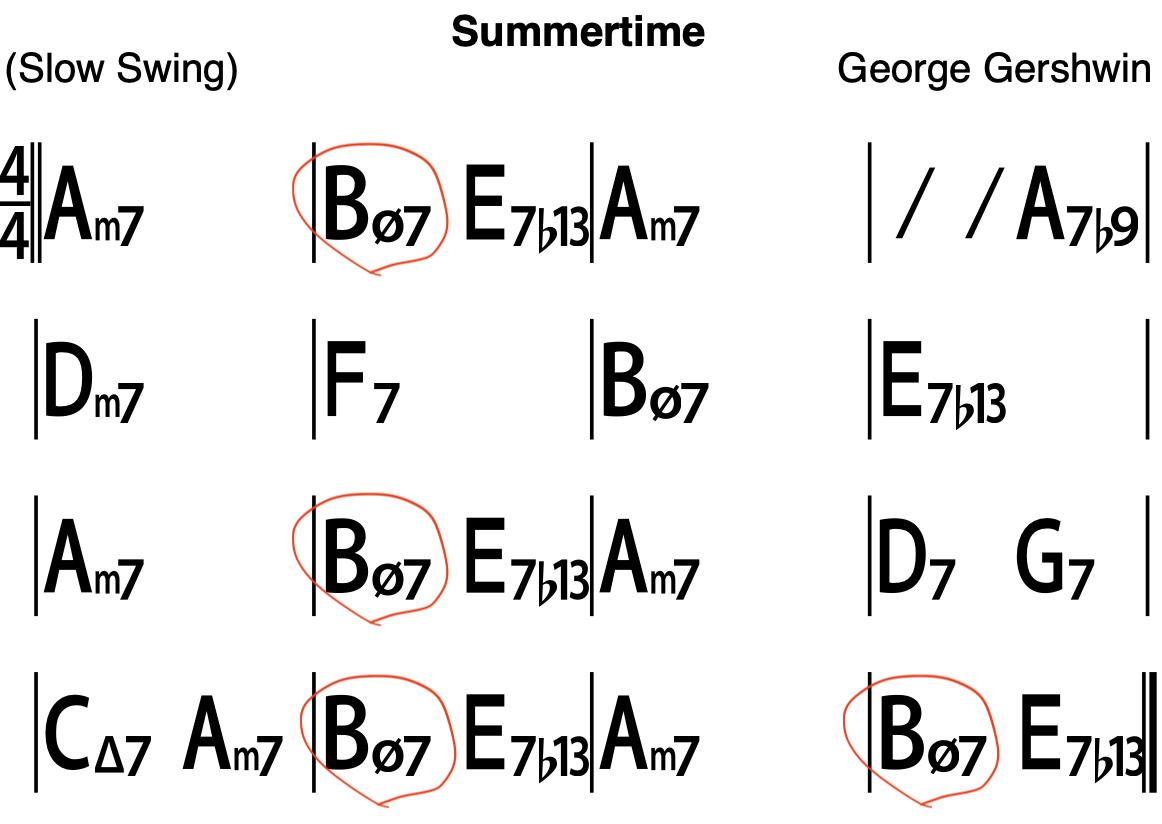
This creates a more atmospheric, evocative minor sound, and it’s exactly the progression used in the jazz standard “Summertime,” by George Gershwin.
Theory like this clicks a lot faster when someone can point out exactly where it shows up in a tune you’re already working on — which is exactly what a teacher is for.
Want Personalized Feedback on Your Playing?
This is exactly the kind of thing that’s hard to fix alone — and where having a teacher makes all the difference.
At Line on Bass, I offer an online lesson service where you send me a video of your playing, and I give you specific, detailed feedback — every single day if you want.
Students from around the world are using this to fix exactly these kinds of issues and steadily improve their jazz bass skills.