This article is written by Toru Hoshino, a jazz bassist and instructor based in Japan who teaches online lessons to students worldwide. In this article, he shares a more advanced walking bass technique: building lines that don’t always start each bar on the root.
This one’s for anyone who’s thought, “my approach to building bass lines feels a little one-note.” Today we’re covering a more advanced way to construct a walking bass line: deliberately not playing the root as the first note of the bar.
Contents
A Bass Line That Deliberately Skips the Root on Beat 1
Here’s a bass line over the first 16 bars of “Fly Me to the Moon.”
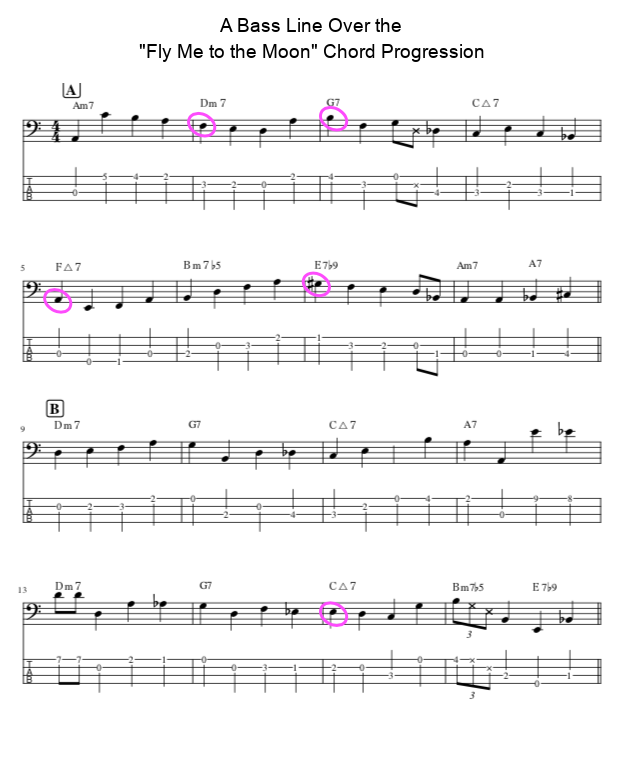
Give it a listen — does it sound natural to you, with no real sense of anything “off”?
Here are 3 things I kept in mind while building this line, plus 3 things to watch out for.
3 Things I Kept in Mind
1. Keeping the Flow Smooth
Take bar 2: starting on F (the minor 3rd of Dm7), the line moves F (m3rd) → E (9th) → D (root) → A (5th).
Looking back from the previous bar, the Am bar’s 2nd through 4th notes form a smooth descending line: C → B → A. Rather than awkwardly forcing a jump from that 4th note, A, straight to D (the root of the upcoming Dm7), I deliberately landed instead on F (the m3rd of Dm7) — to keep that smooth descending motion intact.
2. Landing on the 3rd
As in bar 2, I land on the 3rd a lot throughout this line. The 3rd is the note that splits major from minor in character, which makes it a great note for projecting a chord’s distinct flavor. In short: when you’re not leading with the root, leading with the 3rd instead is a solid, reliable choice.
3. Mixing in the Root Too
Even after landing on the 3rd, I make a point of working the root in shortly after — doing this gives the whole bar a clear sense of the underlying chord. One detail: if the root shows up as the 2nd note right after a 3rd-note start, it can sound like the root landed a beat late by mistake. So I deliberately placed the root as the 3rd note of the bar instead.
3 Things to Watch Out For
Don’t Overdo It
As a baseline, it’s still ideal for the first note of a bar to be the root, most of the time. Use a non-root opening note here and there, as more of an occasional accent. In this example, only 5 bars out of 16 open on a note other than the root.
This Works Better During Improvising Than During the Melody
During the melody (the “head”), the actual tune’s melody is often written assuming the bass is anchoring the chord’s root underneath it. “Fly Me to the Moon,” for instance, often has its main melody starting on the 3rd of the chord. If the bass also starts every line on the 3rd while that’s happening, the two can clash. So save non-root opening notes mainly for when you’re improvising, not for when you’re backing the melody.
Be Careful Around Section Changes
A tune typically has an A section, B section, C section, and so on — and those section boundaries are important moments of change. If you use a non-root note right where a new section begins, that shift can be harder for the listener (and the rest of the band) to feel clearly. So it’s best to stick with the root specifically at section boundaries.
Hopefully this gives you a useful next step beyond always opening a bar with the root.
Added later: I also covered this non-root-opening approach in a video, using a Paul Chambers performance as a reference point — well worth checking out if you want to hear how a legend approached the same idea.
Knowing when it’s the right moment to break from the root is a judgment call that’s hard to make reliably on your own — a teacher can tell you in real time whether a given choice actually landed well.
Want Personalized Feedback on Your Playing?
This is exactly the kind of thing that’s hard to fix alone — and where having a teacher makes all the difference.
At Line on Bass, I offer an online lesson service where you send me a video of your playing, and I give you specific, detailed feedback — every single day if you want.
Students from around the world are using this to fix exactly these kinds of issues and steadily improve their jazz bass skills.