This article is written by Toru Hoshino, a jazz bassist and instructor based in Japan who teaches online lessons to students worldwide. In this article, he shares a rhythm drill for tightening up the precision of a bossa nova bass line.
This drill is a little involved, but it’s genuinely effective for training non-swung, straight-eighth-note feels — bossa nova, eighth-note-driven rock, pop, and similar styles. (There’s also a video walkthrough linked near the bottom if you’d rather watch than read.)
Contents
A Slightly Tricky Rhythm Drill
This is a drill I come back to myself on a regular basis. Set your metronome to click only on the “&” of beat 2 and the “&” of beat 4, using F and C as your two notes. Set the tempo to around 60 bpm, and try playing exactly that.
…and you’ll probably find it’s genuinely hard to lock in.
If You Can’t Quite Land It
First, get a feel for what “the & of beat 2 and the & of beat 4” actually means. Here’s the idea:
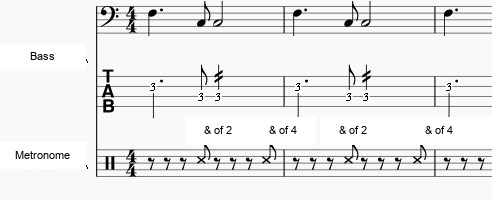
Even once you understand the mechanics, actually keeping up with it in real time is still genuinely difficult. When you’re struggling to lock in, try singing it out loud first to get a feel for it.
Use these syllables: sing “da” on beat 1, “da” again on the “&” of beat 1, “dee” on beat 2, and then “DIT” exactly where the metronome clicks, on the “&” of beat 2 — then repeat the same “da-da-dee-DIT” pattern for beats 3 and 4, landing the second “DIT” on the “&” of beat 4 where the metronome clicks again.
Once You’ve Got That, Try Playing It
Using just F and C, try this:
1st note attacks on “da” (dotted quarter note)
held through “da”
held through “dee”
2nd note attacks on “DIT” (eighth note — this is where the metronome clicks)
1st note attacks on “da” (half note)
held through “da”
held through “dee”
held through “DIT” (this is where the metronome clicks)
Give that a try.
What This Drill Trains
By deliberately attacking notes in the silent gaps between clicks and making the metronome “catch up to you” instead of the other way around, your rhythmic precision gets a real workout. It’s especially effective for sharpening eighth-note accuracy, which makes it great practice for eighth-note rock, pop, and bossa nova alike.
How to Practice It
Start with just two notes, as shown above. Early on, you genuinely won’t be able to lock in without singing it first — if you can’t sing it, that’s a sign you haven’t internalized it yet, and you won’t be able to translate it to your hands either.
Once you can hold that for a stretch, move on to phrases that actually show up in real tunes. In “The Girl from Ipanema,” for example, a bass line like this comes up often. Once you can play a line like that cleanly for 3 or 4 choruses, starting from nothing, your sense of rhythm will have genuinely sharpened.
Hopefully this is a useful addition to your practice routine.
Getting these off-beat attacks to actually lock in takes real-time feedback that’s hard to give yourself — a teacher can tell immediately whether you’re really landing the click or just close to it.
Want Personalized Feedback on Your Playing?
This is exactly the kind of thing that’s hard to fix alone — and where having a teacher makes all the difference.
At Line on Bass, I offer an online lesson service where you send me a video of your playing, and I give you specific, detailed feedback — every single day if you want.
Students from around the world are using this to fix exactly these kinds of issues and steadily improve their jazz bass skills.