This article is written by Toru Hoshino, an upright bass player and teacher based in Tokyo.
It’s aimed at:
· Those picking up an upright bass for the first time
· Those who are about to start learning upright bass
· Those who want to revisit and refine their playing posture
*Different schools and teachers approach upright bass technique differently, so please treat this article as one reference among others, rather than the only correct way.
Contents
Posture
How to Stand
Keep your back straight, but don’t lean back too far.

That said, a hunched back looks unnatural too.

Aim for a relaxed, natural standing position.

Front view:

Foot Width
Set your feet about shoulder-width apart.

Standing with your feet too close together makes it hard to play,

and standing with your feet too far apart looks unnatural as well.

Angle of the Strings
If the strings face too far inward, it’s hard to reach the E string (the thickest one).

On the other hand, if the strings face too far outward, you won’t be able to see the fingerboard.

In practice, you want a line of sight where you can see the E string (the thickest one) but barely see the others.
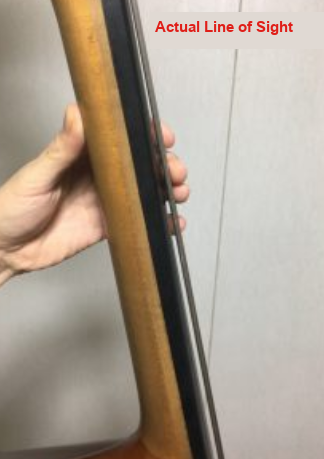
Front view.

Neck Position
If the neck is too far away from you, fretting notes with your left hand becomes a struggle, so position the neck so it isn’t too far out.

Personally, I play with the neck positioned roughly like this relative to my body.
Find a Position Where the Bass Stays Balanced Even With Your Hands Off
Unlike an electric bass, the upright bass has no strap, so your body always has to support it.
Ideally, you want a position where the bass stays balanced for a moment even if you let go like this:

Skilled players can keep the bass balanced like this for extended periods without using their hands at all.
The Notch Near Your Side/Waist
This part of the bass —

— tends to sit more stably when nestled against the notch just below your right side/waist.


An Instrument Where Form Really Matters
The upright bass has high string tension and a large body, so it’s genuinely hard to get a solid sound out of it when you’re just starting — but plenty of smaller-framed players still play it well.
That said, if your form stays awkward, you won’t get a solid sound, so it’s worth making good form a habit early on.
Also, the advice you’ll get can vary depending on your height, hand size, the genre you play, and the teacher you study with — so if you’re just starting out, it’s a good idea to have a professional check your form periodically.
Want Personalized Feedback on Your Playing?
This is exactly the kind of thing that’s hard to fix alone — and where having a teacher makes all the difference.
At Line on Bass, I offer an online lesson service where you send me a video of your playing, and I give you specific, detailed feedback — every single day if you want.
Students from around the world are using this to fix exactly these kinds of issues and steadily improve their jazz bass skills.