This article is written by Toru Hoshino, an upright bassist, electric bassist, and instructor based in Tokyo. I originally wrote it back in 2016.
A while back, I put a set of flatwound strings on my main P-bass for the first time.
I’d like to share my impressions after playing on flatwounds for a week.
Before that, though, let’s go over the difference between roundwound and flatwound strings.
Contents
The Difference Between Roundwound and Flatwound Strings
This is the kind of thing you’d see explained in a bass magazine.
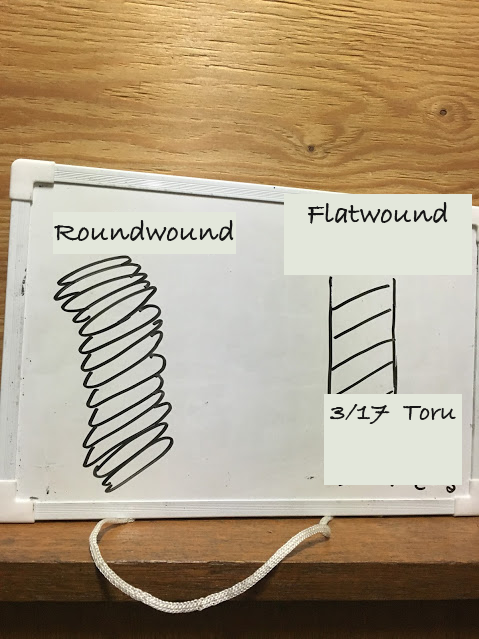
It comes down to a difference in string construction. Here’s a sketch I made to illustrate it.
Standard Roundwound
Roundwound strings are made by winding a thin, round wire around a core, and they’re the type used most widely on bass and guitar. They have a textured, slightly rough feel to the touch. They’re known for great sustain, with a bright tone and a fast attack. Whether it’s the punchy attack of a slap thumb, a snappy pull, or finger-style and pick playing, you get a sound rich in harmonic overtones. It’s fair to say that the vast majority of electric bass tone you hear comes from roundwound strings.
Flatwound, With Character
Flatwound strings, on the other hand, use a flat winding wire wrapped around the core, giving them a smooth surface with no texture. The tone is rounder, with the highs rolled off and a thicker midrange and low end. Rather than a modern, bright sound, it leans toward a vintage ’60s-’70s tone — the kind associated with funk and Motown-era recordings. Some players string up flatwounds specifically to chase that sound.
Which one you use really comes down to personal preference, but the vast majority of strings on the market today are roundwound. I didn’t even know flatwound strings existed until I started playing jazz.
Why I Switched From Round to Flat
It was the squeak.
It’s not an issue when I’m playing walking bass or a bass solo within an ensemble, but since I also do solo bass playing, that finger-squeak noise started bothering me.
When shifting position with the fretting hand, the texture of roundwound strings creates friction between the ridges of the winding and your finger, which is what causes that squeaking sound.
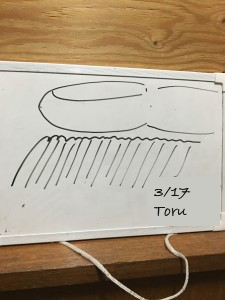
Alright, now for what you’ve been waiting for — my impressions.
My Impressions After a Week, As a Bassist Who’d Used Nothing but Roundwound for Over 10 Years
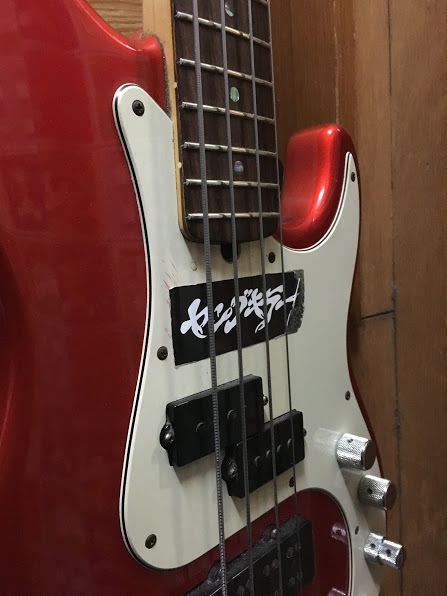
No Slide
Since the surface is coated and smooth, I figured it would slide easily under the fingers — but it’s actually the opposite. It barely slides at all. I was tempted to reach for some Finger Ease just to get around. It’s taking me a while to get used to it (and honestly, I still haven’t).
Slower Attack
Compared to roundwound, it’s a subtle difference, but through an amp, where a roundwound string gives that immediate “boi-i-i-ng” resonance the instant you touch it, the attack on flatwound feels more settled and composed. It feels like the rough edges and the excess overtones have been smoothed away.
Those are my two main impressions. Not particularly positive, not particularly negative — more of a “good and bad, both at once” kind of feeling.
The Flatwound Strings I Used
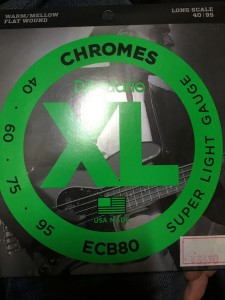
I went with D’Addario Chromes, the lightest gauge they make — 40-60-75-95.
Want Personalized Feedback on Your Playing?
This is exactly the kind of thing that’s hard to fix alone — and where having a teacher makes all the difference.
At Line on Bass, I offer an online lesson service where you send me a video of your playing, and I give you specific, detailed feedback — every single day if you want.
Students from around the world are using this to fix exactly these kinds of issues and steadily improve their jazz bass skills.