This article is written by Toru Hoshino, an upright and electric bassist and instructor based in Tokyo, for bassists who want to understand
the II-V-I
and
Tonic, Dominant, and Subdominant
Understanding what these mean and how they work will make analyzing a tune much faster.
I covered how to analyze a tune in this article, and getting faster at analysis means you can look at a chart and put together a bass line or an improvised solo more quickly too, which is especially useful if you’re:
• A bassist who composes
• A bassist who improvises
• A bassist studying music theory
• A bassist who wants to level up
• A bassist who plays in jam sessions
Contents
Tonic, Dominant, and Subdominant, Explained
Let’s try playing a bass line over a progression like this.

Example 1
That doesn’t really feel like it “ends,” does it? It feels like the tune is going to keep going.
Example 2
Now what about this one — doesn’t this feel like it actually comes to a rest?
Example 1 has that unresolved, hanging feeling — like something’s left unfinished.
Example 2 has a settled, resolved feeling — like things have wrapped up cleanly.
Looking at it in terms of chords:
Ending on the chord G7 creates that unresolved feeling (Example 1).

And arriving at the chord C△7 creates that resolved, settled feeling (Example 2).

The role that G7 plays here — creating that unresolved, hanging feeling — is called the “dominant.”
The role that C△7 plays — creating that resolved feeling — is called the “tonic.”
And then there’s a third role: a chord that’s neither as unresolved as the dominant nor as settled as the tonic — somewhere in between. That’s called the “subdominant,” and here that’s the Dm7 chord.

The last 3 bars of this example move:
subdominant ▸ dominant ▸ tonic
and this particular motion is widely considered very pleasant to the ear, and gets used constantly in jazz and pop music.

Since saying “subdominant, dominant, tonic” every time is a mouthful, this motion gets a shorthand name: the “II-V-I.”
What Is a II-V-I?
This builds directly on the diatonic chord chart.
| Key | I△7 | IIm7 | IIIm7 | IV△7 | V7 | VIm7 | VIIm7(♭5) | Key Signature |
|---|---|---|---|---|---|---|---|---|
| C | C△7 | Dm7 | Em7 | F△7 | G7 | Am7 | Bm7(♭5) | None |
| G | G△7 | Am7 | Bm7 | C△7 | D7 | Em7 | F♯m7(♭5) | 1 sharp |
| D | D△7 | Em7 | F♯m7 | G△7 | A7 | Bm7 | C♯m7(♭5) | 2 sharps |
| A | A△7 | Bm7 | C♯m7 | D△7 | E7 | F♯m7 | G♯m7(♭5) | 3 sharps |
| E | E△7 | F♯m7 | G♯m7 | A△7 | B7 | C♯m7 | D♯m7(♭5) | 4 sharps |
| B | B△7 | C♯m7 | D♯m7 | E△7 | F♯7 | G♯m7 | A♯m7(♭5) | 5 sharps |
| F♯ | F♯△7 | G♯m7 | A♯m7 | B△7 | C♯7 | D♯m7 | E♯m7(♭5) | 6 sharps |
| C♯ | C♯△7 | D♯m7 | E♯m7 | F♯△7 | G♯7 | A♯m7 | B♯m7(♭5) | 7 sharps |
| F | F△7 | Gm7 | Am7 | B♭△7 | C7 | Dm7 | Em7(♭5) | 1 flat |
| B♭ | B♭△7 | Cm7 | Dm7 | E♭△7 | F7 | Gm7 | Am7(♭5) | 2 flats |
| E♭ | E♭△7 | Fm7 | Gm7 | A♭△7 | B♭7 | Cm7 | Dm7(♭5) | 3 flats |
| A♭ | A♭△7 | B♭m7 | Cm7 | D♭△7 | E♭7 | Fm7 | Gm7(♭5) | 4 flats |
| D♭ | D♭△7 | E♭m7 | Fm7 | G♭△7 | A♭7 | B♭m7 | Cm7(♭5) | 5 flats |
| G♭ | G♭△7 | A♭m7 | B♭m7 | C♭△7 | D♭7 | E♭m7 | Fm7(♭5) | 6 flats |
| C♭ | C♭△7 | D♭m7 | E♭m7 | F♭△7 | G♭7 | A♭m7 | B♭m7(♭5) | 7 flats |
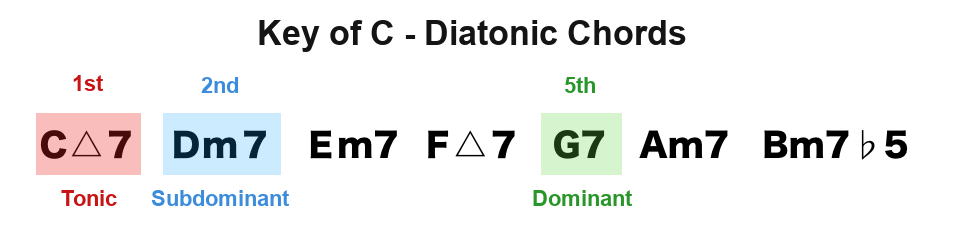
Going back to that subdominant ▸ dominant ▸ tonic motion, and applying it to the diatonic chords:
The 2nd chord is the subdominant
The 5th chord is the dominant
The 1st chord is the tonic
So:
The motion subdominant ▸ dominant ▸ tonic is what’s called a 2-5-1, or “II-V-I.”
That said, when you change key, the tonic and dominant chords change along with it, as shown below.
| Key | 1st (Tonic) | 2nd (Subdominant) | 5th (Dominant) |
|---|---|---|---|
| C | C△7 | Dm7 | G7 |
| G | G△7 | Am7 | D7 |
| D | D△7 | Em7 | A7 |
| A | A△7 | Bm7 | E7 |
| E | E△7 | F♯m7 | B7 |
| B | B△7 | C♯m7 | F♯7 |
| F♯ | F♯△7 | G♯m7 | C♯7 |
| C♯ | C♯△7 | D♯m7 | G♯7 |
| F | F△7 | Gm7 | C7 |
| B♭ | B♭△7 | Cm7 | F7 |
| E♭ | E♭△7 | Fm7 | B♭7 |
| A♭ | A♭△7 | B♭m7 | E♭7 |
| D♭ | D♭△7 | E♭m7 | A♭7 |
| G♭ | G♭△7 | A♭m7 | D♭7 |
| C♭ | C♭△7 | D♭m7 | G♭7 |
Looking at the table above:
In the key of F, Gm7 is the 2nd chord, C7 is the 5th chord, and F△7 is the 1st chord
In the key of G, Am7 is the 2nd chord, D7 is the 5th chord, and G△7 is the 1st chord
An Easier Way to Think About the II-V-I
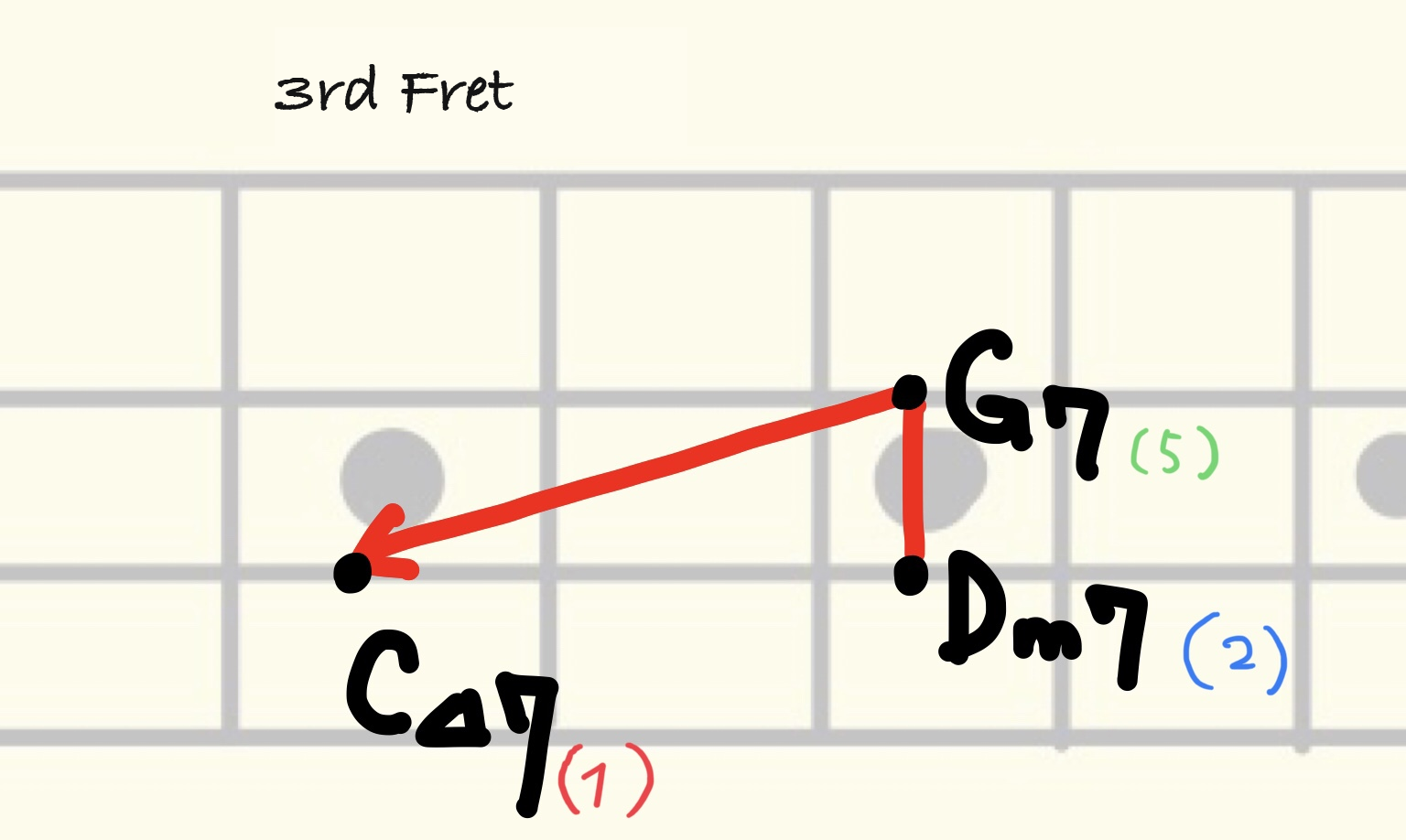
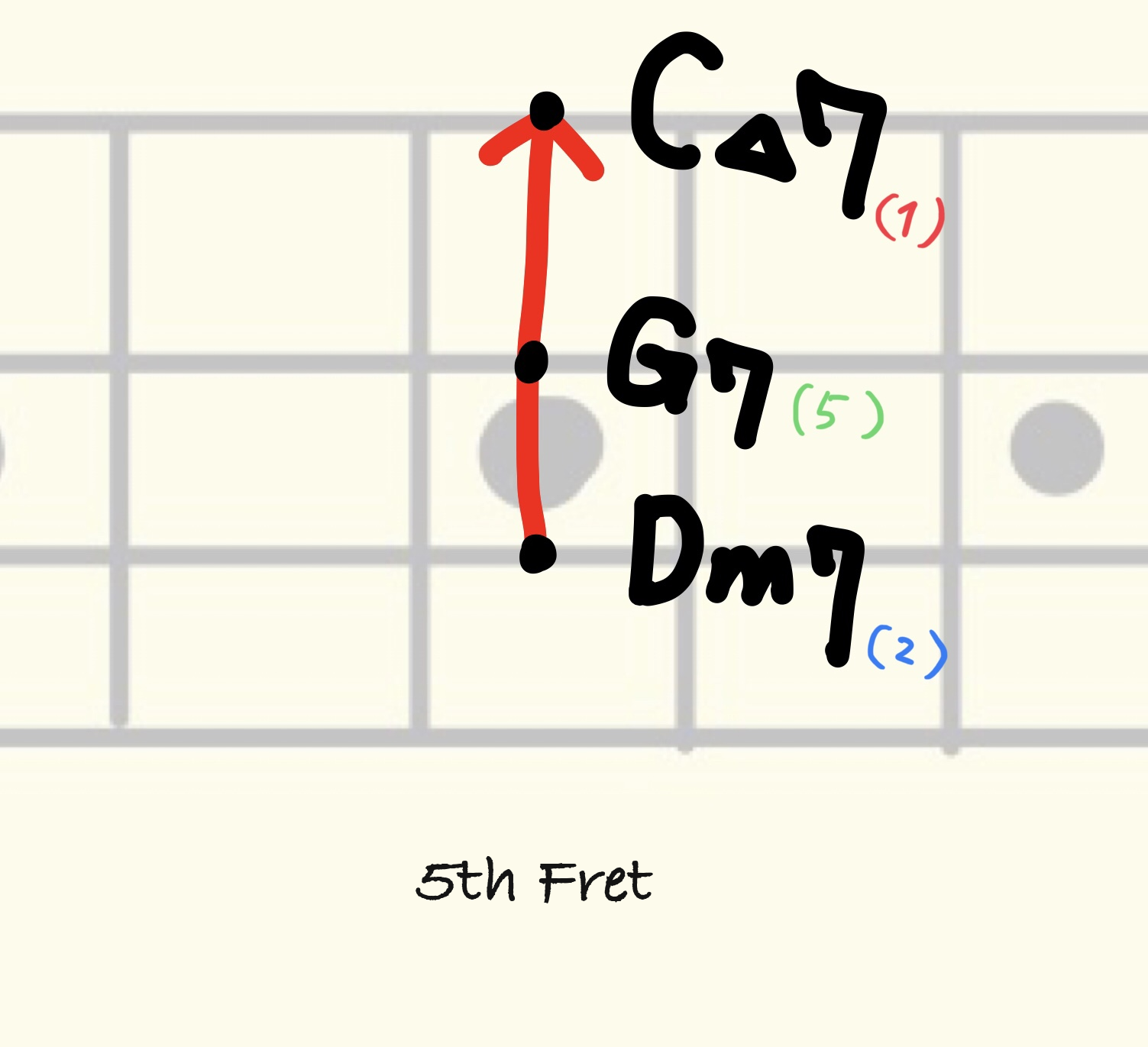
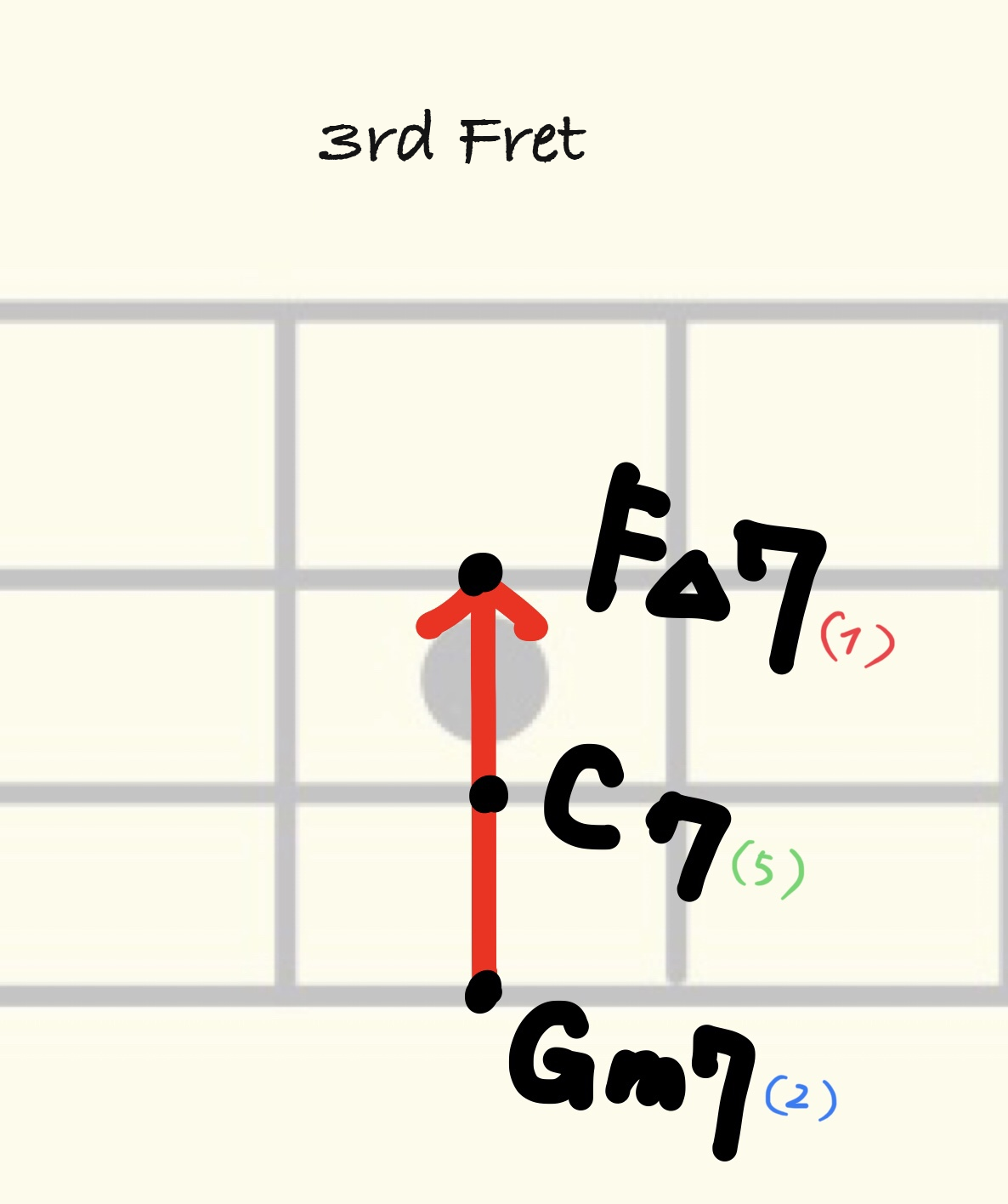
The II-V-I is a lot easier to grasp if you think about it visually, on the bass neck.
Take Dm7 ▸ G7 ▸ C△7. That motion looks like this on the neck…
 or like this…
Take Gm7 ▸ C7 ▸ F△7, and that motion looks like this…

…or like this.
Take Am7 ▸ D7 ▸ G△7, and that motion looks like this…
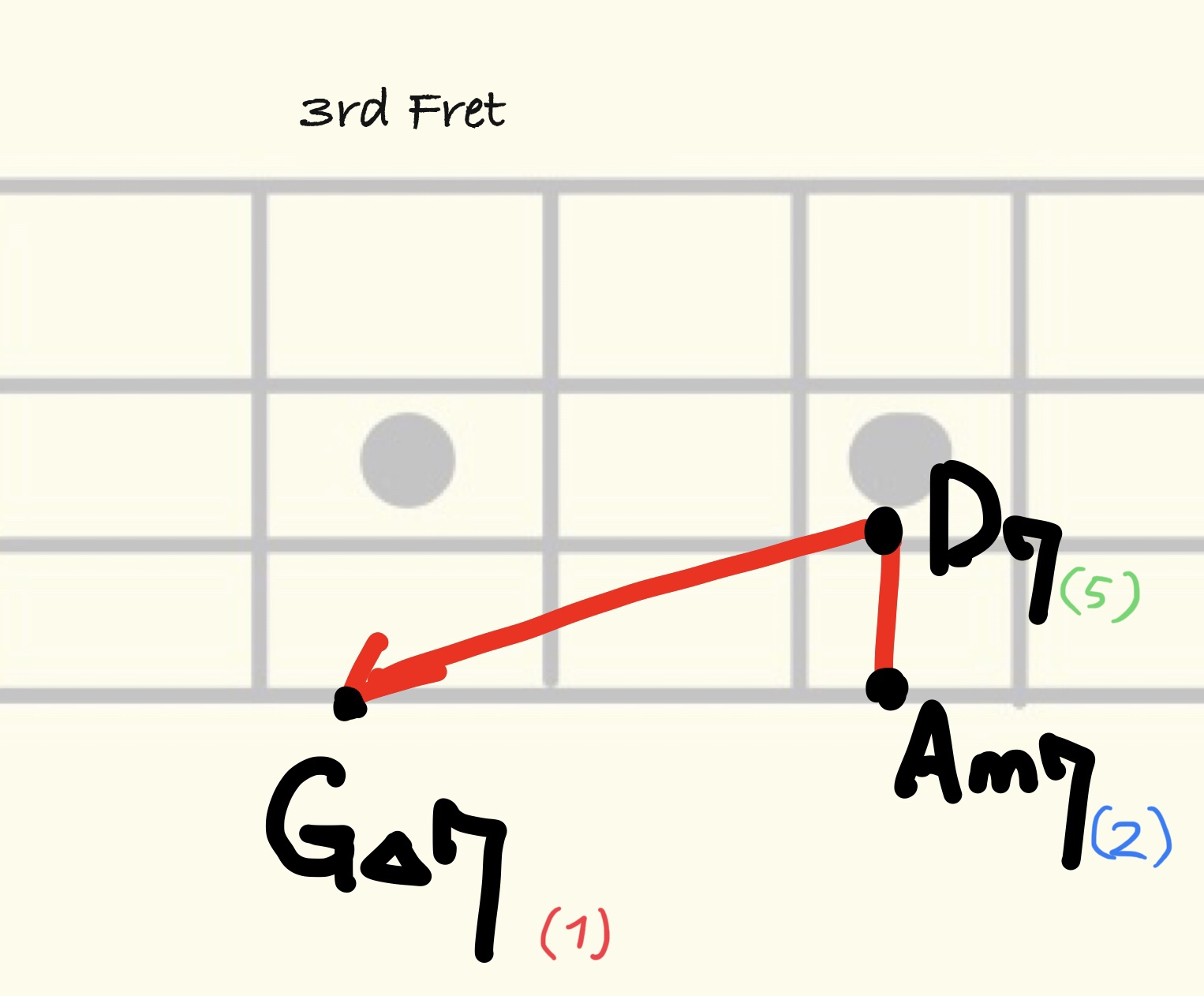
…or like this.
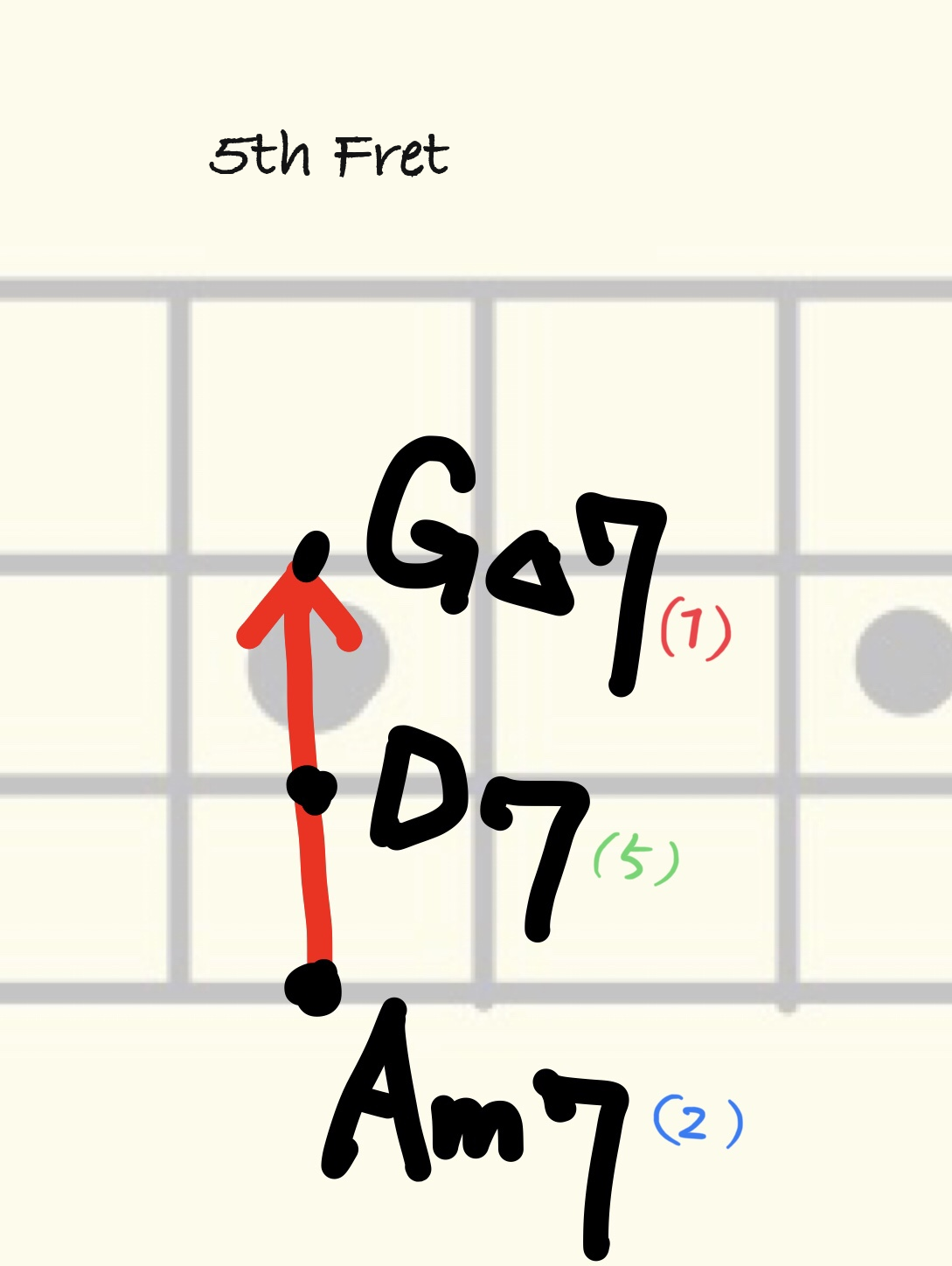
Once you see it this way, it’s a lot easier to recognize and react to on the fretboard.
What’s the Point of Knowing About the II-V-I?
You might be thinking: “Okay, I get the theory behind the II-V-I, but what do I actually do with it?”
Once you recognize a progression as a II-V-I, you can reuse material you’ve already worked out.
This is especially useful if you’re someone who struggles to come up with a bass line or a solo on the spot just by looking at the chord symbols.
Reusing a Bass Line
Say you worked out a bass line like this over a progression like this one.
A bass line used in tunes like “But Not for Me”
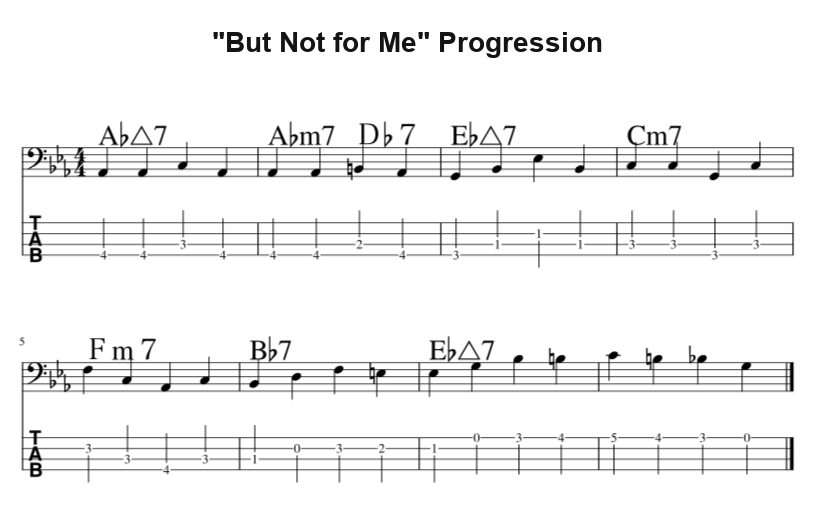
The chord motion used here — Fm7 → B♭7 → E♭△7 — shows up constantly in jazz tunes.
So I took this exact same bass line and dropped it directly into a different tune.

A bass line used in tunes like “It Could Happen to You”

In theory, this same bass line works over this tune’s progression too.
You’ll still want to actually play it and check whether it fits the feel of the tune, but once you can reuse material like this, you can work through tunes more efficiently and react a lot faster.
So that’s the rundown on tonic, dominant, subdominant, and the 2-5-1, aimed at bassists.
I hope it’s useful for your daily practice.
Want Personalized Feedback on Your Playing?
This is exactly the kind of thing that’s hard to fix alone — and where having a teacher makes all the difference.
At Line on Bass, I offer an online lesson service where you send me a video of your playing, and I give you specific, detailed feedback — every single day if you want.
Students from around the world are using this to fix exactly these kinds of issues and steadily improve their jazz bass skills.