This article explains how to use the “3rd” on bass.
Playing the root note will always get a bassline to work, but holding down the root for an entire song gets boring fast.
Just a small tweak to the notes you choose can make a bassline much more expressive.
This time, we’re focusing on the “3rd.”
I’ll walk through how major and minor 3rds work and how to use them, both here and in the video below.
· Anyone wondering what a “3rd” (or “degree”) even means
· Anyone wanting to study music theory
· Anyone wanting to rethink how they build basslines
Contents
First, a Quick Bit of Chord Theory
Chords break down broadly into two types:
minor chords
and
major chords.
In general, a chord is built from the 1st, 3rd, and 5th of a scale (for a basic triad).
If a chord is written as “C,” it’s built from “C E G.”
If a chord is written as “G,” it’s built from “G B D.”
If a chord is written as “Cm,” it’s built from “C E♭ G.”
If a chord is written as “Gm,” it’s built from “G B♭ D.”
The Key to Telling Major and Minor Apart
The 3rd is what tells major and minor apart.
The two clips below are both a “C” chord — the only difference is whether the 3rd is “E” or “E♭.” Give them a listen.
This one is “C-E-G” (the major sound):
This one is “C-E♭-G” (the minor sound):
Don’t they give a really different impression?
Generally, minor sounds darker, and major sounds brighter.
That’s enough theory for now — let’s put this to use in practice.
Comparing to Root-Only: A 3rd-Based Bassline Approach
Let’s work through the chord progression C → Am → Dm → G7 as an example.
First, the root-only approach:

Next, here’s an approach using the 3rd. Out of the four quarter notes in each measure, I swapped just one note for the 3rd.

Doesn’t the bassline feel like it has more dimension now?
Use the 3rd Just Above the Root
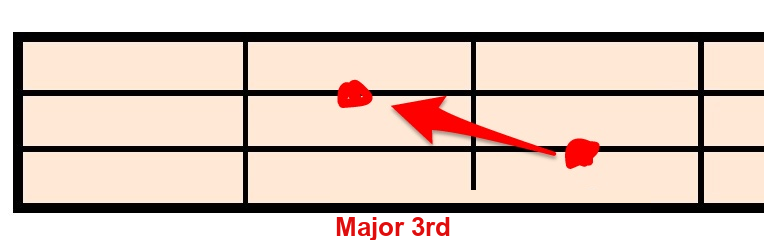
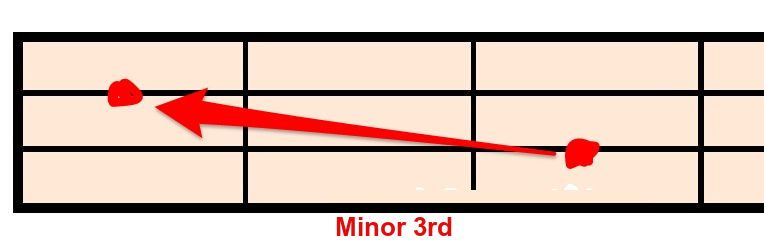
The “3rd just above” refers to a 3rd that sits in the fretboard position shown below. Early on, using a 3rd in this position makes it much easier to actually hear that you’re “making it sound right.”
· Major 3rd
· Minor 3rd
For example, take the note C: technically, both the 3rd fret on the 2nd string and the open 4th string count as a “3rd.” But that lower 3rd tends to get buried in the bass’s tone.
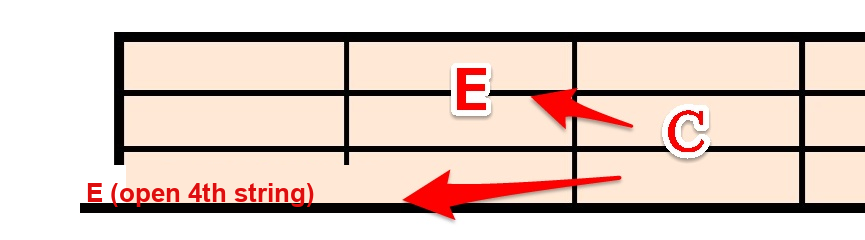
Compare the two below.
· Bassline using the lower 3rd

↑ I wrote this one on a 5-string bass because of the fret positions involved. You can hear the accent, but the light/dark contrast you get from root-to-upper-3rd is harder to feel here. (There’s nothing wrong with this — it’s totally fine if it’s intentional.)
· Bassline using the upper 3rd
↑ This one has a clear outline and a more distinctly upbeat feel.
Using the 3rd in a Bassline
Once you get comfortable using the 3rd, it’ll help your bass improvisation too.
Want Personalized Feedback on Your Playing?
This is exactly the kind of thing that’s hard to fix alone — and where having a teacher makes all the difference.
At Line on Bass, I offer an online lesson service where you send me a video of your playing, and I give you specific, detailed feedback — every single day if you want.
Students from around the world are using this to fix exactly these kinds of issues and steadily improve their jazz bass skills.