“What even is the ‘root’ on bass?”
This article (and accompanying video) is for anyone asking that question.
The root note comes up no matter what you’re playing — pop, rock, jazz, you name it — so make sure you get comfortable with it.
Contents
What Is the Root?

Take the sheet music above, for example:
The root note of measure 1 is “C”
The root note of measure 2 is “D”
The root note of measure 3 is “F”
The root note of measure 4 is “G”
At the top of each measure, you’ll see a “chord” symbol written.
A chord is what’s called a “harmony” — a symbol that represents several stacked notes. The symbols underlined in red below — Cmaj7, Dm7, Fmaj7, G7, and so on — are chords.

Chords have all kinds of symbols attached on the right — maj7, 7, m7, and so on.
If you strip all of those away, you’re left with just C, D, F, and G.
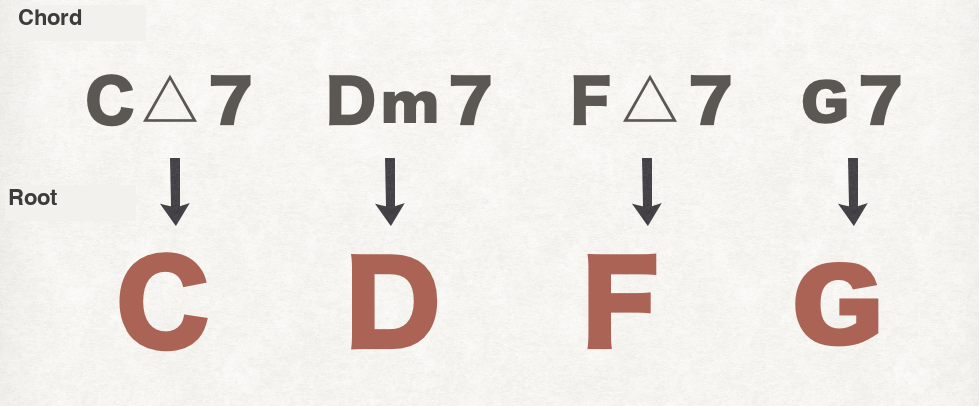
That’s the root note.
When you see Cmaj7 written, think of it as
C maj7 — in other words, “C” is the root note.
When you see G7 written, think of it as
G 7 — in other words, “G” is the root note.
Going Deeper: More on Bass Roots
Let’s say you’ve got a chord progression like this, and you want to play just the root notes.
The backing track here is just a piano playing these chords.

On bass, each fret position corresponds to a fixed note, like this:

Now back to the chords. With a progression like this, look at the chord symbols on the left.
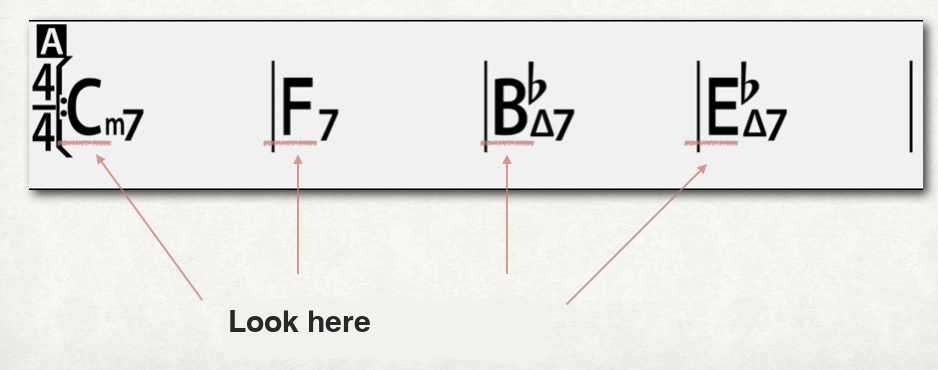
Now back to the fretboard. Find the root notes — you’ll find them right where the arrows point.

Those are the root notes. Let’s try playing each one four times.
Playing the root note is what makes a bassline feel like it “fits” with the harmony.
If that’s hard to hear, try listening to what happens when I deliberately avoid the root. It feels off, right?
Just Changing the Root Changes Everything!
Let’s run an experiment to show how much the root note alone can change the feel of a piece.
I played the same Do-Re-Mi-Fa-Sol-La-Ti-Do melody on piano, and created two versions that differ only in the root note.
· Pattern 1
· Pattern 2
Notice how different they feel?
Pattern 1 sounds bright and catchy.
Pattern 2 sounds dark and a bit sad.
But all I changed was the bassline:
Pattern 1’s bassline is just “C-C-C-C” (the root held on C).
Pattern 2’s bassline is just “A-A-A-A” (the root held on A).
That’s how much the bass root note can shape the mood of a piece of music.
That said, when you’re just starting out, don’t overthink it — it’s fine to simply go with:
When you see Cmaj7 written, think of it as
C maj7 — “C.”
When you see G7 written, think of it as
G 7 — “G.”
That’s a perfectly good starting interpretation.
Want Personalized Feedback on Your Playing?
This is exactly the kind of thing that’s hard to fix alone — and where having a teacher makes all the difference.
At Line on Bass, I offer an online lesson service where you send me a video of your playing, and I give you specific, detailed feedback — every single day if you want.
Students from around the world are using this to fix exactly these kinds of issues and steadily improve their jazz bass skills.