This article is for:
· Bassists who want to play jazz but don’t know where to start
· Bassists who want to try improvising
· Anyone who bought a music theory book, gave up, and now has it gathering dust in a closet
Contents
Quick Recap
Last time, I explained that:
Diatonic chords are useful for improvising and copying solos by ear. Here are the diatonic chords in the key of C — when you solo, you can use the notes Do Re Mi Fa Sol La Ti Do.
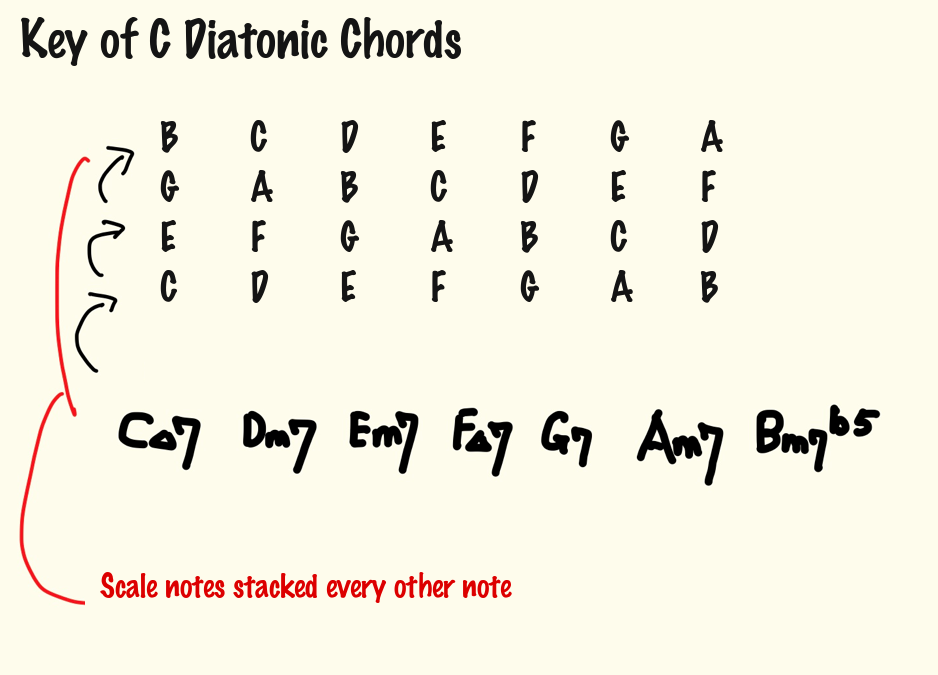
…but that was a pretty rough explanation, and I didn’t go into the detailed structure behind it.
This time, I’ll explain more specifically how diatonic chords are actually built.
Understanding this will take some time, but once you get it, you’ll be able to use diatonic chords freely for improvising, copying solos by ear, and building basslines — giving you much more freedom in your playing.
You can find the previous article in this series, “What Are Diatonic Chords? #1,” on this site once it’s translated — for now, here’s a quick recap above to get you up to speed.
How Diatonic Chords Are Built
A diatonic chord is simply a chord built from a diatonic scale.
This time, I’ll explain both the “diatonic scale” and the “chord” side of that equation.

What Is a Diatonic Scale?
A diatonic scale is, within one octave, a scale made up of five whole-step intervals and two half-step intervals.
For example, here’s a well-known one. To keep it simple, I’ve written it out on a single string.
Example 1
Whole — Whole — Half — Whole — Whole — Whole — Half
This pattern of intervals is called the major scale.
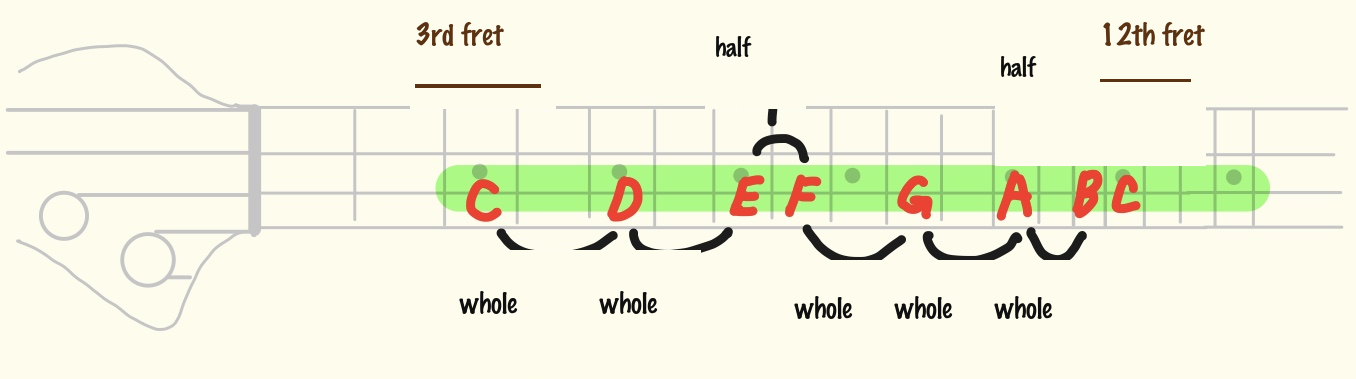
Starting from C at the 3rd fret of the 3rd string: C D E F G A B C. In other words, Do Re Mi Fa Sol La Ti Do.
There’s another common pattern too.
Example 2
Whole — Half — Whole — Whole — Half — Whole — Whole
This is called the minor scale. It’s also a type of diatonic scale.
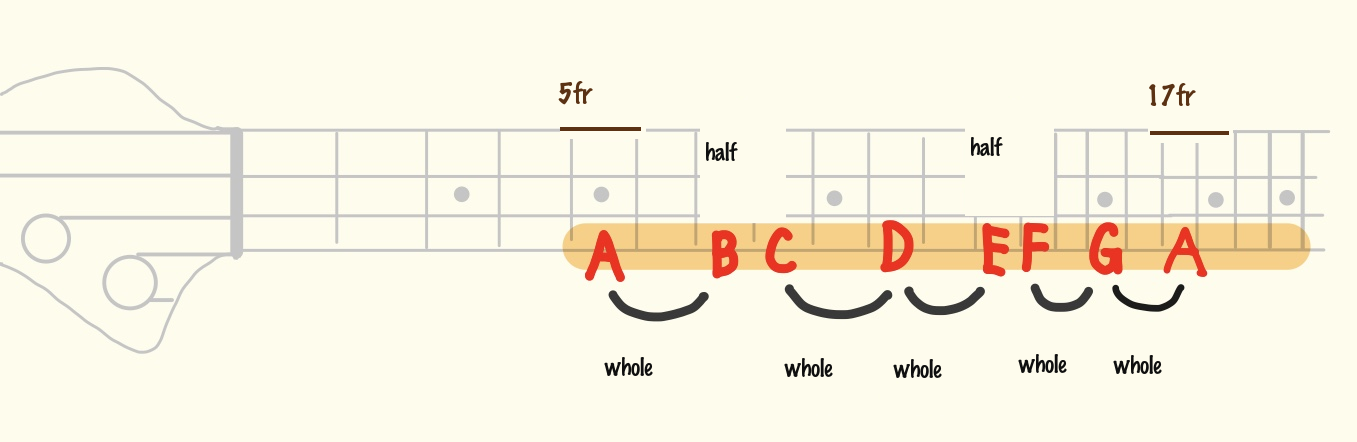
For this article, I’ll use the major scale as the main example going forward.
What Is a Chord?
A chord is essentially a symbol that represents a stack of notes.
Generally this is called a “harmony,” and there are countless possible combinations.
For example, take this progression:

C / a chord made of C, E, G
Am / a chord made of A, C, E
Dm / a chord made of D, F, A
G7 / a chord made of G, B, D, F
You could stack any notes, in any way, and technically call it a “chord” —
…but as you can hear, that doesn’t exactly sound pleasant to the ear!
That’s where a stacking pattern that’s generally considered pleasant to the ear comes in.
What Makes a Stack of Notes Sound “Pleasant”?
Take that diatonic scale from before, and stack the notes by skipping every other one, like this:
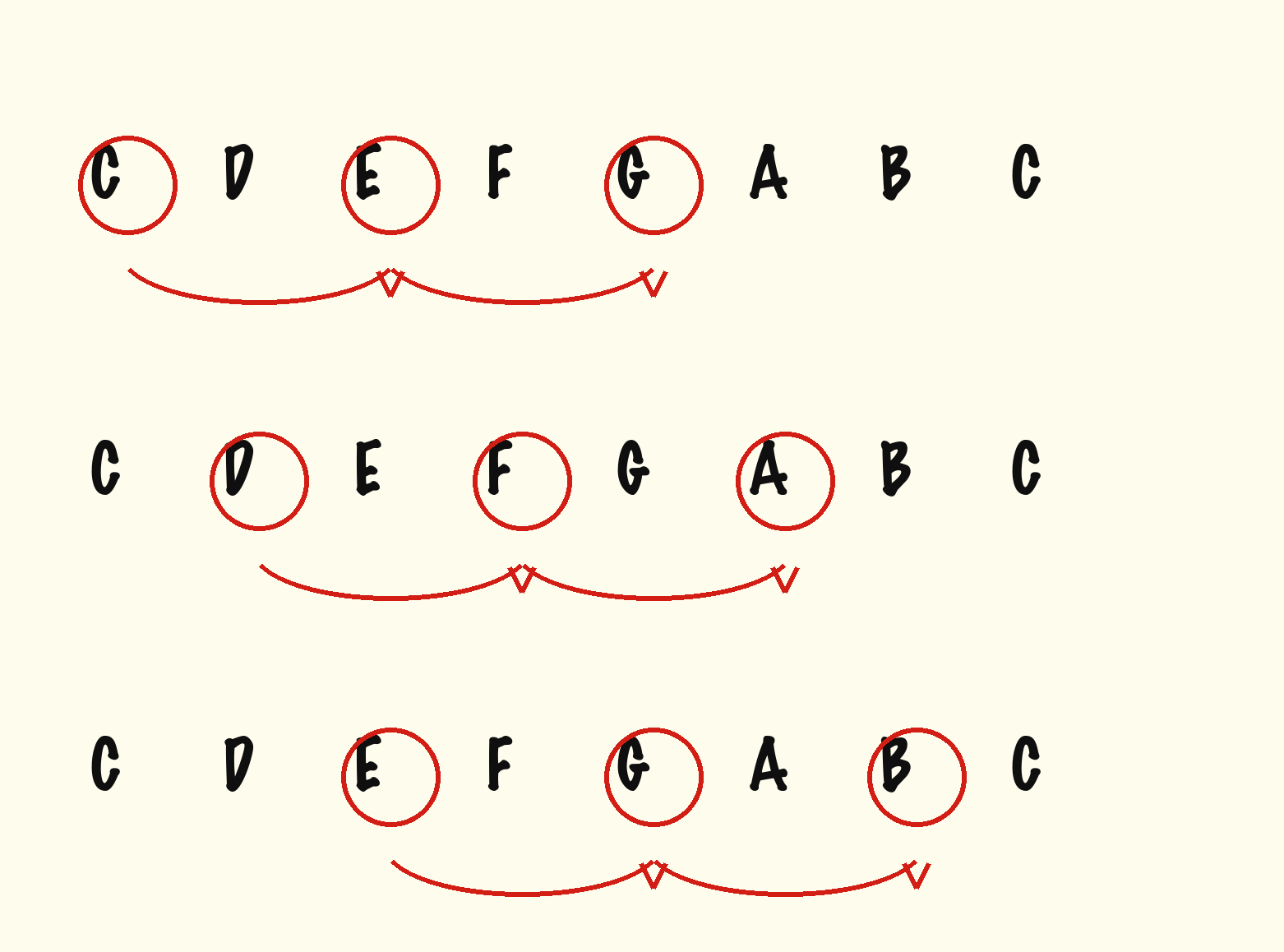
This “skip one note at a time” stacking is generally considered to sound pleasant to the ear.
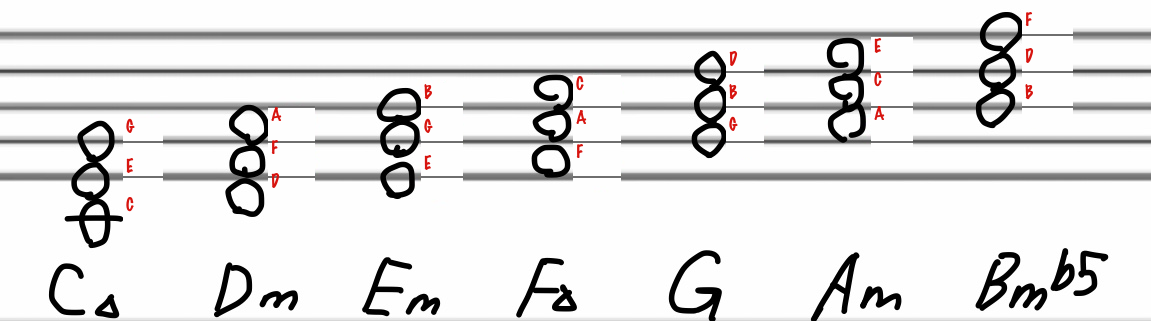
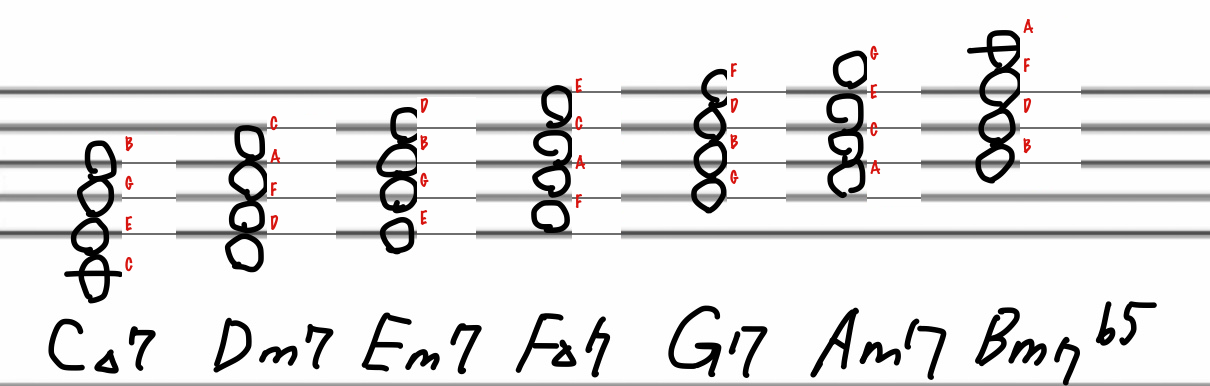
This is exactly what a diatonic chord is: a chord built by stacking the notes of a scale, skipping every other note.
Pop and rock songs are often written using these as 3-note chords (triads):
In jazz and other styles that use a wider harmonic palette — seventh chords, tension notes, and so on — chords are more often written as these 4-note chords:
Diatonic Chords and Transposition

Now, say you have a chord progression like this, and your vocalist says:
“This is hard to sing in the key of C — can you bump it up a whole step? (Make it key of D?)”
What happens to the diatonic chords in that case?

If you’re just playing root notes, you could simply shift your hand position — but let’s actually think it through theoretically, since we’re here.
If in the key of C, Do Re Mi Fa Sol La Ti Do is the diatonic scale, then wouldn’t the diatonic chords in the key of D be built from Re Mi Fa Sol La Ti Do Re?
If you think about it that way… you’d be wrong.
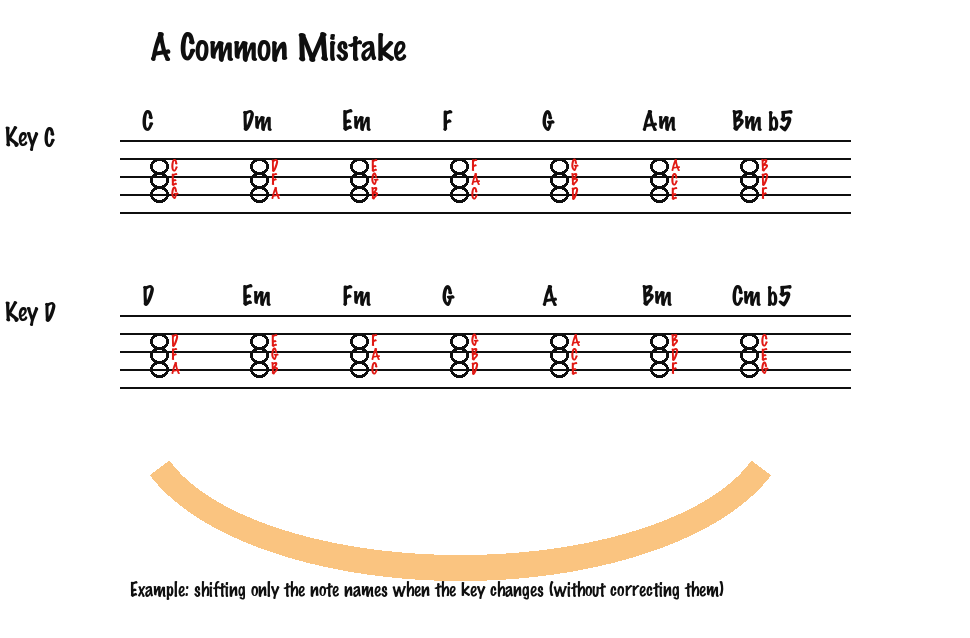
Let’s look at it the same way as before, using Whole — Whole — Half — Whole — Whole — Whole — Half.
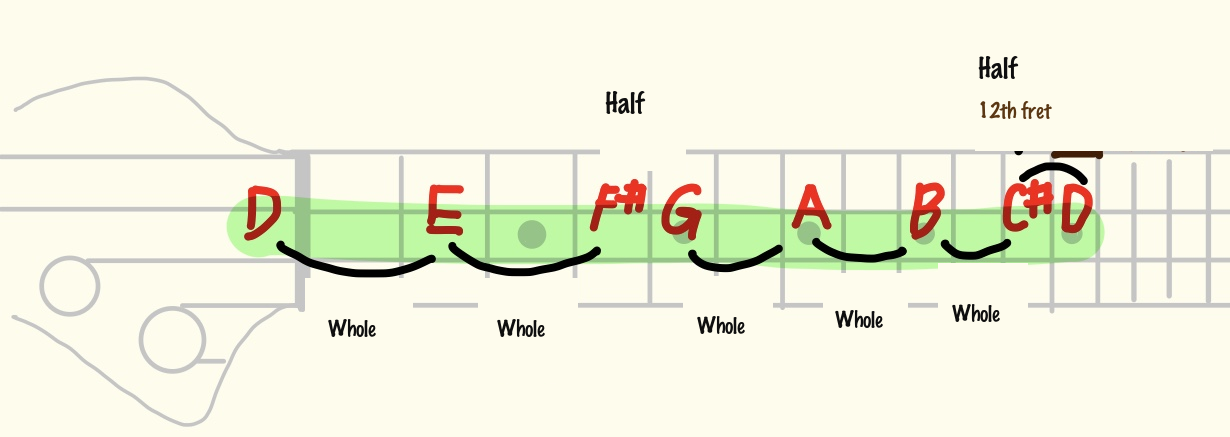
Oh, I see — F and C both have sharps.
Exactly right, good catch. Now let’s stack these notes again, skipping every other one, to find the “pleasant-sounding” chords.

In terms of diatonic chords, here’s how that breaks down (as triads):
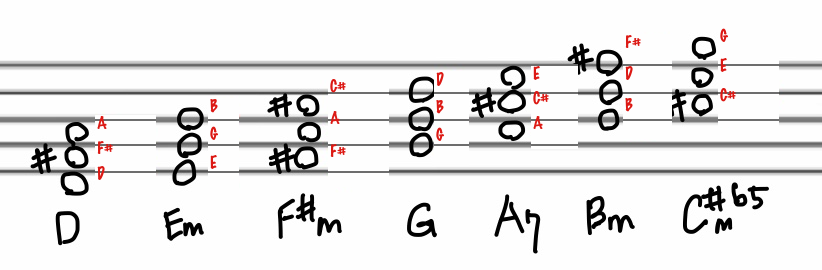
So, raising the key by a whole step gives you these diatonic chords:

Key Point
When you change keys, the diatonic chords change too — sharps and flats may appear.
But no matter what key you’re in, the diatonic scale’s interval pattern of
Whole — Whole — Half — Whole — Whole — Whole — Half
never changes.
For this article, it’s enough to get a general sense of this. Your understanding will deepen as you apply it to real songs going forward.
Finally, here’s a reference table and summary.
Key & Diatonic Chord Reference Tables
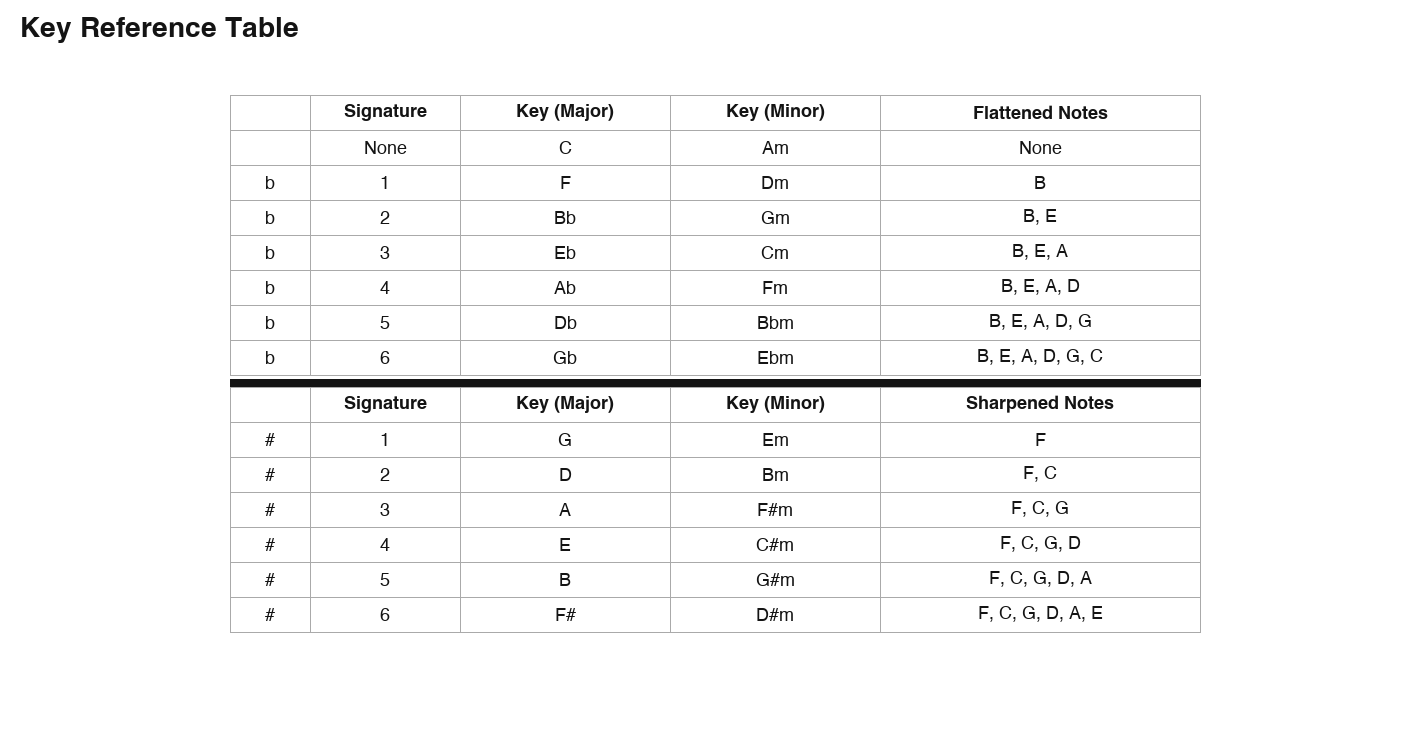
A song’s key is determined by the number of sharps or flats written at the start of the sheet music.
For example:
Key of D has two sharps in the key signature

Key of F has one flat in the key signature

Key of C has no key signature

…and so on. It’s all fixed and predictable.
Here’s a reference table of key signatures and keys.
And here’s a reference table of key signatures and diatonic chords.
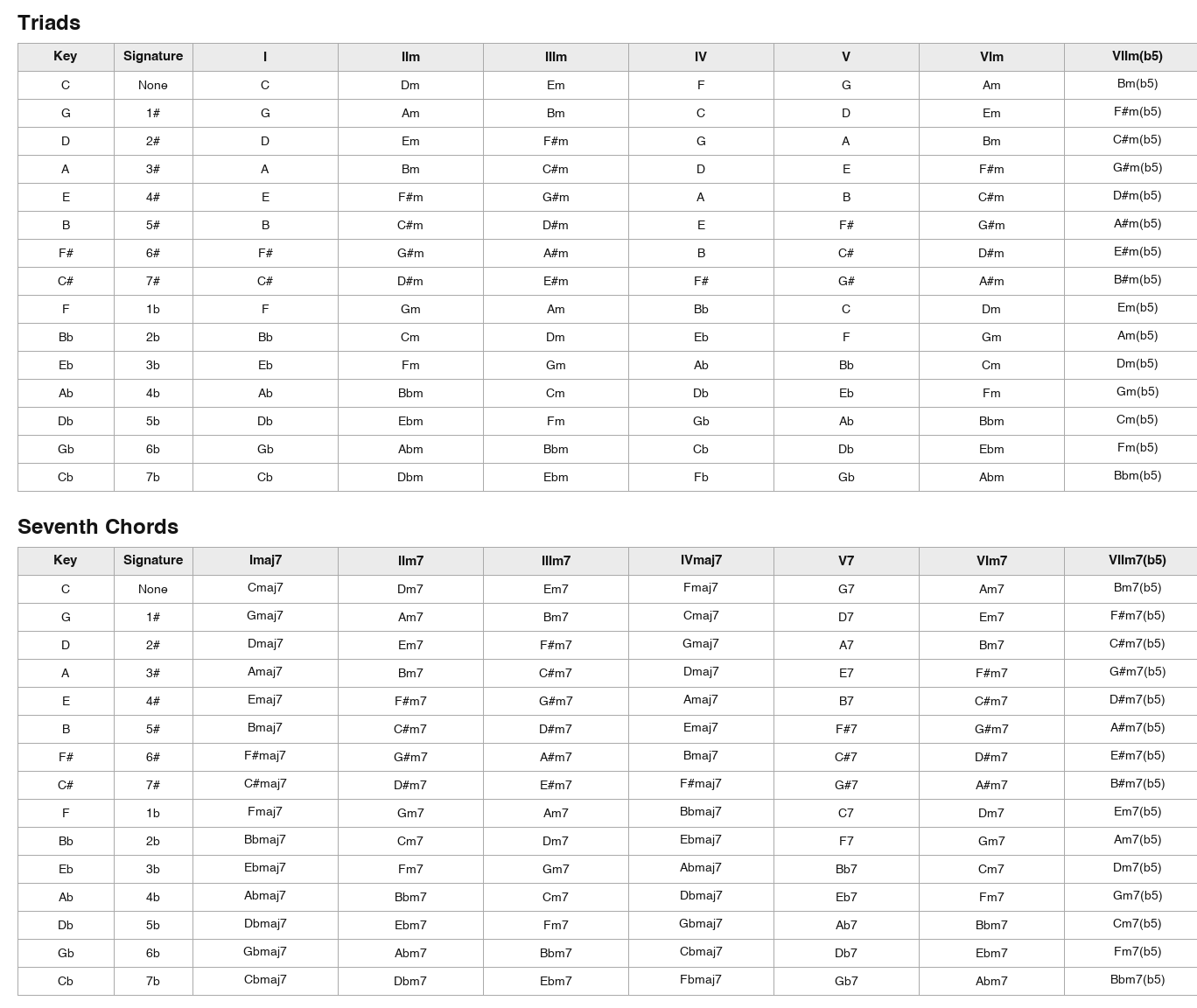
You probably won’t be able to recall key signatures and their diatonic chords instantly — keep these tables handy as a reference.
As you apply this to real songs — analyzing tunes and writing your own — you’ll gradually get more comfortable with diatonic chords.
When a bassist has this knowledge, it helps in all kinds of ways:
· You can analyze songs
· You can improvise, including bass solos
· It’s easier to build moving basslines
· It opens up your range as a songwriter
· You’ll get faster at learning songs and copying parts by ear
Next time, I’ll apply diatonic chords to a real song.
Want Personalized Feedback on Your Playing?
This is exactly the kind of thing that’s hard to fix alone — and where having a teacher makes all the difference.
At Line on Bass, I offer an online lesson service where you send me a video of your playing, and I give you specific, detailed feedback — every single day if you want.
Students from around the world are using this to fix exactly these kinds of issues and steadily improve their jazz bass skills.