This article is written for bassists who play walking bass lines without being fully clear on the difference between a dominant seventh chord and a major seventh chord — by Toru Hoshino, a Tokyo-based jazz bassist and instructor (@jazzbassisttoru).
Here’s a mistake that comes up often in walking bass lines when a chord has a “7” attached to it.
Contents
Bass Lines That Mistakenly Use a Major Seventh Note Over a Dominant Seventh Chord
Example 1
The first two bars of a progression often used in tunes like “Autumn Leaves”:

What do you think? Depending on how you listen to it, it might not sound wrong, but…

This version sounds more natural, I think. (The note marked in red has been corrected.)
Example 2
The first four bars of an F blues:

What do you think? Depending on how you listen to it, it might not sound wrong, but…

This version sounds more natural, I think. (The note marked in red has been corrected.)
Here’s the Key Point!
A dominant seventh chord (“◯7”) and a major seventh chord (“◯△7”) are different.
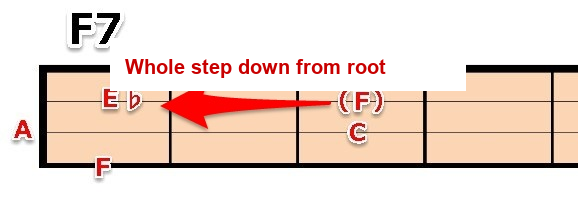
On a dominant seventh chord, the 7th is a whole step below the root.
On a major seventh chord, the 7th is a half step below the root.
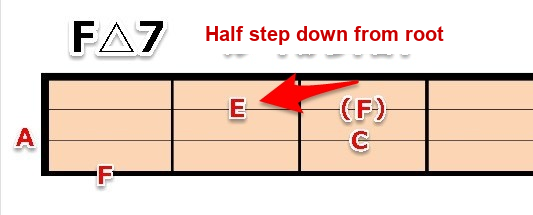
Going back to the progression at the start of the article: if you want to use the note E as the second note of the second bar, then theoretically it’s more accurate to write it as F△7.

That said, a Cm7 → F△7 progression isn’t something you see very often.
From the root, it’s only the difference of a half step versus a whole step, but small details like this can change the nuance quite a bit.
This is a point beginners often get wrong, so it’s worth paying attention to.
Want Personalized Feedback on Your Playing?
This is exactly the kind of thing that’s hard to fix alone — and where having a teacher makes all the difference.
At Line on Bass, I offer an online lesson service where you send me a video of your playing, and I give you specific, detailed feedback — every single day if you want.
Students from around the world are using this to fix exactly these kinds of issues and steadily improve their jazz bass skills.