This article is written by Toru Hoshino, a jazz bassist and instructor based in Japan who teaches online lessons to students worldwide. In this article, he talks about what the ideal left-hand shape looks like on bass.
Contents
Keep Your Left Hand Curled
A curled shape like this is the ideal form for your left hand.

Keep your hand resting in that curled position at all times.

For example, say your ring finger is currently fretting the 5th fret, and your next note requires your index finger to play the 3rd fret.

If your hand is already curled, your index finger is sitting right there, ready to land on the 3rd fret instantly.
A Bad Example
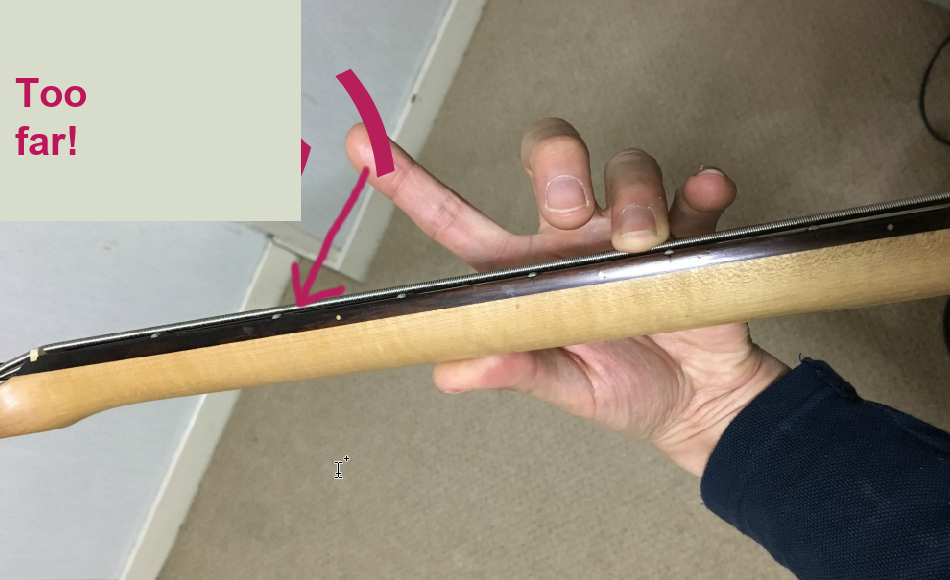
↑ This is a bad example.
The index finger is way too far off the fretboard, right?
When your hand sits like this, it takes noticeably longer to actually fret the note.
If your fingers stay right at the edge of the strings, every single fretting motion becomes much easier.
Make a conscious habit of keeping that “left-hand curl” in mind.
Curled vs. Uncurled
Here’s a roughly 18-second comparison: with the left hand kept curled, fretting a simple major scale takes noticeably less movement and feels far more efficient than the uncurled version — which one looks easier to play is obvious at a glance.
That said, it’s genuinely difficult for a beginner to build a curled-hand habit right from the start.
Staying Curled All the Time Is Hard
I’ve made it sound simple, but keeping your fingers curled at all times is genuinely difficult.
So here’s a practice you can build into your daily routine, focused on developing that curl gradually: hold a relaxed, curled hand shape over the fretboard and walk it slowly up and down each string, fret by fret, keeping every finger hovering just above the strings instead of letting it drift away after each note.
If you work on this daily while staying mindful of the curl, your left hand stops flailing around within about a month.
It also works great as a warm-up before practice, so give it a try.
I hope this gives you something useful for your daily practice.
Once your left hand starts holding that curled shape naturally, getting a second pair of eyes on your actual playing is the next step toward locking it in for good.
Want Personalized Feedback on Your Playing?
This is exactly the kind of thing that’s hard to fix alone — and where having a teacher makes all the difference.
At Line on Bass, I offer an online lesson service where you send me a video of your playing, and I give you specific, detailed feedback — every single day if you want.
Students from around the world are using this to fix exactly these kinds of issues and steadily improve their jazz bass skills.