This article is written by Toru Hoshino, a jazz bassist and instructor based in Japan who teaches online lessons to students worldwide. In this article, he shares how using triads — not just scales — can take your improvised bass solos to the next level.
✅️ You’re not sure how to structure an improvised solo
✅️ You want fresh ideas for building solo lines
✅️ You’re just getting started with jazz bass
Contents
Triad Soloing: The Big Picture
This time, we’re going to practice building improvised solos using triads.
In a previous lesson, I explained that if you can instantly picture the 3rd of each chord as it goes by, and connect those 3rds together, your lines start to sound melodic.
But I never actually explained what notes you should use to connect those 3rds together. That’s what we’re covering today.
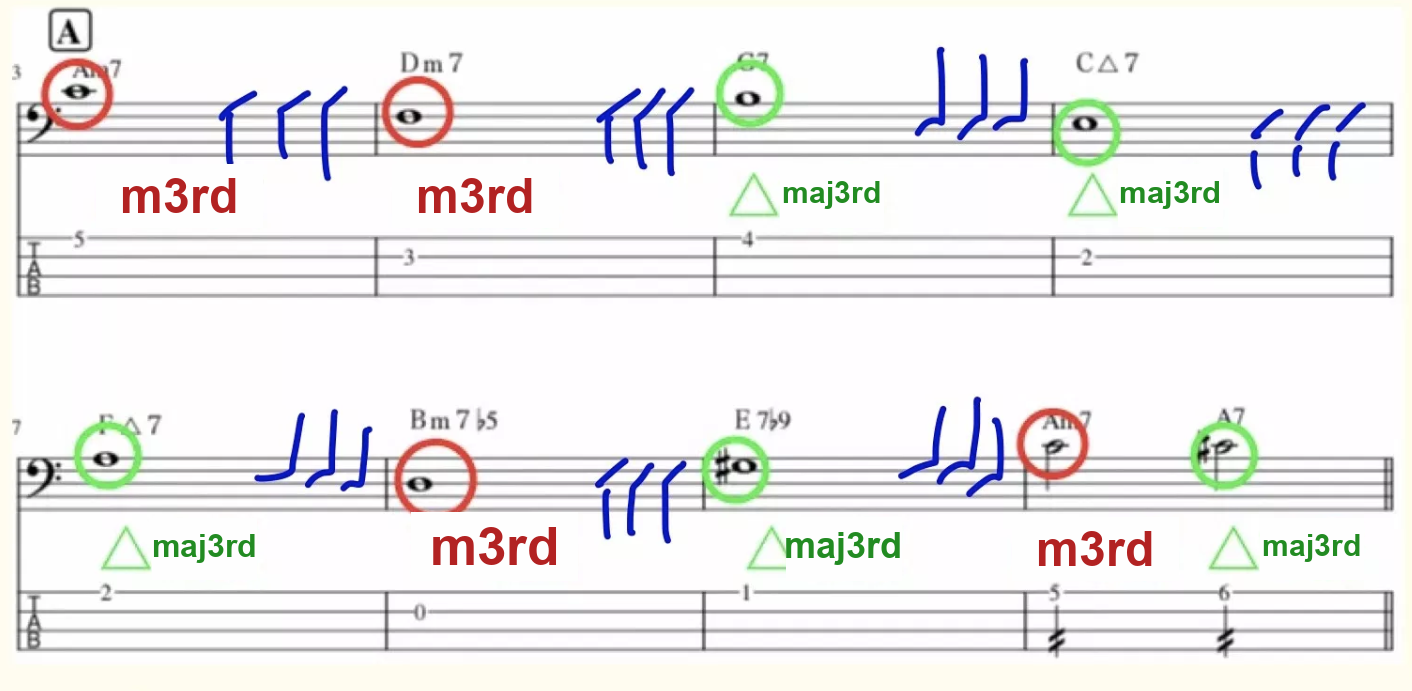
↑ That’s the idea from last time — using the 3rd of each chord as an anchor point. This time, we’ll take it further: use the notes of the triad to connect one 3rd to the next.
What Is a Triad, and Why Does It Matter for Improvising?
Chord tones are usually described as the root, 3rd, 5th, and 7th. From here on, we’ll focus specifically on the three notes that make up the basic triad: the 1st, 3rd, and 5th.
This three-note chord — root, 3rd, and 5th — is called a “triad.”
Here’s what the triad looks like for each chord in this progression:
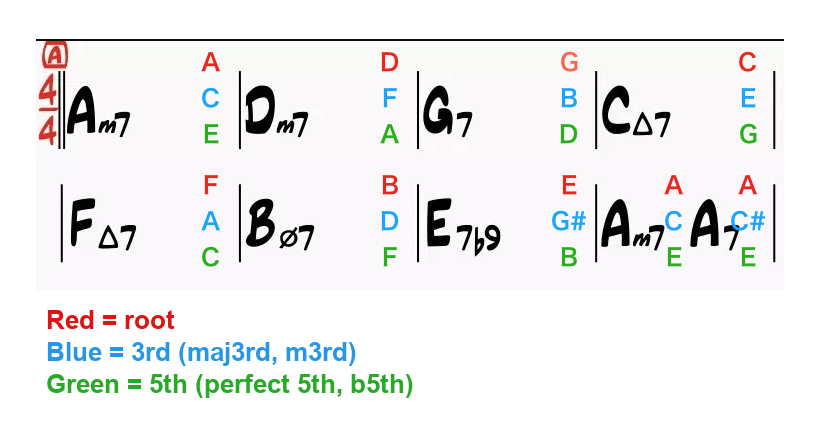
Now, start each bar on the 3rd of the chord, and connect those notes using the triad. It sounds like this:
(Example 1)

(Example 2)

As I mentioned last time, just connecting the 3rds and filling in the notes between them more or less freely will already sound reasonably good. But doesn’t it feel like the sound gets a lot more solid and intentional once you connect them specifically through the triad?
To be clear, an improvised solo doesn’t have to be built entirely out of triads. But being conscious of the triad really helps in situations like:
When you want to bring out the chord sound more clearly
When you want to weave in tension notes
When you want your solos to break free from the “one scale fits all” approach
Keeping the triad in mind matters for all of these.
The Skeleton of the Chord: What the Triad Does for You
Again — an improvised solo doesn’t have to be built only from triads.
If you’ve got a C△7 chord, you might play the diatonic scale (do-re-mi-fa-so-la-ti-do), or you might play a pentatonic line (do-re-mi-so-la-do). Both are valid.
That said, the more your phrase leans on do-mi-so (the triad notes) and sticks close to the triad, the more clearly you bring out that chord’s sound.
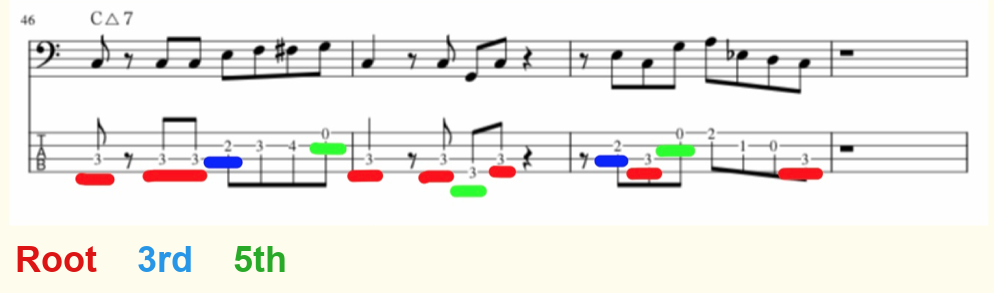
On the other hand, the further you deliberately steer away from do-mi-so — avoiding the triad on purpose — the softer, hazier, or more “floating” the line will sound.
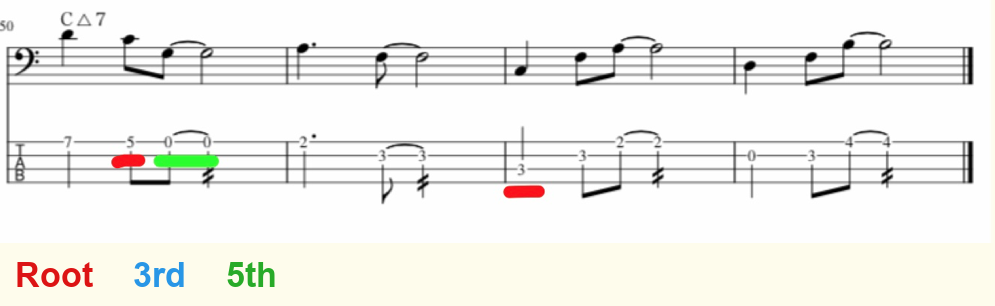
Which approach you prefer is really a matter of taste and expression — there’s no right answer. But either way, being aware of where the triad sits is what gives you control over that expression.
So the main point of this article is simply this: the triad is genuinely important when it comes to improvising.
Triads in Action: Real Jazz Tunes
Plenty of jazz tunes use approaches built around triads. In the notation below:
Red lines mark the root (1st) of the chord
Blue lines mark the 3rd
Green lines mark the 5th
· I Mean You

· Confirmation

· Doxy

You’ve probably heard lines like these before without realizing it.
So, to sum up: being able to use triads confidently is a genuinely important skill when it comes to playing improvised solos. Next time, we’ll get into concrete practice methods for actually putting triads to use.
Want Personalized Feedback on Your Playing?
Hearing the difference between a triad-anchored line and a scale-only line is one thing — actually hearing it in your own playing and fixing it is a different challenge entirely, and it’s exactly where a second pair of ears makes the biggest difference.
This is exactly the kind of thing that’s hard to fix alone — and where having a teacher makes all the difference.
At Line on Bass, I offer an online lesson service where you send me a video of your playing, and I give you specific, detailed feedback — every single day if you want.
Students from around the world are using this to fix exactly these kinds of issues and steadily improve their jazz bass skills.