This article is written by Toru Hoshino, a jazz bassist and instructor based in Japan who teaches online lessons to students worldwide. In this article, he answers a question about whether to use the ring finger in the low position on electric bass.
I recently got a question from an electric bass player that went something like this: “I found one method book that shows the low position fretted like this” —
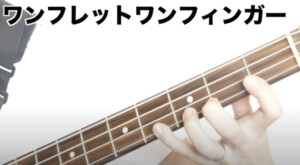
— “using a one-finger-per-fret approach with the index, middle, ring, and pinky all spread out. But another book shows the low position fretted like this instead” —
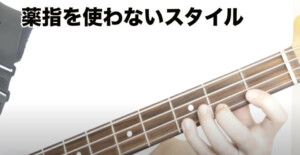
— “using only the index, middle, and pinky, skipping the ring finger entirely. Which one should I actually trust?“
My honest answer to this: it depends on the playing style you’re going for.
Personally, I go with the second approach — skipping the ring finger and fretting the low position with just index, middle, and pinky. There are 2 reasons why:
1. Because I also play upright bass
2. Because the one-finger-per-fret approach doesn’t reach the very edge of the fret as comfortably for me
Contents
1. Because I Also Play Upright Bass
On upright bass, the low position is typically fretted using just the index, middle, and pinky fingers. Here’s what that hand shape looks like:
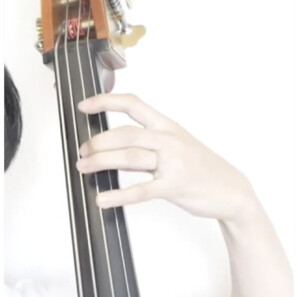
I used to use my ring finger in the low position on electric bass too, but once I started playing upright, my electric bass fingering naturally lined up with my upright technique instead.
2. Because the One-Finger-Per-Fret Approach Doesn’t Reach the Edge of the Fret as Well
Here’s a shot of fretting the 3rd fret on the 1st string. This is pressing down right at the edge closest to the headstock, which tends to cause fret buzz.
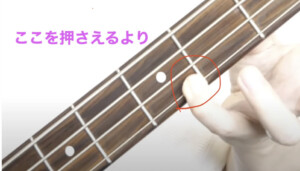
Whereas fretting closer to the body-side edge, like this, tends to buzz less.
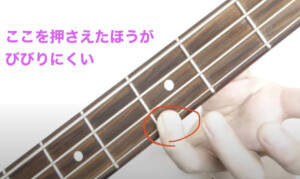
Personally, I find it harder for my left-hand fingers to comfortably reach that body-side edge when I’m locked into one-finger-per-fret. So I use the index/middle/pinky approach instead, since it makes that cleaner fretting position easier to reach consistently.
That’s the reasoning behind why I personally play the low position on electric bass using just three fingers — index, middle, and pinky.
In lessons, for students who eventually want to pick up upright bass, I often recommend starting with this index/middle/pinky approach on electric bass. For students without that goal who find one-finger-per-fret more comfortable, I’m just as happy to have them stick with that instead.
Genuinely opposite opinions like this come up a lot in instrumental technique — strap length, string height (action), you name it: some swear “longer/higher is better,” others swear the exact opposite.
In the end, I think the real answer always comes down to: what style are you going for, what tone do you want, and what do the players you admire actually do? That’s usually what resolves the contradiction.
Hopefully this gives you a useful way to think it through next time you run into two pieces of conflicting advice.
Working out which approach actually fits your hand and your goals is exactly the kind of judgment call that’s easier to make with a second pair of eyes watching you play.
Want Personalized Feedback on Your Playing?
This is exactly the kind of thing that’s hard to fix alone — and where having a teacher makes all the difference.
At Line on Bass, I offer an online lesson service where you send me a video of your playing, and I give you specific, detailed feedback — every single day if you want.
Students from around the world are using this to fix exactly these kinds of issues and steadily improve their jazz bass skills.