This article is written by Toru Hoshino, a jazz bassist and instructor based in Japan who teaches online lessons to students worldwide. In this article, he answers a question he gets constantly: can an electric upright bass actually substitute for upright bass practice?
“I’d love to play upright bass, but I can’t commit to buying one because of noise concerns where I live. So I’m considering an electric upright bass for home practice instead — but how different does it actually feel from a real upright? Does practicing on an electric upright really count as upright bass practice?”
This is a question I get all the time.
Right off the bat: they’re genuinely different instruments, so yes, the feel is different.
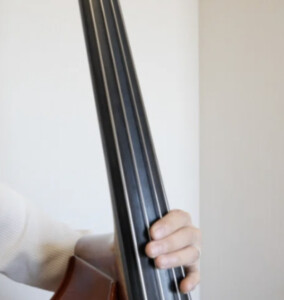
That said, your environment isn’t something you can just change overnight. So personally, I think starting with an electric upright bass is perfectly fine.
Here’s why: on upright-style instruments — both electric upright and full-size upright — there are no frets marking off the pitches under your left hand, so you can absolutely use one to build your sense of left-hand positioning, intonation, and how far apart your fingers need to stretch. You can also get a feel for playing standing up and how your right hand strikes the strings.
The big difference is that an upright bass has a large, boxy body.
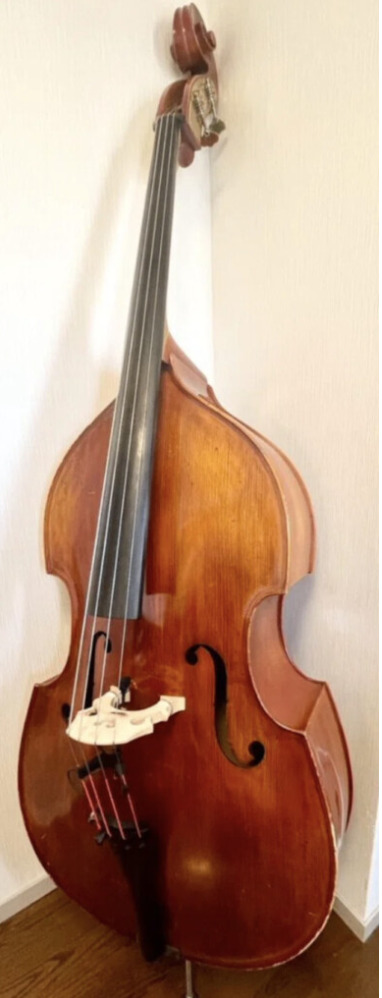
An electric upright doesn’t have that large boxy body, so the sensation of that resonating body — and the way the instrument actually vibrates as a result — is genuinely different between the two.
I didn’t start out by buying a real upright bass myself, either. I used an electric upright for a long time at the start.
My honest mindset going in was more like, “I want to try upright bass, but there’s no way I can handle something that huge.” I never expected to stick with it for this long, but my thinking is: start with whatever instrument lets you practice comfortably at home — including whether you’ll actually stick with it long-term — get a feel for things gradually, and once you’re genuinely committed, sort out your space and move up to a real upright bass.
Of course, some people will say, “just start on a real upright bass from day one — an electric upright won’t actually help you practice.” That’s a fair opinion too, so take mine as just one perspective among others. 🙂
Deciding which instrument and setup actually fits your situation is exactly the kind of judgment call a teacher can help you make with confidence.
Want Personalized Feedback on Your Playing?
This is exactly the kind of thing that’s hard to fix alone — and where having a teacher makes all the difference.
At Line on Bass, I offer an online lesson service where you send me a video of your playing, and I give you specific, detailed feedback — every single day if you want.
Students from around the world are using this to fix exactly these kinds of issues and steadily improve their jazz bass skills.