This article is written by Toru Hoshino, a bassist and instructor based in Tokyo, and it’s a column on how to build improvised solos.
Today I’ll be answering a question from one of my students.
Student: “I connect triads through scale tones and chromatic passing tones, but it still doesn’t sound very jazzy. What should I do?”
In response to that question,
Toru: Try using intervals of a 3rd for your phrases instead of whole steps or half steps.
is what I told them.
Contents
The Student’s Phrase, Explained
Let’s take a look at the actual transcribed notation.
Example 1 — The Original Question
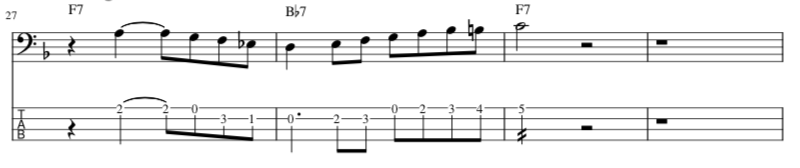
Triads are connected chromatically, resolving to chord tones.
Pulling this off in real time already takes serious skill, but in Example 1, most of the movement is by whole steps or half steps.
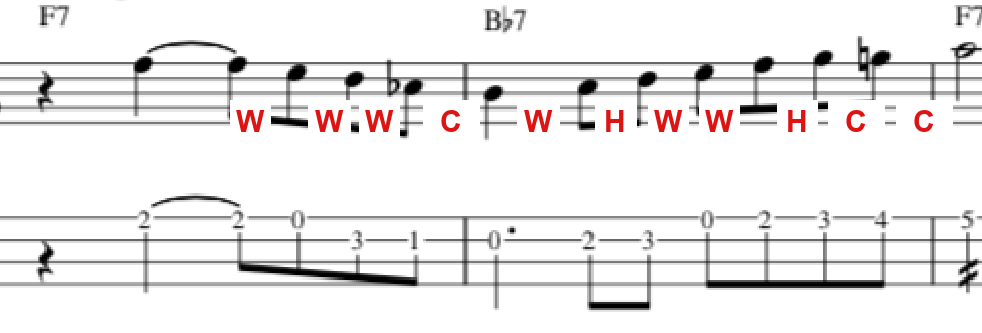
Example 2 — My Suggested Revision
Here’s what I turned it into.
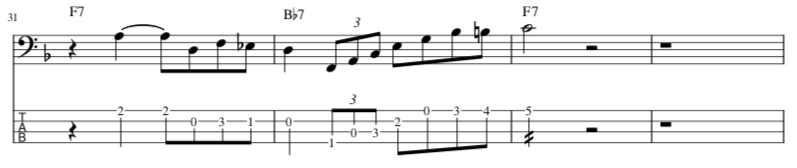
This is an example built using chromatic motion and intervals of a 3rd instead of whole-step or half-step motion.
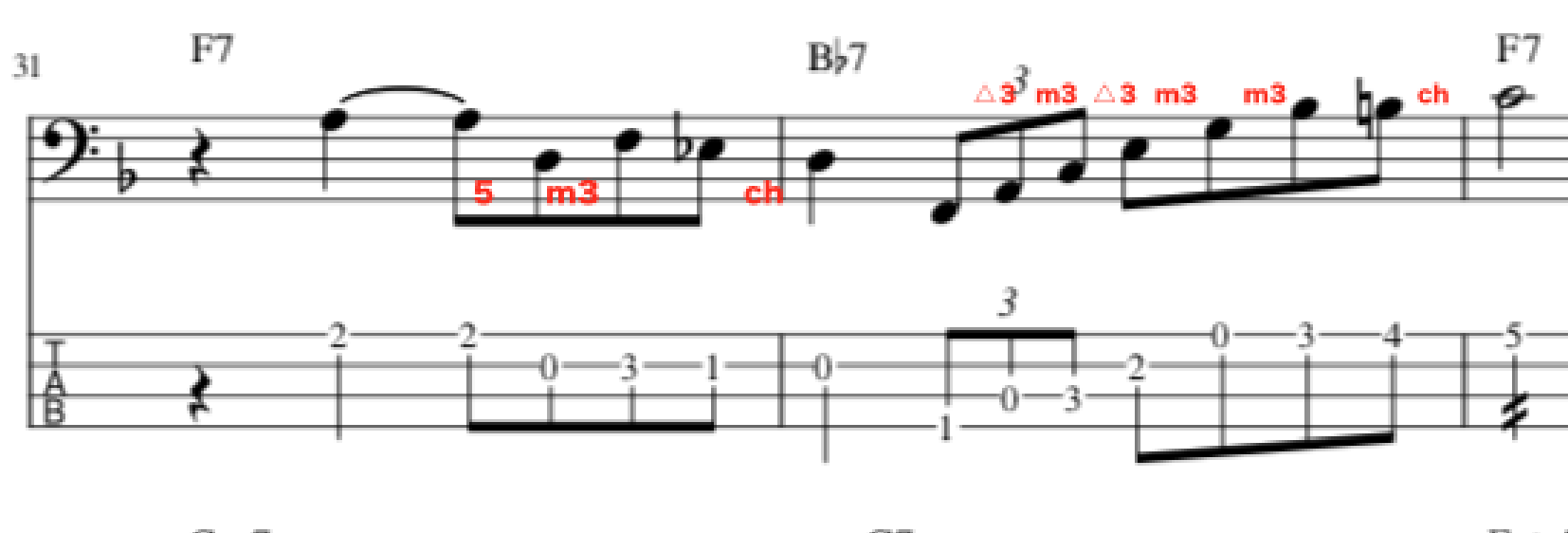
Especially in the second measure, where it’s all intervals of a 3rd. Compared to Example 1, the flow of the notes is noticeably steeper, right?
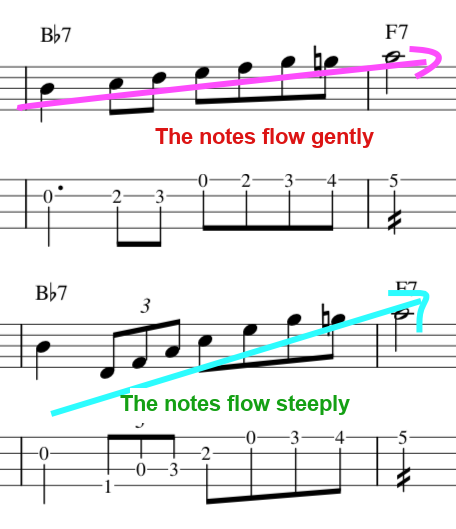
If you’re deliberately going for a smoother, more gradual melodic flow, sticking to whole-step or half-step motion is perfectly fine,
but bebop and other jazzy-sounding lines are often built from intervals wider than a whole step.
Example 3 — Another Question
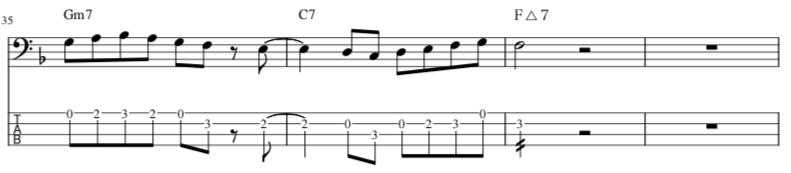
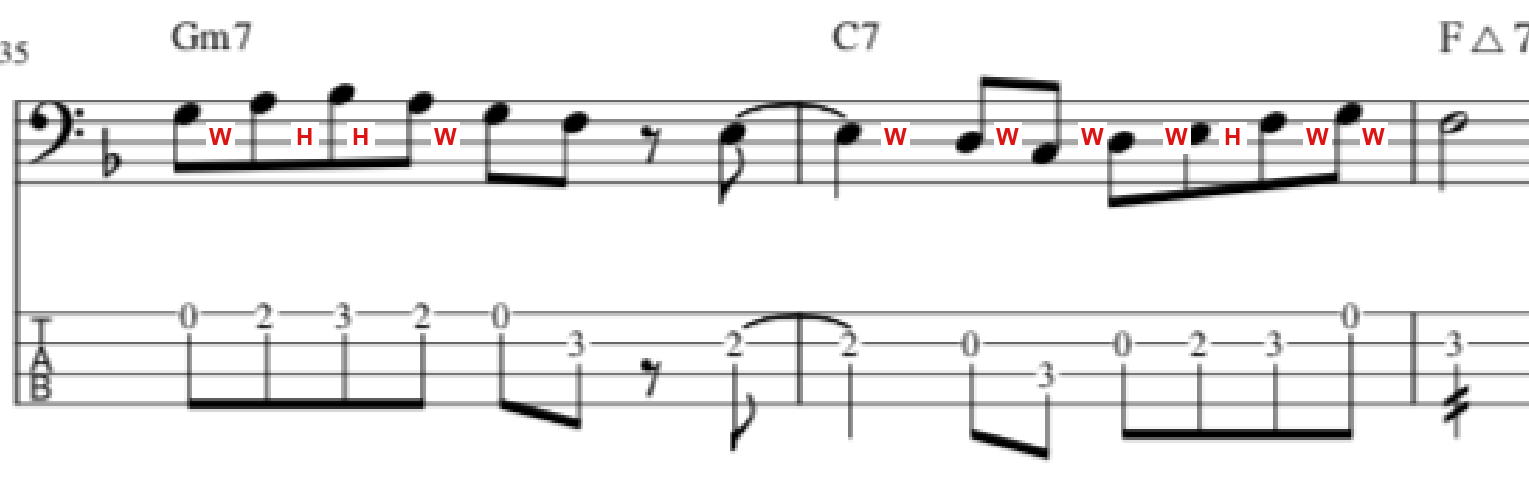
Same as Example 1: triads connected chromatically, resolving to chord tones.
Looking at it this way, the intervals are once again mostly whole steps or half steps.
It has a real “this is just muscle memory” kind of feel to it.
Example 4 — My Suggested Revision
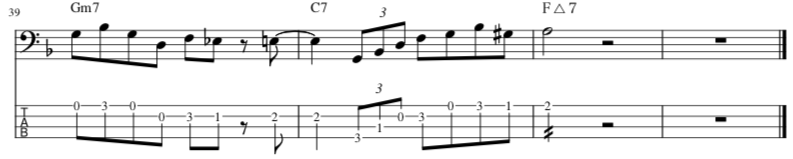
Here too, I removed the whole-step and half-step motion and built the line using intervals of a 3rd plus chromaticism, with the second measure made entirely of 3rd intervals to give the line a steeper, more dramatic flow.
Just Being Aware of 3rd Intervals Can Make Your Lines Sound “Jazzy”
If you ever feel like “this doesn’t quite sound jazzy,” try consciously building your solo around intervals of a 3rd like in these examples.
Just by shifting your mindset from whole-step/half-step motion to 3rd-interval motion, lines that sound flat, repetitive, or rock-ish can instantly start to sound jazzy.
Want Personalized Feedback on Your Playing?
This is exactly the kind of thing that’s hard to fix alone — and where having a teacher makes all the difference.
At Line on Bass, I offer an online lesson service where you send me a video of your playing, and I give you specific, detailed feedback — every single day if you want.
Students from around the world are using this to fix exactly these kinds of issues and steadily improve their jazz bass skills.