This article is by Toru Hoshino, founder of the online bass school Line on Bass (@jazzbassisttoru). It explains how to read bass TAB notation.
Contents
How to Read Bass TAB
For 4-string bass, TAB notation has four horizontal lines, like this:

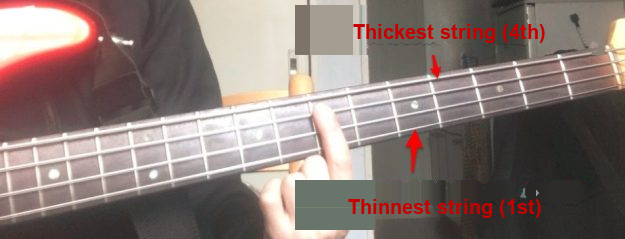
The top line represents the thinnest string (the 1st string).
The bottom line represents the thickest string (the 4th string).
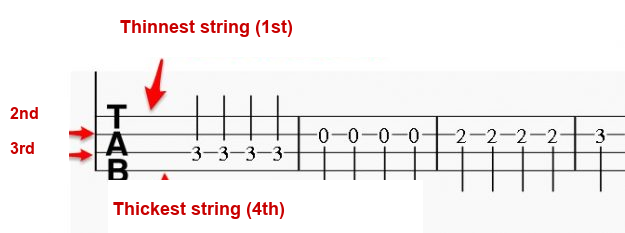
Here’s what that looks like on the actual instrument:
If you see a “1” written on the bottom line, that means play here (4th string, 1st fret):


If you see a “2” written on the top line, that means play here (1st string, 2nd fret):


If you see a “3” written on the third line from the top, play this note (3rd string, 7th fret):


Putting It Into Practice
Example 1

If you see TAB like this, play the notes in this order:

Example 2

This TAB…

…is played like this. (Note: “6” means open string.)
It’s certainly better to be able to read standard notation, but reading notes and instantly translating them into finger positions is hard at first, and takes practice.
I’ve been playing since high school myself, and in the beginning I couldn’t read standard notation, so I relied on TAB.
Reading TAB is far easier than reading standard notation.
If you’re just starting out on bass, I think it’s perfectly fine to start by learning to read TAB. 🙂
Here’s an F blues — a progression that comes up a lot in jazz — played with TAB notation included. Feel free to use it as a reference.
Want Personalized Feedback on Your Playing?
This is exactly the kind of thing that’s hard to fix alone — and where having a teacher makes all the difference.
At Line on Bass, I offer an online lesson service where you send me a video of your playing, and I give you specific, detailed feedback — every single day if you want.
Students from around the world are using this to fix exactly these kinds of issues and steadily improve their jazz bass skills.