This article is written by Toru Hoshino, a jazz bassist and instructor based in Japan who teaches online lessons to students worldwide. In this article, he breaks down a bass line approach over the chord progression to a C blues.
This comes up a lot at jam sessions, so it’s well worth having in your back pocket.
Contents
A Bass Line Over a C Blues Progression
I built this out as three choruses (12 bars × 3 times through), centered mostly around the low frets.
The theme I was going for was “don’t let it sound like rock” — I built it with an overall emphasis on a smooth, connected flow. Let me walk through a few of the choices I made.
A Smooth, Flowing Bass Line That Avoids a Rock Feel
If you’re new to walking bass, this is the kind of approach you tend to gravitate toward:
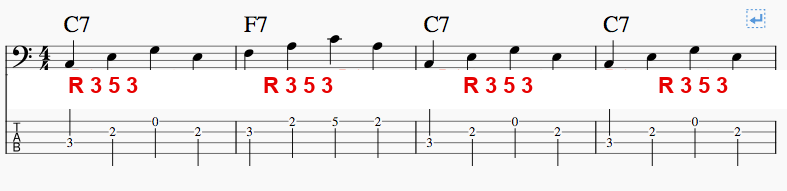
It uses solid chord tones, and it’s not bad exactly, but it has a somewhat one-note feel to it — honestly, an eighth-note rock groove would probably suit this approach better.
This time, I built the bass line around a more relaxed, flowing sense of note movement instead, like this:
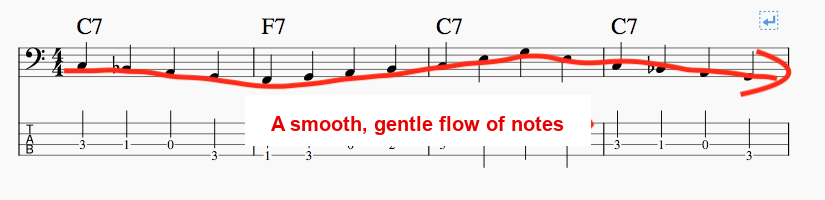
This kind of approach fits a jazz four-feel much more naturally.
How to Approach a Chord That Holds for Several Bars
Having the same chord hold for several bars in a row is something that comes up constantly in jazz, and it’s a spot a lot of players aren’t sure how to approach.
The thing to keep in mind here is still “flow.”
Take the section below, starting around 0:07:
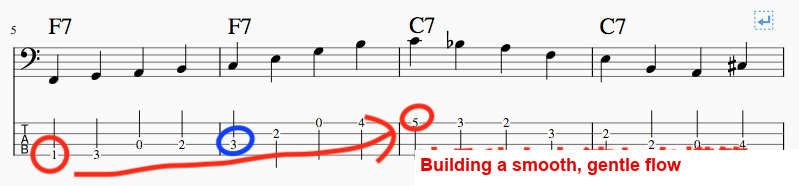
The idea is to build a sense of motion from the red circle toward the next red circle.
If you land back on the root at the blue circle’s position, the flow breaks, and it ends up feeling like things have stalled out.
So — and I say this a lot on this blog —
When the same chord holds for two or more bars, you don’t actually need to start every single bar on the root.
Just keep that in the back of your mind.
Leaning Heavily on Chromatic Movement
Take the approach in bars 1–3 of the third and final chorus.
I’m approaching the root of the next chord chromatically pretty much the whole way through.
Here, you might find it a little confusing that, say, over a C7 you’ll see both E♭ (the minor 3rd) and E (the major 3rd), or over an F7 both A♭ (the minor 3rd) and A (the major 3rd), happening within the same bar.

If you’re newer to jazz, this kind of movement might not sit comfortably with your ear at first.
But in a blues like this, it’s a completely valid approach.
Blues, at its core, has this quality of not being clearly major or minor — and deliberately building a line around that same kind of chromatic ambiguity is a very common move.
That covers the breakdown.
A Recommended Recording
The Red Garland Trio’s album “Groovy.”
True to its name, it’s incredibly groovy.
The bass line from this article works over the chord progression to “C Jam Blues” on this album, so once you’re comfortable with it, it’s worth trying to play along.
I hope this gives you something useful for your daily practice — and once you’ve got the concept down, getting feedback on how it actually sounds when you play it is the natural next step.
Want Personalized Feedback on Your Playing?
This is exactly the kind of thing that’s hard to fix alone — and where having a teacher makes all the difference.
At Line on Bass, I offer an online lesson service where you send me a video of your playing, and I give you specific, detailed feedback — every single day if you want.
Students from around the world are using this to fix exactly these kinds of issues and steadily improve their jazz bass skills.