This article is written by Toru Hoshino, a jazz bassist and instructor based in Japan who teaches online lessons to students worldwide.
This one’s for anyone who’s noticed:
“My fingering never quite comes together.”
“My bass lines don’t have that light, swinging feel.”
This time, the topic is: building your walking bass lines around open strings plus the first three frets can make your fingering dramatically more efficient.
Contents
Efficient Fingering: The Case for Open Strings
Let’s start with something to look at. This is a chord progression you could use over “Autumn Leaves,” and notice that the left hand never shifts position at all.
Because the hand stays completely fixed within this one position, with zero shifting, you’re free to focus on reading the music and listening to what’s happening around you.
And what I’m doing deliberately here is using open strings.
Let’s Try Using Open Strings
Example 1
Here’s the same notes as above, played without using any open strings.
(The pink lines mark spots where I deliberately fretted a note instead of playing it as an open string.)

If you try playing it, you’ll notice it feels pretty cluttered and awkward.
Here’s the version that uses open strings instead.
Example 2

Doesn’t that look a lot easier to play?
For an A, Use the Open A String Instead of the 5th Fret on the E String
One of the things that makes jazz-style walking bass sound so stylish is that it almost never repeats the same pitch on consecutive quarter notes.
Making efficient fingering choices is key to playing that kind of walking line with a light touch.
It depends on the situation, but as one example: if you need to play an A, being able to use the open A string instead of the 5th fret on the E string leads to much more efficient fingering.
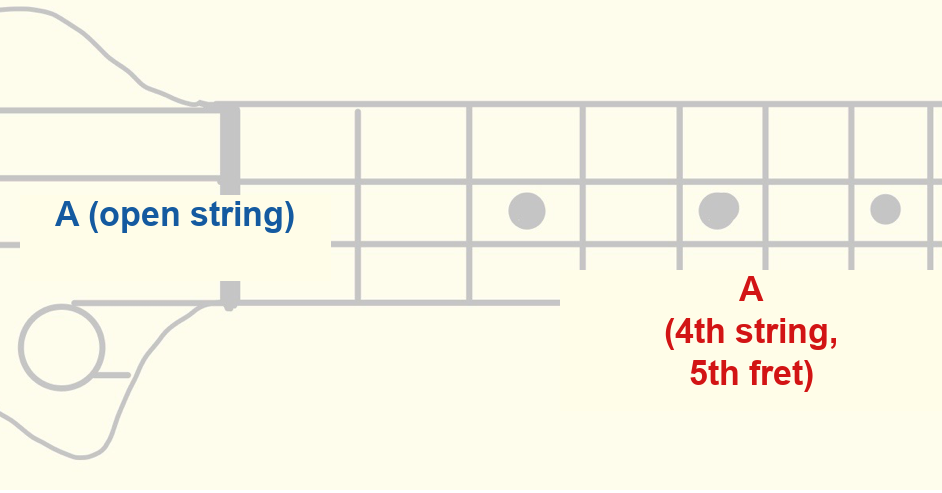
Compare the fretted version of bars 5–6 below…

…with the version using an open string for the same bars.

The difference in playability is night and day.
If you’re playing rock, where the root note often holds steady for a long stretch, fretting that A solidly on the E string can actually add more feeling to the note — and that’s a perfectly valid choice in that context.
But when you’re aiming for a light, swinging walking bass line, make a conscious habit of reaching for open strings.
More Reasons to Love Open Strings
They Help With Double Bass Fingering
A lot of players currently on electric bass tell me they’re thinking about eventually picking up the double bass.
If you try playing that earlier example — the one without open strings — on a double bass, nailing the intonation becomes seriously difficult.
On double bass especially, fingering within what’s called the “half position” (roughly equivalent to frets 1–3 on an electric bass) is critical, so if you’re hoping to try double bass down the line, get comfortable using open strings now.
Preventing Your Left Hand From Flailing
Jazz-style walking bass, where you’re often playing a different note on every single quarter note, keeps your left hand constantly busy.
When the fingering gets that busy, your left hand can end up flailing around more than it should.
A flailing left hand makes it much harder to nail fast passages or play with a light, swinging feel.
To avoid that, regularly resetting your busy fretting hand with an open string makes your fingering noticeably more manageable — and that in turn helps you nail those fast, light passages.
So that’s the case for using open strings to make your fingering more efficient. I hope this helps if you’ve been struggling with fingering, or feel like your bass lines are missing that light, swinging quality.
I hope this gives your walking bass lines a noticeably lighter feel — and once your fingering is cleaner, getting feedback on how it actually translates when you play is the natural next step.
Want Personalized Feedback on Your Playing?
This is exactly the kind of thing that’s hard to fix alone — and where having a teacher makes all the difference.
At Line on Bass, I offer an online lesson service where you send me a video of your playing, and I give you specific, detailed feedback — every single day if you want.
Students from around the world are using this to fix exactly these kinds of issues and steadily improve their jazz bass skills.