This article is written by Toru Hoshino, a jazz bassist and instructor based in Japan who teaches online lessons to students worldwide. In this article, he gives a clear explanation of relative keys, with a full reference chart for every key.
Here’s a quick-reference chart of relative keys:
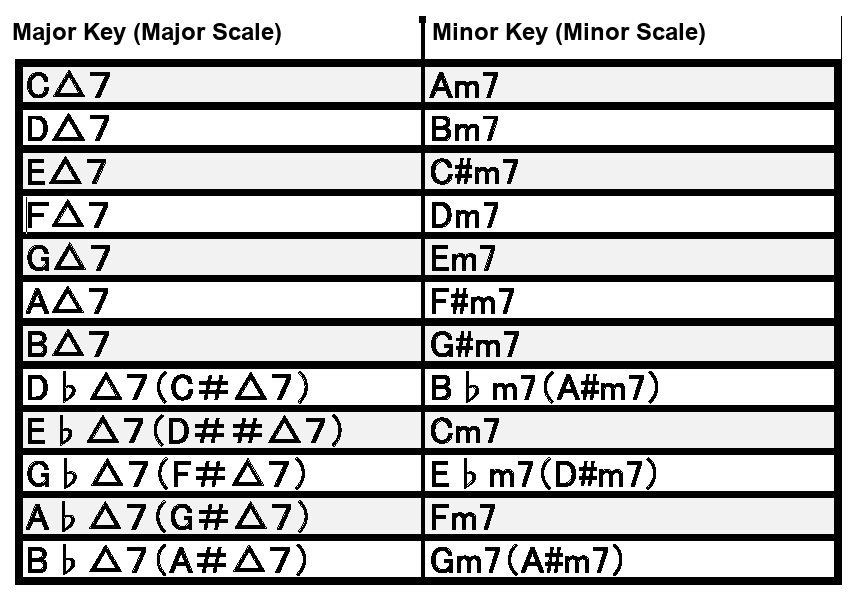
The chords linked by the bold black boxes on the left and right are relative to each other. Let’s break down exactly what that means.
Contents
Hearing It in Action: How Relative Keys Work
↑ That’s do-re-mi-fa-so-la-ti-do. This is the key of C major — the C major scale.
↑ That’s la-ti-do-re-mi-fa-so-la. This is the key of A minor — the A minor scale.
↑ That’s Bb-C-D-Eb-F-G-A-Bb. This is the key of B♭ major — the B♭ major scale.
↑ That’s G-A-Bb-C-D-Eb-F-G. This is the key of G minor — the G minor scale.
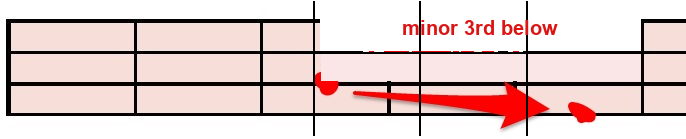
If you take the exact same notes used in a major scale on the left of the chart and start playing them from a minor third below, you get its relative key.
Minor third below:
For C major, the scale is do-re-mi-fa-so-la-ti-do:

For A minor, the scale is la-ti-do-re-mi-fa-so-la:

For a C△7 chord, if you take the same do-re-mi-fa-so-la-ti-do notes from the scale and instead start playing from the 5th fret on the 4th string, playing “la-ti-do-re-mi-fa-so-la,” that’s the relative key.
The notes being used are exactly the same — only the starting point and the chord’s “home base” change.
What Makes Relative Keys Distinctive (Major vs. Minor Scales)
Here’s a simple audio example — just the melody re-do-ti-la, re-do-ti-la, re-do-ti-la, re-do-ti-la — but I split the bass line into a C major version and an A minor version.
Major and minor give you a really different feel, even over the same melody.
· Major (C major scale)
· Minor (A minor scale)
This is the basic principle behind why major scales sound bright and minor scales sound dark. It’s a foundation used in an enormous number of songs out there.
Relative Keys and Walking Bass
In practice, nobody’s going to tell you “this tune is in a relative key relationship, so build your walking bass line this way.” You’re also not going to hear band mates or session players say things like “give me a bass line that sounds relative-key-ish” — in everyday musical communication, this concept almost never comes up directly in conversation.
That said, understanding how relative keys work is genuinely useful when you’re studying a chart, analyzing a tune, or writing your own music — it makes that whole process go a lot more smoothly.
Want Personalized Feedback on Your Playing?
Understanding the theory behind relative keys is one thing — actually hearing how that major/minor contrast comes through in your own bass lines is much easier to judge with outside ears.
This is exactly the kind of thing that’s hard to fix alone — and where having a teacher makes all the difference.
At Line on Bass, I offer an online lesson service where you send me a video of your playing, and I give you specific, detailed feedback — every single day if you want.
Students from around the world are using this to fix exactly these kinds of issues and steadily improve their jazz bass skills.