This article is written by Toru Hoshino, a jazz bassist and instructor based in Japan who teaches online lessons to students worldwide. In this article, he explains passing tones — one of the most common approaches used in jazz walking bass lines.
Who this is for
・Anyone interested in jazz bass lines
・Anyone who wants to build smoother, more stylish bass lines
・Anyone who wants to try walking bass
・Anyone who wants to bring jazzy flavor into their band’s bass lines
Passing tones smooth out the flow between notes, and they show up constantly in blues and jazz — definitely worth mastering.
Contents
Adding Passing Tones to a Bass Line
Here’s an F blues progression with passing tones added in.

Listen to the comparison below.
Bass line without passing tones:

Bass line with passing tones:

What do you think? Doesn’t the version with passing tones feel a lot smoother?
Where the Passing Tones Are Used
The passing tones are at the spots marked in red below.

There’s no hard rule for exactly what counts as a passing tone, but most often, it’s a note a half step or whole step above or below the root of the chord that’s coming up next.
For example: if the root of the next chord is B♭, you’d approach it with a passing tone a half step above — B (bars 1–2).

In bar 5, the note C is used (approaching B from a half step above) (bars 5–6).

And here’s an approach to C from a half step below, using B (bars 9–10).

Thinking in note names can get a little overwhelming, so it helps to picture it more simply, like this:
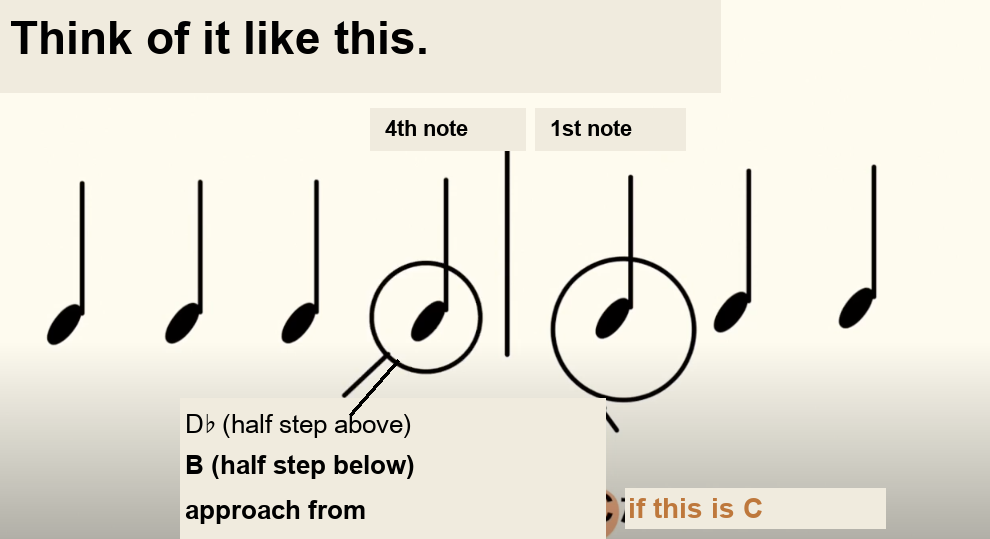
This is a genuinely beginner-friendly approach, so if you want to bring some jazzy flavor into your everyday playing, give it a try.
Knowing the theory behind passing tones is one thing — hearing in real time whether your specific choice of approach note actually worked is exactly where a teacher’s ear helps.
Want Personalized Feedback on Your Playing?
This is exactly the kind of thing that’s hard to fix alone — and where having a teacher makes all the difference.
At Line on Bass, I offer an online lesson service where you send me a video of your playing, and I give you specific, detailed feedback — every single day if you want.
Students from around the world are using this to fix exactly these kinds of issues and steadily improve their jazz bass skills.