This article is written by Toru Hoshino, a jazz bassist and instructor based in Japan who teaches online lessons to students worldwide. In this article, he covers a beginner exercise for learning the note names across the fretboard using a simple C-major scale.
For anyone about to start learning bass
For anyone who wants to revisit the basics or rethink their playing style
For installment #5, we’re going to play through a major scale to learn the note names across the fretboard. This is commonly called “scale practice,” and it builds several skills at once — fingering, knowing where notes live on the neck, and rhythmic timing.
Contents
The Bass Has a Scale Too
Just like a piano keyboard has note names:
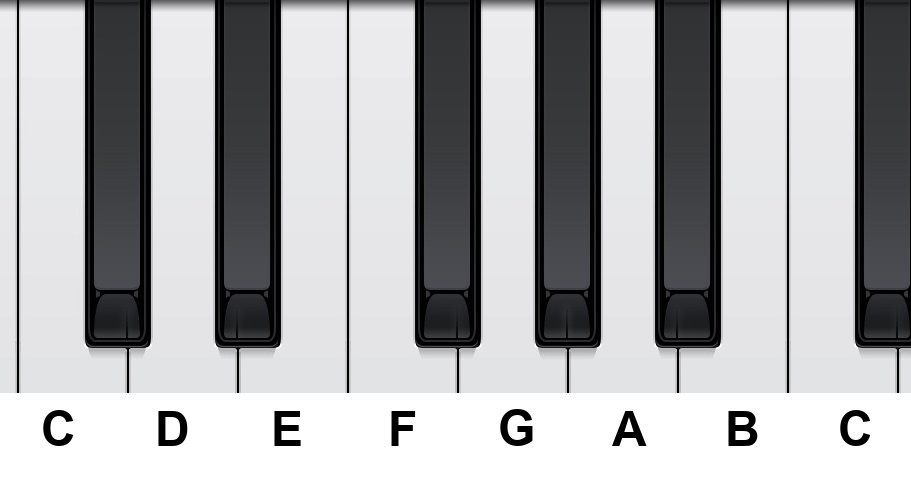
The bass has note names too.

This is the C-major scale, and in the context of popular music, rock, and similar styles, it’s typically referred to by its letter names: C D E F G A B C.
Today, we’re going to learn to play this C-D-E-F-G-A-B-C scale on the bass.
Scale Pattern 1
First, the position for C: fret the 3rd fret of the 3rd string with your index finger.

Next, the position for D: play the 5th fret of the 3rd string with your pinky.

Next, the position for E: play the 2nd fret of the 2nd string with your index finger.

Following this same logic, try playing through the full pattern shown below:
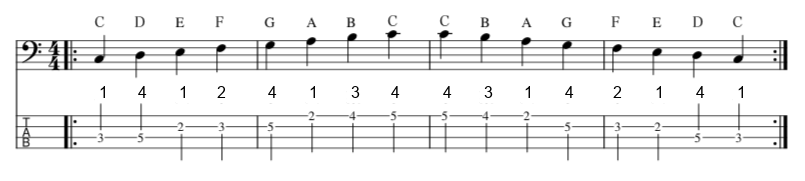
Once you’re comfortable, try playing along with the audio below.
(Note: this is played at a tempo of 60, going up and back down the scale twice.)
Scale Pattern 2
The C-major scale isn’t limited to just the one fingering pattern above — there’s another shape too.
For example, D is also available as an open string on the 2nd string, and G as an open string on the 1st string, so the same scale can also be played like this:

Which one’s better depends on the tune you’re playing, but being comfortable with both will widen your playing range, so work toward learning both eventually.
Try this one too once the hand shape starts to feel natural.
Applied Practice With C-D-E-F-G-A-B-C
Once you’re comfortable with the above, here’s a bit of an applied exercise. Play the scale up, and keep going past the octave into the notes above.

And here’s an efficient fingering pattern I worked out for it:
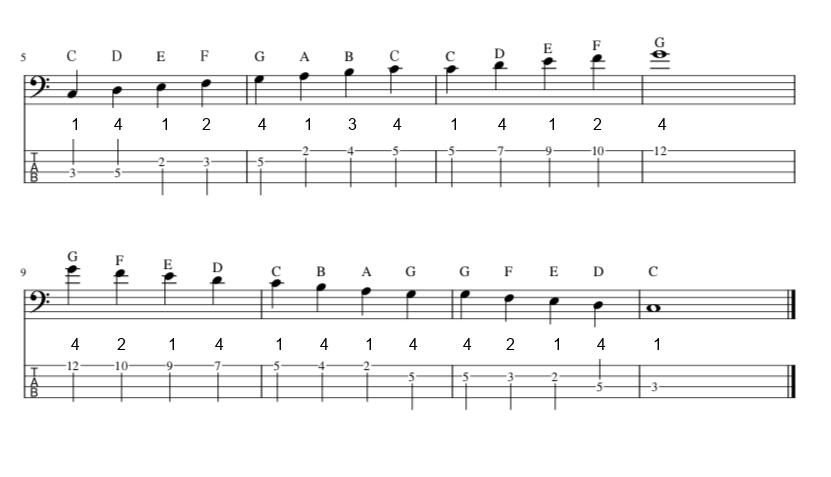
Play up through C-D-E-F-G-A-B-C-D-E-F-G, reaching the higher notes, then come back down:
G-F-E-D-C-B-A-G-F-E-D-C
back to where you started.
Playing through a fixed sequence of notes like this is what’s called “scale practice.”
Once you’re comfortable, try playing along.
Make a Point of Learning C-D-E-F-G-A-B-C
You can absolutely play bass reading only tab notation. But the longer you stick with bass, the more often you’ll find yourself reading chord symbols instead.

Learning your note names as C-D-E-F-G-A-B-C will pay off down the line by making chord symbols much easier to work with — so make a habit of learning the letter names of your notes.
Connecting note names to actual fretboard positions in real time, without having to think about it, is exactly the kind of thing that’s faster to build with a teacher watching and correcting you.
Want Personalized Feedback on Your Playing?
This is exactly the kind of thing that’s hard to fix alone — and where having a teacher makes all the difference.
At Line on Bass, I offer an online lesson service where you send me a video of your playing, and I give you specific, detailed feedback — every single day if you want.
Students from around the world are using this to fix exactly these kinds of issues and steadily improve their jazz bass skills.