This article is written by Toru Hoshino, a jazz bassist and instructor based in Japan who teaches online lessons to students worldwide. In this article, he answers a student question about how to add movement to a bossa nova bass line without it falling apart.
I got a question recently that I wanted to answer here:
“My bossa nova bass lines are mostly just root and 5th, root and 5th — I’d like to add a bit more movement. How should I approach that?”
This actually comes up a lot in lessons too.
Bossa lines can feel monotonous when they’re just root–fifth, root–fifth the whole way through — it gets boring fast.

A lot of people feel this way. The problem is, if you add movement carelessly, the sound can fall apart — so people often aren’t sure how to approach it.
Here’s the short version of the answer:
“When you want to add movement to a bossa bass line, the cleanest way to do it is to move the bass exactly where the melody isn’t moving. That tends to sound cool rather than cluttered.”
Today I’ll walk through this using the tune Blue Bossa as the example.
Contents
Moving the Bass Where the Melody Isn’t Moving
Let’s look at Blue Bossa. As I mentioned above, the idea is to move where the melody is staying still. Here’s what that looks like in practice.
Example 1 — bars 5 to 8

Example 2 — bars 9 to 12
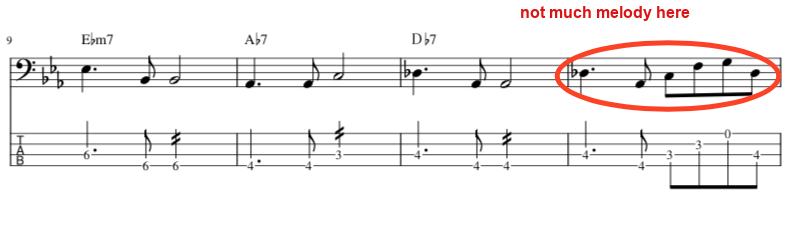
When the melody is moving, keep the bass simple — root, fifth, root, fifth.
When the melody is sitting on a whole note or a rest and isn’t moving much, that’s your cue to move the bass.
Playing with that kind of contrast — busy where the melody is still, simple where the melody is busy — is what gets rid of the monotony.
Things to Watch Out for When Moving a Bossa Bass Line
Adding movement to a bass line sounds great, but if you can’t land exactly on time on the root of the next chord, the whole thing falls apart.
One trick that helps a lot here: make the last note of your moving line an open string.
For example, take the Cm7 → E♭m7 progression in bars 8–9:
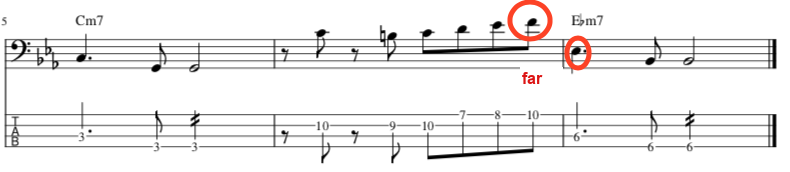
Try playing through that. Notice how, going from the last F at the end of bar 8, it’s a stretch to get back to the root of the next chord, E♭, in time.
That’s exactly the situation where you want to make the last note of the moving line an open string, like this:
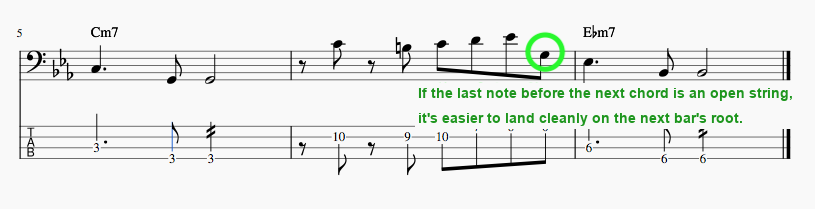
Doing it this way frees up your left hand for a split second, which makes it much easier to land cleanly on the root of the next bar even after moving around.
It’s worth getting in the habit of using open strings strategically like this.
Want Personalized Feedback on Your Playing?
Knowing the theory behind where to move and where to stay still is one thing — actually hearing whether your own bossa lines land cleanly on the next root is much easier with a second set of ears.
This is exactly the kind of thing that’s hard to fix alone — and where having a teacher makes all the difference.
At Line on Bass, I offer an online lesson service where you send me a video of your playing, and I give you specific, detailed feedback — every single day if you want.
Students from around the world are using this to fix exactly these kinds of issues and steadily improve their jazz bass skills.